Quick Answer
Needle bearings use long, slender cylindrical rollers (aspect ratio >= 2.5-3:1) that contact raceways in a line contact, delivering 3-5x higher radial load capacity than ball bearings of the same shaft diameter in a compact cross-section. Ball bearings use spherical rolling elements in point contact, enabling speeds 2-3x higher and the ability to handle radial, axial, and combined loads. Choose needle bearings for pure radial loads in tight spaces; choose ball bearings when you need speed, axial load capacity, or combined loading.
Rolling bearings are fundamental components in mechanical systems. Their job is simple but critical: reduce friction between rotating parts while supporting applied loads. A rolling bearing typically consists of four basic components: an inner ring, an outer ring, rolling elements, and a cage (retainer) that keeps the rolling elements evenly spaced.
The rolling elements are where the real difference lies. Rolling bearings fall into two main categories based on rolling element shape: ball bearings (spherical rolling elements) and roller bearings (cylindrical rolling elements). Needle bearings are a specialized subset of roller bearings that use long, slender cylindrical rollers-commonly called “needles.”
The fundamental distinction between these two types comes down to geometry: ball bearings create point contact with the raceways, while needle bearings create line contact. This single geometric difference drives everything else-load capacity, speed limits, friction, heat generation, and application suitability.
Key point: Point contact vs. line contact is the mechanical root of every performance difference between these bearing types.
Common Advantages of Rolling Bearings
Before diving into what makes needle bearings and ball bearings different, it’s worth noting what they share. Compared to sliding bearings (plain bearings), all rolling bearings offer several common advantages:
- Low starting friction-the difference between static and kinetic friction is small, which means smooth startups
- International standardization-bearings follow unified standards (ISO, DIN, ABMA), making replacement and procurement straightforward
- Easy lubrication-require less lubricant and are simpler to maintain
- Dual load capability-a single bearing can handle both radial and axial loads (depending on type)
- Wide temperature range-perform reliably in both high and low temperature conditions
- Adjustable rigidity-bearing stiffness can be increased by applying preload
These shared benefits make rolling bearings the default choice across countless industries, from automotive to industrial machinery to precision equipment.
Ball Bearings: Structure and Characteristics
What Is a Ball Bearing?
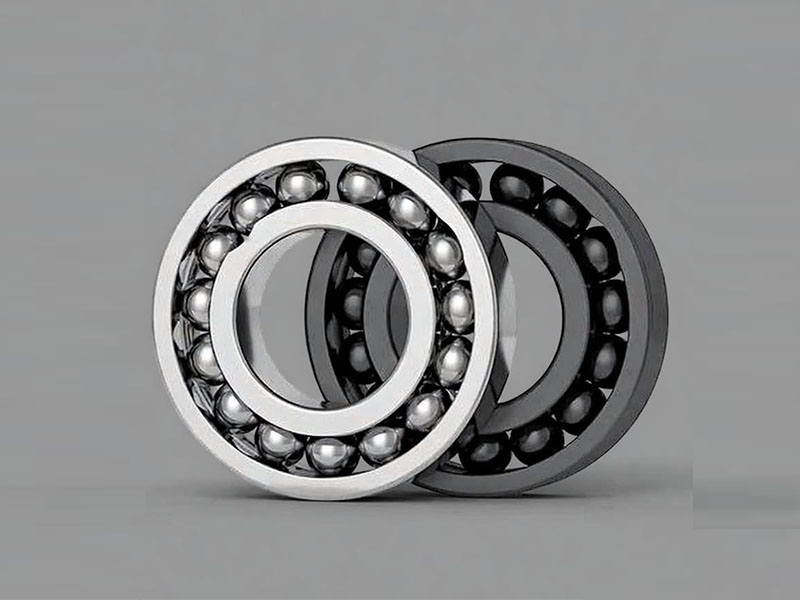
A ball bearing is a type of rolling bearing that uses spherical balls to maintain the clearance between the bearing races. The primary components are steel balls (the rolling elements), an outer ring, an inner ring, and a cage that keeps the balls evenly spaced.
The balls contact the raceways at point contact-technically, under load, the elastic deformation creates a small elliptical contact patch. Because the contact area is small, friction is low, which allows ball bearings to run at high speeds with minimal heat generation.
Main Types of Ball Bearings
Ball bearings come in several configurations, each designed for specific load and alignment conditions:
- Deep groove ball bearings-the most common type. The inner and outer ring raceways are arc-shaped deep grooves. These can handle radial loads, bidirectional axial loads, or combined loads, and are suitable for high-speed rotation
- Angular contact ball bearings-designed to handle significant axial loads in one direction, along with radial loads
- Self-aligning ball bearings-feature two rows of balls and can accommodate shaft misalignment
- Thrust ball bearings-specialized for axial (thrust) loads, typically in low-speed applications
- Radial ball bearings-the basic type, primarily for radial loads
Advantages of Ball Bearings
Ball bearings offer several distinct advantages that make them the go-to choice for many applications:
- Low friction resistance-the point contact between balls and raceways minimizes friction, reducing energy loss and heat generation
- High-speed capability-maximum speed can reach 2-3 times that of needle bearings under similar operating conditions
- Combined load handling-can support radial, axial, and combined loads (especially angular contact types)
- Smooth, quiet operation-low vibration and noise levels make them ideal for precision equipment
- Compact and lightweight-smaller and lighter than needle roller bearings of similar capacity
- Long service life-durable and typically last for extended periods under proper lubrication and maintenance
- Good misalignment tolerance-more forgiving of installation errors than needle bearings
Disadvantages of Ball Bearings
Ball bearings aren’t perfect for every scenario. Their main limitations include:
- Limited radial load capacity-compared to needle bearings of the same shaft diameter, ball bearings have significantly lower radial load capacity
- High contact stress-the small point contact area means higher stress per unit area, which can lead to surface fatigue under heavy radial loads
- High precision requirements-the small contact area demands very high precision during processing and assembly; otherwise, the bearing may be damaged or its service life shortened
Key point: Ball bearings are the go-to choice for high-speed, low-friction, and combined-load applications.
Needle Bearings: Structure and Characteristics
What Is a Needle Bearing?
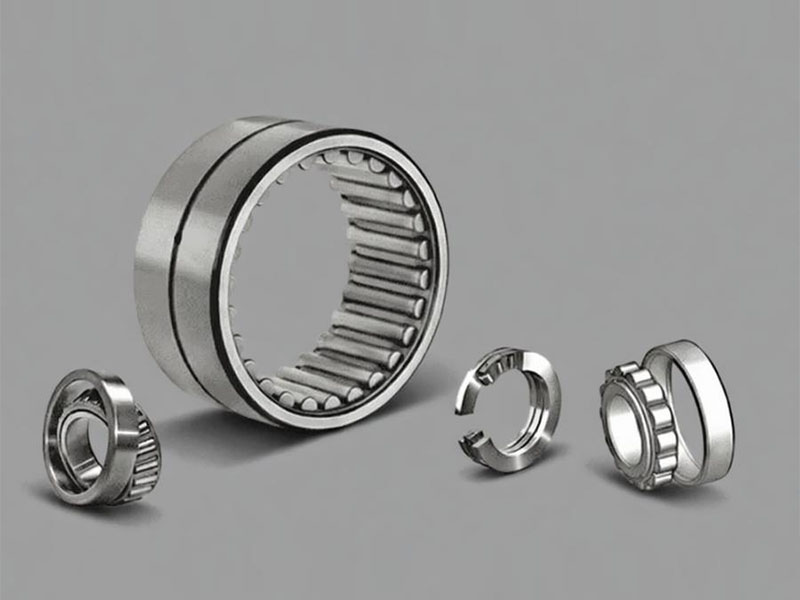
A needle bearing is a type of roller bearing that uses long, slender cylindrical rollers called “needles.” The defining characteristic is the aspect ratio (length-to-diameter ratio) of the rollers. Needle rollers typically have a diameter of <= 6 mm and an aspect ratio of >= 2.5, with many designs reaching 3:1 to 10:1.
The needles contact the raceways in line contact. This line contact is what gives needle bearings their exceptional radial load capacity.
Needle bearings come in several structural forms:
- With inner ring-standard configuration
- Without inner ring-the shaft itself serves as the raceway (saves space but requires the shaft to meet hardness and surface finish requirements)
- Drawn-cup type-thin outer shell, ideal for tight envelopes and press-fit housings
- Machined-ring type-offers higher stiffness and better shock resistance
- Caged vs. full-complement-caged versions allow higher speeds; full-complement (no cage) versions handle higher loads
Components of a Needle Bearing
A typical needle bearing consists of:
- Needle rollers-the primary load-carrying elements, usually made of hardened steel
- Cage (retainer)-holds the needles in position and keeps them evenly spaced
- Outer ring-provides the outer raceway
- Inner ring-included in some designs; omitted in others where the shaft serves as the raceway
Advantages of Needle Bearings
Needle bearings excel in specific demanding applications:
- Exceptional radial load capacity-because of the large line-contact area, needle bearings can withstand 3 to 5 times more radial load than ball bearings of the same shaft diameter
- Compact cross-section-the slender rollers allow more rolling elements in a smaller bearing envelope, providing high load capacity in minimal space
- Space efficiency-ideal for mechanical structures with limited radial installation space, such as gearboxes and automotive components
- Lower precision requirements for mating parts-the larger contact area makes needle bearings more tolerant of manufacturing tolerances on the housing and shaft than ball bearings (though needle bearings themselves require precise manufacturing)
- Good shock resistance-perform well in low-speed, high-load, or shock-load situations
- Variety of configurations-available in radial, thrust, and combined types
Disadvantages of Needle Bearings
Needle bearings also have significant limitations:
- No axial load capacity-needle bearings can only withstand pure radial loads. Applying axial thrust will cause the needles to skew, leading to rapid bearing failure
- Higher cost-the manufacturing process for long, slender rollers with precise geometry is more complex, making them generally more expensive than ball bearings
- Higher noise and vibration-greater friction and noise, especially at high speeds
- Speed limitations-the large aspect ratio of needle rollers makes them prone to centrifugal force effects at high speeds; they are suitable for low-to-moderate speeds
- Sensitive to misalignment-less tolerant of shaft-to-housing misalignment than ball bearings; requires precise mounting
- Complex mounting-the wider contact area and lack of inner ring in some designs require more careful installation
- Not suitable for small oscillation angles-needle bearings can operate with full or partial rotations but are not suitable for swiveling angles of only a few degrees; this leads to localized and premature wear
Key point: Needle bearings are specialists in high radial load and tight spaces, but they cannot handle axial loads and are sensitive to misalignment. (Special combined bearing designs that integrate thrust bearings can handle axial loads, but standard radial needle bearings cannot.)
Needle Bearings vs Ball Bearings: Key Differences
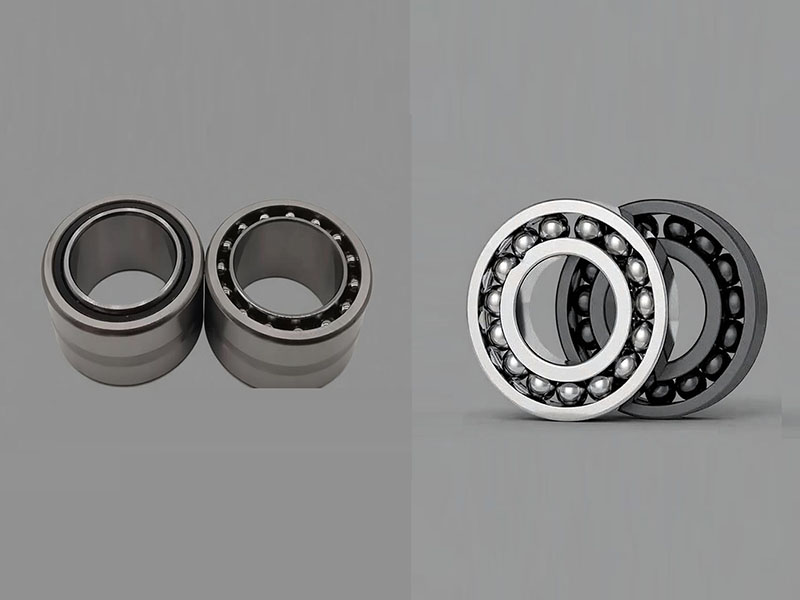
This section focuses purely on the differences. (The decision-making process based on these differences follows in the next section.)
Contact Type and Contact Stress
| Feature | Needle Bearing | Ball Bearing |
|---|---|---|
| Contact type | Line contact (Hertzian line contact) | Point contact (Hertzian point contact) |
| Contact area | Large-10-25 mm long, microns wide | Small-elastic deformation creates a small ellipse |
| Contact stress | Lower-load distributed over a line | Higher-load concentrated at a point |
| Surface area | Greater surface area in contact with raceways | Smaller contact surface |
The physics behind this difference is described by Hertzian contact theory. In line contact (needle bearings), the load is distributed across a long, narrow rectangle. The maximum contact stress is proportional to (F / L)^0.5-where F is the applied load and L is the effective roller length. In point contact (ball bearings), the load concentrates within a small elliptical patch, and the maximum stress is proportional to F^(1/3). This means that for the same radial load, a needle bearing experiences significantly lower surface stress, reducing the risk of surface fatigue and subsurface cracking. Ball bearings, with their higher concentrated stress, are more susceptible to pitting and spalling under heavy radial loads.
Load Capacity
(Comparative data below assumes the same shaft diameter and similar operating conditions.)
| Feature | Needle Bearing | Ball Bearing |
|---|---|---|
| Radial load capacity | Extremely high-3-5x that of ball bearings (same shaft diameter) | Moderate |
| Axial load capacity | None-pure radial loads only | Yes-can handle axial loads |
| Combined load | Cannot handle | Yes-especially angular contact types |
| Load distribution | Single rolling element carries more load; fewer elements total | More balls distribute load more evenly across the raceways |
Industry comparison matrices (such as those referenced in engineering design handbooks) consistently rate needle rollers as “Good” for pure radial load but “Not Recommended” for pure axial load and combined load. Ball bearings, by contrast, rate as “Satisfactory” across pure radial, pure axial, and combined load categories.
Speed and Friction Performance
| Feature | Needle Bearing | Ball Bearing |
|---|---|---|
| Speed limit (dmn value) | Lower-centrifugal force and heat limit high-speed operation | Higher-2-3x the maximum speed of needle bearings |
| Friction torque | Higher-line contact creates more sliding friction | Lower-point contact minimizes rolling friction |
| Heat generation | Higher-more friction leads to more thermal energy | Lower-runs cooler even at high speeds |
| Noise level | Higher-more noise at high speeds | Lower-smoother, quieter operation |
| Cage effect | With cage: higher speed, lower load; without cage: higher load, lower speed | Cage allows consistent high-speed operation |
Industry design guides note that ball bearings are generally better suited for high-speed applications, whereas needle bearings can accommodate heavier loads but at lower rotational speeds.
Space and Installation Requirements
| Feature | Needle Bearing | Ball Bearing |
|---|---|---|
| Radial cross-section | Minimal-extremely compact; ideal for thin-wall housings | Larger-requires more radial space for the same bore size |
| Misalignment tolerance | Low-sensitive to angular misalignment of the shaft | Higher-more forgiving of installation errors |
| Installation precision | Moderate for mating parts (larger contact area distributes errors), but careful alignment required | High precision required for both shaft and housing |
| Mounting complexity | More complex, especially for inner-ring-less designs | Simpler-standard press-fit or slip-fit procedures |
| Inner ring option | Can omit inner ring (shaft as raceway) for maximum space savings | Inner ring always required |
When installation space is at a premium, needle bearings are frequently the preferred solution. Their slim cross-section and high load capacity per unit volume make them uniquely suited for applications where every millimeter of radial space matters.
Cost and Other Factors
| Feature | Needle Bearing | Ball Bearing |
|---|---|---|
| Manufacturing cost | Higher-complex grinding and finishing of slender rollers | Lower-mass production of balls and raceways is more economical |
| Standardization | High-but less variety than ball bearings | Highest-most common bearing type with the widest selection |
| Running accuracy | Moderate | Higher-often preferred for applications requiring high precision |
| Stiffness | Good-line contact provides high radial stiffness | Moderate-point contact allows some elastic deflection |
How to Choose: Decision Framework
Now that we’ve established the differences above, here is a practical framework for making the actual selection. This framework does not repeat the raw performance data but applies it to real-world decision-making.
Core Selection Factors
Factor 1: Load Direction (The Most Important Question)
This is the single most critical filter. Apply this first:
- Is the load purely radial? -> Proceed to consider needle bearings
- Is there any axial load component or combined load? -> You must choose ball bearings (standard needle bearings cannot handle axial thrust)
Needle roller bearings perform well in applications dominated by radial forces. However, standard radial needle bearings are not designed to handle axial thrust loads. When axial force is applied, the rollers tend to skew relative to the cage, creating edge loading conditions that quickly lead to failure. For this reason, any application with axial load requirements automatically disqualifies standard needle bearings. (Special combined bearings that integrate thrust bearings are available for applications requiring both radial and axial load support.)
Factor 2: Speed Requirements
- Is the application high-speed (e.g., > 10,000 rpm or high dmn value)? -> Ball bearings are the clear choice. Their point contact allows speeds 2-3x higher than needle bearings.
- Is the speed low to moderate? -> Both options are viable; now consider other factors.
The spherical rolling elements in ball bearings create minimal contact area, which reduces friction and allows sustained high-speed operation. Needle bearings, with their extended line contact, generate more heat through friction and face centrifugal force challenges at elevated speeds.
Factor 3: Space Constraints
- Is radial space extremely limited (e.g., thin-wall gearbox, connecting rod small end)? -> Needle bearings are often the ideal solution due to their minimal cross-section.
- Is radial space ample? -> Ball bearings are simpler to install and maintain.
Needle bearings pack high load capacity into a small radial envelope. This makes them attractive for compact designs where every millimeter of space is allocated to other functional components.
Additional Selection Considerations
Precision requirements: Ball bearings are often preferred for applications requiring high precision, such as machine tool spindles or robotics.
Operating cycle: Consider the motion type. Needle bearings are not suitable for swiveling or oscillating angles of only a few degrees. In such cases, the load always contacts the same needles, leading to brinelling and localized wear.
Caged vs. full-complement (for needle bearings):
- With cage: Higher allowable speed, can compensate for minor misalignments, but lower load capacity
- Without cage (full-complement): Higher load capacity (more needles in the same space), but more friction, lower speed limits, and less tolerant of mounting errors
Lubrication and maintenance: Ball bearings generally run cooler and are easier to lubricate with standard greases or oils. Needle bearings in compact housings may have restricted lubricant flow and require more frequent relubrication intervals or high-performance oils. Consider accessibility for maintenance.
Total cost of ownership (TCO): While needle bearings have higher upfront cost, their superior load capacity in compact spaces can reduce the overall system size, weight, and material cost, which may offset the higher bearing price in large-scale production.
Selection Quick Reference Table
| Operating Condition | Recommended Bearing | Rationale |
|---|---|---|
| High speed + light/moderate load | Ball bearing | Low friction, high dmn capability |
| High radial load + no axial load | Needle bearing | 3-5x higher radial capacity |
| Combined load (radial + axial) | Ball bearing (angular contact) | Standard needle bearings cannot handle axial |
| Severely limited radial space | Needle bearing | Minimal cross-section |
| High precision + high speed | Ball bearing | Preferred for precision applications |
| Shock loads + heavy radial load | Needle bearing | Good shock resistance, robust line contact |
| Quiet operation required | Ball bearing | Lower noise and vibration |
| Low maintenance / high availability | Ball bearing | Easier lubrication, more forgiving |
Typical Applications
Needle Bearing Applications
Needle bearings are found wherever high radial load capacity is needed in a compact space:
- Automotive transmissions-automatic and manual transmissions, transfer cases
- Engine components-valve train components (roller rockers), connecting rod small ends
- Steering systems-steering columns and gearboxes
- Compressors and pumps-automotive air conditioning compressors, fuel pumps
- Motorcycle and powersports-connecting rods and gearbox applications
- Industrial gearboxes-where space is limited and radial loads are high
- Agricultural and construction equipment-universal joints, hydraulic pumps
Common applications for needle roller bearings include automatic transmissions, manual gearboxes, valve train components, and steering column assemblies.
Ball Bearing Applications
Ball bearings are the most versatile bearing type, used across virtually every industry:
- Electric motors-high-speed electric motors, from small appliances to industrial drives
- Pumps and compressors-where smooth, reliable operation is required
- Fans and blowers-low-friction, quiet operation
- Precision instruments-medical devices, robotics, automation equipment
- Machine tools-high-speed spindles requiring accuracy
- Household appliances-washing machines, refrigerators, power tools
- General industrial machinery-the default choice for most rotating equipment
Ball bearings are widely used in electric motors to reduce friction and support both radial and light axial loads. Their low-noise characteristics also make them well-suited for applications requiring quiet operation.
Conclusion
Needle bearings and ball bearings are both essential components in modern mechanical systems, but they serve very different purposes. The choice between them is not about superiority-it’s about suitability for your specific operating conditions.
Choose needle bearings when:
- You need maximum radial load capacity in a compact space (3-5x higher than ball bearings)
- The load is purely radial (no axial component)
- Installation space is severely limited
- Speed requirements are low to moderate
Choose ball bearings when:
- You need to handle axial loads or combined loads (radial + axial)
- High speed is a requirement (2-3x higher capability)
- Low noise and low vibration are important for user comfort or precision
- High running accuracy is required
- You want a versatile, cost-effective, widely available solution with simpler maintenance
There is no universal “best” bearing-only the right bearing for your specific application. The key is to evaluate your load direction, speed requirements, space constraints, precision needs, and total cost considerations before making a decision.
For critical applications, always consult with your bearing manufacturer or supplier. They can provide application-specific guidance, lubrication recommendations, and help you select the optimal bearing for your operating conditions.
The bottom line: Needle bearings are radial-load specialists for tight spaces; ball bearings are high-speed, low-friction all-rounders that handle combined loads. Use each where it excels.
FAQs
Q1: What is the most fundamental difference between needle bearings and ball bearings?
The most fundamental difference is the shape of the rolling elements and the resulting contact type. Needle bearings use long, slender cylindrical rollers (needles) that contact the raceways in line contact. Ball bearings use spherical balls that contact the raceways in point contact. This single geometric difference drives every performance distinction between the two types.
Q2: Can needle bearings handle axial loads?
No. Standard needle bearings are designed to withstand pure radial loads only. Applying axial thrust will cause the needles to skew against the cage, leading to edge loading, increased friction, and rapid bearing failure. If your application has any axial load component, you need ball bearings (especially angular contact types) or special combined bearings that integrate thrust bearings with needle roller designs.
Q3: Which bearing has higher load capacity-needle or ball?
In terms of radial load capacity, needle bearings are significantly stronger. Under the same shaft diameter, a needle bearing can withstand 3 to 5 times more radial load than a ball bearing. However, ball bearings have the advantage when it comes to axial loads and combined loads-standard needle bearings cannot handle these at all.
Q4: Which bearing is better for high-speed applications?
Ball bearings are better for high-speed applications. Their point contact creates less friction, allowing maximum speeds 2-3 times higher than needle bearings. Needle bearings generate more friction and heat at high speeds due to their line contact and are more prone to centrifugal force effects because of the large aspect ratio of the needles.
Q5: Why are needle bearings more expensive than ball bearings?
Needle bearings are generally more expensive because the manufacturing process is more demanding. Producing long, slender cylindrical rollers with the required sub-micron precision, consistent geometry, and proper surface finish is more complex than manufacturing spherical balls. However, in applications that demand high radial load capacity in a compact envelope, the performance benefits often justify the higher cost.
Q6: What’s the difference between caged and full-complement needle bearings?
Caged needle bearings (with a retainer) have fewer rolling elements but can operate at higher speeds, generate less friction, and can compensate for minor misalignments. Full-complement needle bearings (without a cage) have more needles packed into the same space, giving them higher radial load capacity, but they generate more friction, have lower speed limits, and are less tolerant of mounting errors.
Q7: Which bearing should I choose when space is extremely limited?
Needle bearings are often the preferred choice when radial installation space is limited. Their slim profile (thin-walled drawn cup or machined ring) and high load capacity per unit volume make them uniquely suited for applications where every millimeter counts. Ball bearings require more radial space for the same bore size and load capacity.
Q8: How do I quickly decide between a needle bearing and a ball bearing?
Follow this quick decision tree:
- Is there any axial load? -> Yes -> Choose ball bearing (standard needle bearings cannot handle axial loads)
- Is speed a priority? -> Yes -> Choose ball bearing (2-3x higher speed capability)
- Is radial space extremely limited with high radial load? -> Yes -> Choose needle bearing
- Need high precision or low noise? -> Choose ball bearing
- Heavy radial load, moderate speed, tight space? -> Choose needle bearing
Q9: Are needle bearings suitable for oscillation or partial rotation?
Generally no. Needle bearings can operate with full or partial rotations but are not suitable for swiveling or oscillating angles of only a few degrees. In such cases, the same needles are always subjected to the motion in the same position, leading to localized fretting, brinelling, and premature wear. For small oscillations, consider ball bearings or plain bearings.
Q10: What are the typical applications for each bearing type?
Needle bearings are commonly found in automotive transmissions, engine components (valve trains, connecting rods), steering systems, compressors, pumps, and anywhere high radial load capacity is needed in a compact radial space.
Ball bearings are used in electric motors, fans, pumps, precision instruments, robotics, machine tools, household appliances, and general industrial machinery-essentially anywhere that requires high speed, low friction, low noise, or combined load handling.