1. Introduction to Linear Bearings
Have you ever wondered how the precise head movement in your 3D printer happens, or how a heavy CNC machine tool can carve metal with micron-level accuracy? The answer often lies in a critical component: the linear bearing.
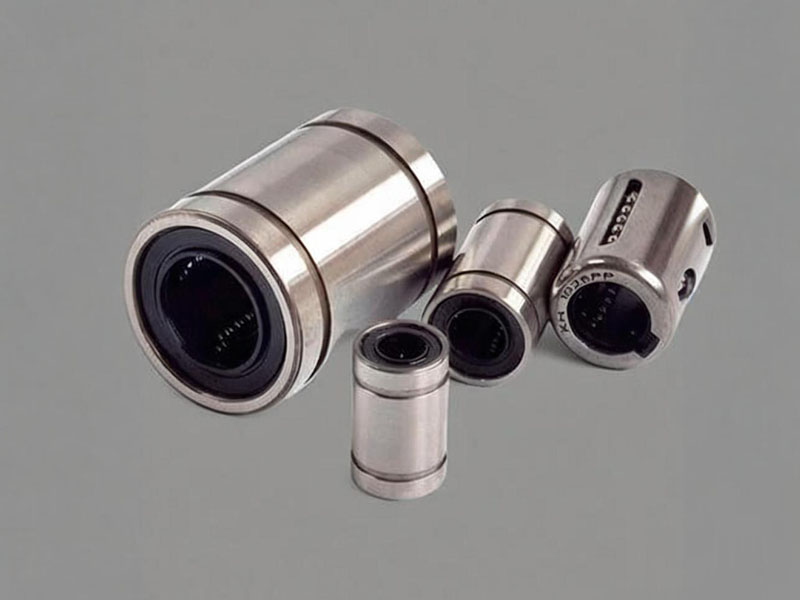
In simple terms, a linear bearing is a mechanical element designed to provide free, linear motion in a single direction. Unlike traditional bearings that facilitate rotational movement around an axis, linear bearings guide and support moving parts along a straight path. They are the unsung heroes of modern automation, enabling smooth, precise, and low-friction motion in countless applications.
This guide aims to provide you with a complete understanding of what linear bearings are, how they work, and how to select the perfect one for your needs.
2. Key Components of a Linear Bearing System
A linear bearing system is rarely just a single part; it’s a carefully engineered assembly. While configurations vary, most systems include several of the following components:
- Guide Rail / Track: The hardened and precision-ground steel rail on which the bearing block slides. It provides the reference surface for motion.
- Bearing Carriage / Block: The moving part that travels along the rail. It houses the rolling elements (balls or rollers).
- Rolling Elements: Balls or rollers that recirculate within the carriage, reducing friction between the carriage and the rail.
- Seals: Attached to the ends of the carriage to keep lubricant in and contaminants (dust, chips) out, ensuring longevity.
- Lubrication System: Fittings and channels that allow for grease or oil to be delivered to the rolling elements.
- Housing / Bearing Pillow Block: A housing that encloses the bearing and allows it to be mounted to a machine’s moving part.
- Support Rail / Shaft: For systems using a cylindrical shaft, these are the guide rods.
- End Supports: For shaft-based systems, these hold the shaft rigidly in place at both ends.
3. Main Types of Linear Bearings
Choosing the right bearing starts with understanding the different types available. They can be broadly categorized by how they handle motion:
3.1 Recirculating vs. Non-Recirculating Linear Bearings
- Recirculating Linear Bearings: In these bearings, the rolling elements (balls or rollers) travel in an endless loop within the carriage. As the carriage moves, the balls roll to one end, are picked up by a channel, and are recirculated back to the front. This allows for unlimited linear travel.
- Non-Recirculating Linear Bearings: These bearings use rollers or balls held in a cage between two surfaces. The travel length is limited because the rolling elements move only half the distance of the moving part. However, they offer extremely high precision and rigidity, ideal for short-stroke, high-loadapplications.
3.2 Detailed Classification by Motion Type
Ball-Type Linear Bearings: These use balls as the rolling element. They are known for smooth, high-speed motion and are a cost-effective solution for moderate loads.
Examples: Standard linear ball bushings, linear bearing units with housings.
Roller-Type Linear Bearings: Using cylindrical rollers instead of balls provides a larger contact area. This translates to significantly higher load capacity and rigidity, making them ideal for heavy-duty machining.
Examples: Crossed roller guides, linear needle roller bearings, flat roller guides.
Plain / Sliding Linear Bearings: These operate on the principle of sliding friction, often with the help of a lubricant. They are simple, robust, and excellent for absorbing vibration, but have higher friction.
Examples: Dovetail slides, box-way slides.
Non-Contact Linear Bearings: These use a film of air (air bearings) or magnetic fields to levitate the moving part, achieving zero friction and ultimate precision, but at a very high cost.
3.3 Quick Comparison Table
| Type | Advantages | Disadvantages | Best Applications |
| Ball-Type | Low friction, high speed, cost-effective | Moderate load capacity | 3D printers, pick-and-place machines, automation |
| Roller-Type | Very high load capacity, high rigidity, excellent precision | Higher cost, lower max speed | CNC machining centers, heavy milling, grinding machines |
| Plain/Sliding | Simple design, low cost, good damping | High friction, lower speed, wear | Manual slides, machine tool ways, low-speed positioning |
| Non-Contact | Zero friction, ultra-high speed, clean-room compatible | Extremely high cost, low load capacity | Semiconductor manufacturing, precision metrology |
4. How Do Linear Bearings Work?
The fundamental principle of most linear bearings is to convert sliding friction into rolling friction.
- In Recirculating Ball/Roller Bearings: As the bearing carriage moves along the rail, the balls or rollers roll within the precision-ground raceways. When they reach the end of the load zone in the carriage, they are deflected into a return channel (a “recirculation” path) that carries them back to the starting point. This continuous cycle allows for smooth, low-friction motion over any length of rail.
- In Plain/Sliding Bearings: A thin film of lubricant (oil or grease) separates the moving surfaces. The motion relies on the shearing of this film, which has a much lower resistance than direct metal-to-metal contact.
- In Non-Contact Bearings: An external source, like a high-pressure air supply, creates a thin cushion of air that lifts the moving element, completely eliminating physical contact.
5. Materials Used in Linear Bearings
The materials chosen directly impact performance, durability, and suitability for different environments.
- Stainless Steel (e.g., 440C): Offers excellent corrosion resistance, making it the top choice for medical devices, food processing equipment, and wet environments.
- Bearing Steel (e.g., GCr15 / 52100): The industry standard for high hardness and wear resistance. It provides exceptional load capacity and long life, suitable for most general industrial applications.
- Anodized Aluminum: Frequently used for the bearing housing or carriage body to reduce weight, which is crucial in high-speed automation and robotics.
- Engineering Plastics / Composites: Used for the cage in recirculating bearings or as the sliding material in plain bearings. They can be self-lubricating, offer excellent chemical resistance, and operate quietly.
6. Key Applications of Linear Bearings
The versatility of linear bearings means they are found in almost every industry:
- Industrial Automation & Robotics: Guiding robotic arms on gantries, enabling smooth motion in assembly lines.
- CNC Machine Tools: The backbone of machine tools, guiding the movement of tables, spindles, and tool changers with high precision.
- Medical & Laboratory Equipment: Used in CT scanners for precise patient positioning, in DNA sequencing machines, and in automated lab pumps.
- Electronics Manufacturing: Essential for the high-speed, high-accuracy positioning required in pick-and-place machines for circuit boards.
7. Advantages of Using Linear Bearings
Integrating linear bearings into your design offers numerous benefits:
- High Precision: Enables accurate and repeatable positioning.
- Low Friction: Reduces power consumption and allows for higher speeds.
- High Load Capacity & Rigidity: Roller types, in particular, can handle immense forces while resisting deflection.
- Long Service Life: With proper maintenance, they provide reliable performance for years.
- Easy to Replace: Standardized sizes and designs make them readily available and simple to replace.
8. How to Choose the Right Linear Bearing for Your Application
Selecting the optimal bearing is a systematic process. Here is a simple guide to follow:
- Step 1: Define Your Requirements. What is the load (weight and direction)? What is the operating speed and required acceleration? How precise does the motion need to be (positioning accuracy, repeatability)? What is the travel length? What is the environment like (temperature, dust, chemicals)?
- Step 2: Match Requirements to Bearing Types. Use the comparison table in Section 3.3. For example, a heavy CNC machine needs the rigidity of a roller-type. A fast pick-and-place robot benefits from the low friction of a ball-type.
- Step 3: Consider Installation and Maintenance. How much space do you have? Do you need pre-engineered units like pillow blocks? How will you lubricate the system?
- Step 4: Consult with Experts. This is the most crucial step. Getting the right bearing is the foundation of a reliable machine.
With over two decades of experience, the engineers at DUHUI Bearing can help you navigate these choices. We don’t just sell bearings; we provide solutions tailored to your specific application and budget.
9. FAQs About Linear Bearings
What is the difference between a linear ball bearing and a linear roller bearing?
The main difference lies in the rolling element. Ball bearings use balls for point contact, which is ideal for higher speeds and moderate loads. Roller bearings use cylindrical rollers for line contact, providing much higher load capacity and rigidity, ideal for heavy-duty applications.
How do I lubricate my linear bearing system?
Most systems are designed for grease lubrication, applied via grease fittings on the carriage. For very high-speed applications, oil lubrication might be recommended. Always follow the manufacturer’s guidelines. DUHUI bearings are designed with effective lubrication channels for easy maintenance.
Can linear bearings handle both radial and moment loads?
Yes, especially profiled rail guides. They are designed to handle loads from all directions, including radial loads and moment loads (pitching, yawing, and rolling forces).
What does “profiled rail linear guide” mean?
It refers to a linear guide system where the rail has a special profile (shaped like a rectangle or trapezoid) with precision-ground raceways. The bearing carriage matches this profile, allowing it to travel along the rail with high rigidity and accuracy.
Conclusion: Meeting Your Linear Bearings Needs
From the smallest 3D printer to the largest CNC machine, linear bearings are fundamental to modern motion control. Understanding their types, working principles, and how to select them is essential for any engineer or designer.
At DUHUI Bearing, we combine 20 years of manufacturing expertise with a global perspective to deliver bearings that you can rely on. Whether you need a standard product or a custom-engineered solution, our team is ready to support you.