In the demanding world of precision machinery, standard steel bearings often encounter their limits. Whether it’s the need for extreme speeds, resistance to corrosive chemicals, or protection against electrical arcing, engineers are increasingly turning to advanced ceramic solutions. Two primary options dominate this space: full ceramic bearings and hybrid ceramic bearings.
While both utilize ceramic materials, their distinct constructions lead to vastly different performance characteristics. DUHUI will dissect the differences between full and hybrid ceramic bearings, providing a detailed comparison to help you make an informed, cost-effective decision for your specific engineering challenge.
Full Ceramic Bearings
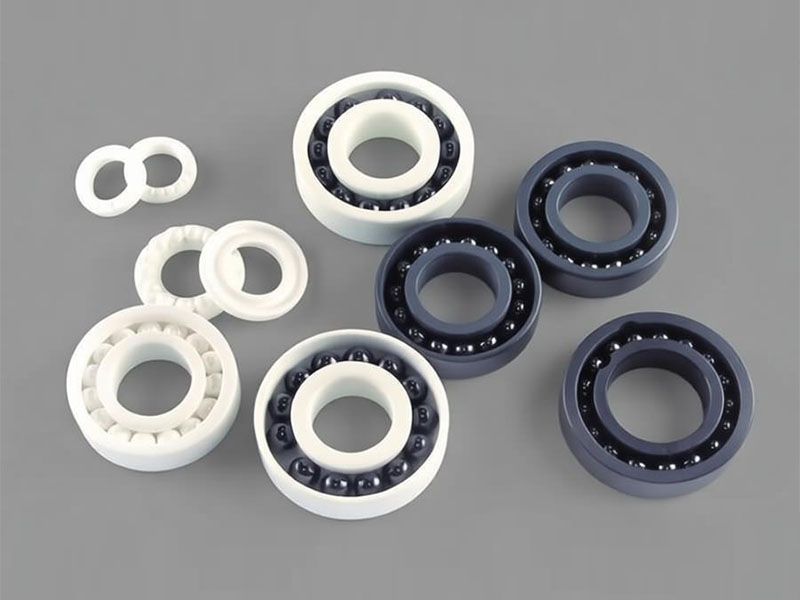
Full ceramic bearings are exactly what their name suggests: bearings where both the rolling elements (balls) and the rings (inner and outer races) are made from ceramic material. The most common materials are Silicon Nitride (Si₃N₄) and Zirconia (ZrO₂).
Core Advantages & Ideal Applications:
- Exceptional Corrosion Resistance: They are virtually inert and can operate directly in highly corrosive media like acids, seawater, and chemicals, making them ideal for chemical pumps, food processing, and semiconductor wet benches.
- Extreme Temperature Tolerance: Depending on the material, they can withstand temperatures from cryogenic levels up to 1000°C in vacuum or inert atmospheres, perfect for heat treating furnaces and high-temperature ovens.
- Inherently Non-Magnetic & Electrically Insulating: They are 100% non-magnetic and provide excellent electrical insulation, crucial for sensitive medical equipment like MRI machines and railway traction motors to prevent stray currents.
- Self-Lubricating Potential: In certain conditions, their low friction coefficient allows for operation without lubricant, making them suitable for vacuum and clean room environments.
Technical Limitations & Challenges:
- Brittleness: Ceramics are harder but less tough than steel. They are more sensitive to impact loads, shock, and improper installation.
- Lower Load Capacity: Due to the material’s modulus of elasticity, full ceramic bearings generally have a lower dynamic load rating compared to similarly sized hybrid bearings.
- High Cost: The complex process of manufacturing and precision grinding ceramic rings makes them the most expensive option.
Hybrid Ceramic Bearings
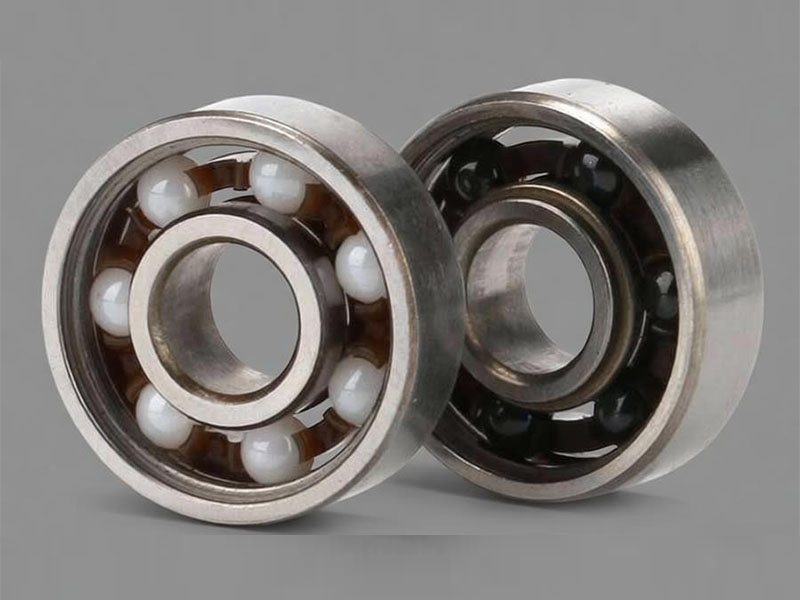
Hybrid ceramic bearings combine the best of two worlds. They feature ceramic rolling elements (typically Silicon Nitride) combined with conventional steel rings (usually made from high-grade bearing steel like 52100 or stainless steel).
Core Advantages & Ideal Applications:
- Superior High-Speed Performance: Ceramic balls are 60% lighter than steel balls. This reduces centrifugal force and skidding at high RPMs, generating less heat and allowing for much faster speeds. This is why they are the go-to choice for high-speed machine tool spindles (up to 60,000 RPM+).
- Enhanced Durability & Toughness: The steel rings provide the toughness and ductility needed to handle heavy loads, shock, and misalignment, making them far more robust than full ceramic bearings in demanding mechanical environments.
- Excellent Anti-Wear & Electrical Protection: The harder ceramic balls create a smoother running surface against the steel races, reducing friction and wear. Crucially, they act as an electrical insulator, preventing fluting (electrical pitting) caused by variable frequency drives (VFDs) in electric motors.
Technical Limitations & Challenges:
- Corrosion Vulnerability: The steel rings are susceptible to corrosion. In humid or chemically aggressive environments, they require special coatings or effective sealing.
- Lubrication & Temperature Dependency: Their performance is still tied to the lubricant. The grease’s temperature range (typically -40°C to +200°C) limits the bearing’s overall operating temperature.
Critical Performance Comparison
To clarify the differences, let’s compare them side-by-side in key areas:
Speed & Load Capability
| Feature | Full Ceramic Bearings | Hybrid Ceramic Bearings |
| Speed Capability | Extreme (can exceed 150,000 RPM in very small sizes, e.g., dental drills) | Very High (optimized for high-speed operation up to ~60,000 RPM with high stiffness) |
| Load Capability | Limited (susceptible to cracking under heavy or shock loads) | High (steel rings provide superior strength and resistance to shock loads) |
Durability & Lifespan
| Feature | Full Ceramic Bearings | Hybrid Ceramic Bearings |
| Lifespan | Longest in clean, corrosive, or high-temp environments. Prone to failure under shock. | Longest in high-speed, high-load applications with proper lubrication and protection. |
| Corrosion Resistance | Excellent (suited for direct contact with harsh media) | Moderate (steel rings require protection; stainless steel rings or coatings help) |
Maintenance Requirements
- Full Ceramic Bearings: In ideal operating conditions, they often require no lubrication and are considered “fit-and-forget.”
- Hybrid Ceramic Bearings: Require regular lubrication, but the interval is significantly longer than for all-steel bearings due to lower operating temperatures and reduced wear.
Application Guide: Which One to Choose?
The choice is dictated by your application’s primary demands.
- Choose Full Ceramic Bearings for: Environments involving extreme corrosion (chemical processing), ultra-high vacuum (semiconductor manufacturing), extreme temperature (ovens, furnaces), or where non-magnetic properties are mandatory (MRI, particle accelerators).
- Choose Hybrid Ceramic Bearings for: High-speed applications requiring reliability under load, such as machine tool spindles, electric vehicle (EV) traction motors, high-performance racing components, and high-speed pumps. They are the ideal upgrade from all-steel bearings for most industrial machinery.
Cost-Benefit Analysis
From a Total Cost of Ownership (TCO) perspective, the initial purchase price is just one factor. While full ceramic bearings have the highest upfront cost, their unique properties are irreplaceable in niche applications. For the vast majority of mainstream high-performance applications, hybrid ceramic bearings offer the sweet spot. They deliver a massive performance boost over steel bearings at a fraction of the cost of full ceramics, paying for themselves through reduced downtime, lower energy consumption, and extended equipment life.
Conclusion
The debate isn’t about which bearing is “better,” but which is better suited for your specific application. Full ceramic bearings are the champions of extreme environments, while hybrid ceramic bearings are the versatile workhorses for high-speed and high-precision machinery.
Choosing the wrong one can lead to premature failure and costly downtime.DUHUI is ready to assist you.