In the world of machinery, ball bearings can keep smooth rotation and reducing friction under immense pressure. For engineers and procurement specialists, selecting the correct bearing is a fundamental decision that dictates equipment performance, efficiency, and lifespan.
Two of the most common categories, radial and thrust ball bearings, are often confused. While they share similar components, their design philosophies and applications are distinctly different. DUHUI will clarify the differences, helping you make an informed decision for your specific application.
1.Understanding Ball Bearings: A Foundation
Before diving into the differences, it’s essential to understand the basic anatomy of a ball bearing. All ball bearings share four core components designed to manage friction:
- Inner Ring: The smaller ring that fits onto a rotating shaft.
- Outer Ring: The larger ring that fits into a housing.
- Rolling Elements (Balls): The spherical components that separate the rings and facilitate rolling motion.
- Cage (Retainer): A component that spaces the balls evenly, preventing them from contacting each other and ensuring smooth operation.
The way these components interact with loads defines the bearing type.
2.Radial Ball Bearings: Engineered for Rotational Motion
Radial ball bearings, most commonly known as deep groove ball bearings, are the workhorses of the industrial world.
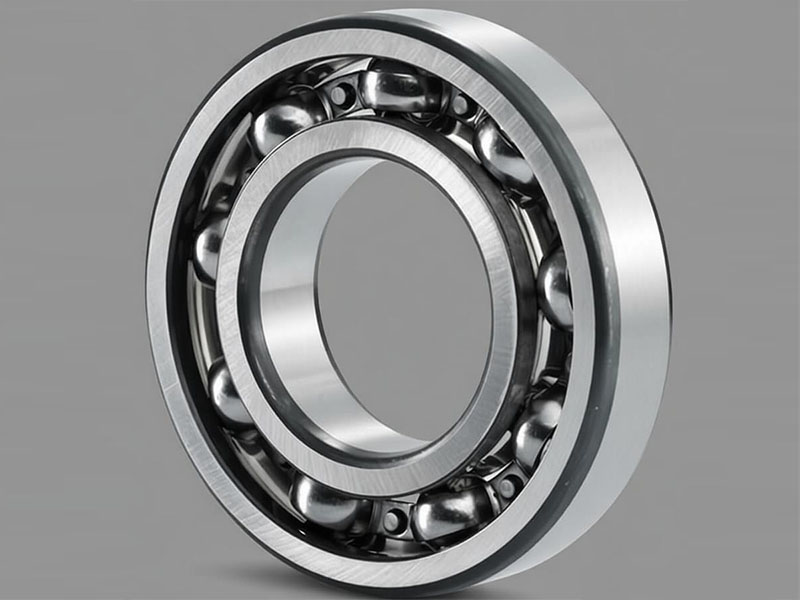
Design Philosophy: Their defining feature is the deep, continuous raceway groove on the inner and outer rings. This groove closely conforms to the shape of the balls.
Load Characteristics: As the name suggests, they are primarily designed to support radial loads, which are forces acting perpendicular to the shaft. A key feature of the deep groove design is its ability to also accommodate a certain degree of axial (thrust) load in both directions, especially in applications with light to moderate combined loads and clean operating conditions. This versatility makes them extremely popular.
Practical Applications: You will find radial ball bearings in high-speed applications where reliability is paramount. Common examples include:
- Electric motors
- Gearboxes and industrial gear drives
- Conveyor systems
- Pumps and compressors
- Automotive wheels and hubs (a core area of DUHUI’s specialization)
3.Thrust Ball Bearings: Built for Axial Precision
Thrust ball bearings are specialists. They are engineered for applications where the primary force travels along the axis of the shaft.

Design Philosophy: A typical thrust ball bearing consists of three separate parts: two washers (races) and a ball and cage assembly. One washer fits tightly on the shaft (shaft washer), while the other sits in the housing (housing washer). This design allows for easy mounting and dismounting.
Load Characteristics: These bearings are exclusively designed to handle axial loads. They can support high thrust loads but are not capable of handling any significant radial load. They are often categorized as single-direction or double-direction, depending on whether the thrust force comes from one or both sides.
Practical Applications: Because they manage end-thrust, they are found in specific, load-intensive environments:
- Automotive clutch release systems
- Vertical shafts in agricultural machinery and irrigation pumps
- Turntables and rotary tables
- Thrust-critical applications in machine tools
4.Radial vs. Thrust Bearings: The Critical Differences
Choosing the correct bearing comes down to understanding the nature of the forces at play. Here are the core distinctions:
Load Direction
Radial Bearings: Optimized for perpendicular forces. Imagine a spinning shaft being pushed down by a belt. A radial bearing handles that downward pressure.
Thrust Bearings: Optimized for parallel (axial) forces. Imagine a vertical shaft in a mixer trying to drop due to gravity and the weight of the mixing blades. A thrust bearing supports this downward push along the shaft’s length.
Contact Angle
The contact angle is the angle between the line connecting the two raceway contact points and a plane perpendicular to the bearing axis.
- Radial Bearings: Have a nominal contact angle of 0 degrees. The load is transmitted radially.
- Thrust Bearings: Have a contact angle of 90 degrees. The load is transmitted directly along the axis.
- Note: For applications with combined high radial and axial loads, engineers often turn to Angular Contact Bearings, which feature a contact angle between 0° and 90° (e.g., 15°, 25°, 40°).
Speed Capability
- Radial Bearings: The deep groove design and centrifugal forces acting on the balls are better managed, allowing them to operate efficiently at high speeds.
- Thrust Bearings: At high speeds, the centrifugal force pushes the balls outward, increasing stress and friction at the contact point. Therefore, they are typically limited to low to moderate speeds, especially under heavy load.
5.Engineering Excellence: Materials, Lubrication & Maintenance
At DUHUI, we know that performance is also defined by materials and care.
- Materials: Most standard bearings are made from high-carbon chromium steel (like GCr15 or SAE 52100) for hardness and durability. For applications requiring corrosion resistance, stainless steel bearings are the preferred choice.
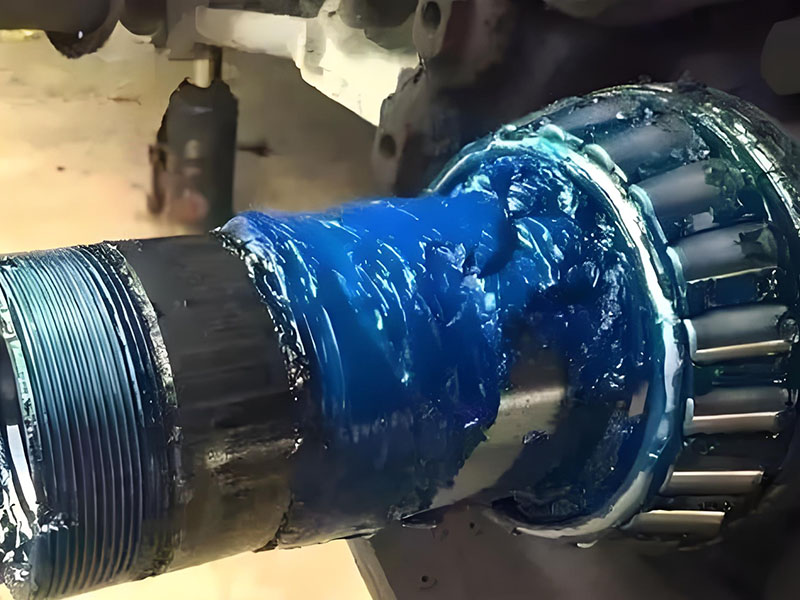
- Lubrication: The lifeblood of any bearing. Lubrication (grease or oil) creates a film that separates moving parts, reducing friction and wear. It also dissipates heat generated during operation and protects internal surfaces from corrosion.
- Maintenance: Proper maintenance extends bearing life exponentially. Best practices include regular condition monitoring (vibration analysis, temperature checks), adhering to relubrication schedules, and protecting bearings from contamination by dust and moisture.
6.A Practical Guide: Selecting the Right Bearing for Your Application
When faced with a bearing selection, follow this simple process:
- Analyze the Loads: Determine the primary direction of the force. Is it radial, axial, or a combination?
- Consider the Speed: Is your application high-speed (like an electric motor) or low-speed/high-load (like a clutch)?
- Evaluate Operating Conditions: Consider temperature extremes, exposure to contaminants (dirt, water), and available space for installation.
If your application is purely radial, a standard radial ball bearing is your starting point. If it’s purely axial, a thrust bearing is the correct choice. For complex, combined loads, consulting with an expert is the safest path. With 15 years of export experience, the engineers at DUHUI Bearing have helped clients worldwide navigate these exact challenges.
Frequently Asked Questions (FAQ)
Q: What is the main difference between radial and thrust ball bearings?
A: The fundamental difference lies in the load they are designed to carry. Radial bearings support forces perpendicular to the shaft, while thrust bearings support forces parallel to the shaft.
Q: Can a radial ball bearing support axial (thrust) loads?
A: Yes, deep groove radial ball bearings can support a certain amount of axial load in addition to their primary radial load. However, this capacity is limited. For pure or heavy axial loads, a thrust bearing is required.
Q: Why is the contact angle important?
A: The contact angle determines the bearing’s ability to support loads. A 0° angle (radial) is optimized for perpendicular forces. A 90° angle (thrust) is optimized for axial forces. The angle dictates the internal load path and stress distribution.
Q: What are the basic maintenance requirements for ball bearings?
A: Key maintenance tasks include proper lubrication (using the right type and amount), protection from contamination (using seals and shields), and periodic inspection for noise, vibration, or temperature changes.
Conclusion
Understanding the distinction between radial and thrust ball bearings is more than technical knowledge—it’s the foundation of equipment reliability and efficiency. By correctly identifying your load requirements, you ensure optimal performance and longevity from your machinery.
For over two decades, DUHUI Bearing has been a trusted partner in this field. We don’t just make bearings; we engineer solutions. We combine robust manufacturing with a deep understanding of global application needs to deliver products you can rely on.