In the world of mechanical engineering, bearings are the unsung heroes, enabling smooth motion and supporting heavy loads in countless applications. When designing or maintaining machinery, a fundamental question often arises: should you use a radial bearing or a thrust bearing? While they may look similar, their functions are distinct and choosing the wrong type can lead to premature failure, costly downtime, and significant efficiency losses.
DUHUI will provide a clear, comprehensive guide to the differences between radial and thrust bearings. We will explore their definitions, advantages, disadvantages, and most importantly, how to select the right bearing for your specific application.
1. Basic Definitions and Core Differences
The primary distinction between these two bearing types lies in the direction of the load they are designed to support.
1.1 What is a Radial Bearing?
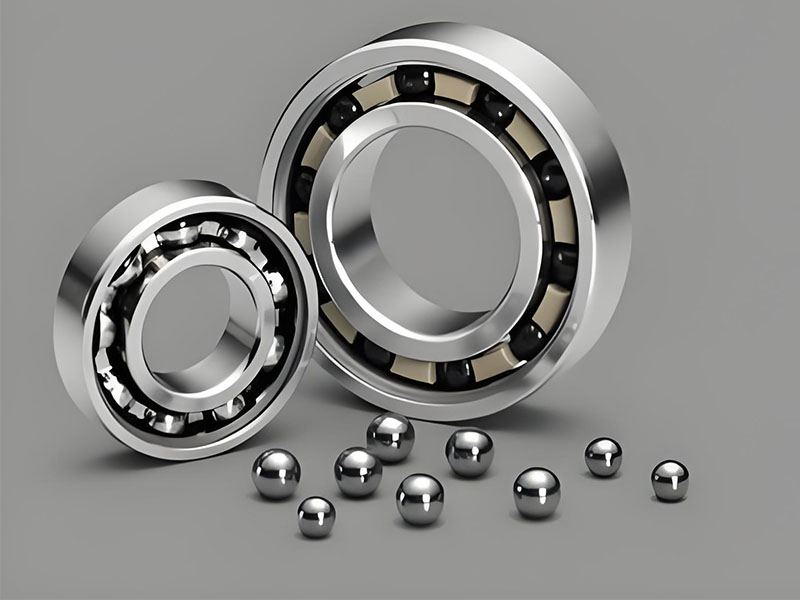
A radial bearing is designed primarily to support a rotating shaft and carry loads that are perpendicular (radial) to the shaft. Think of a car wheel hub bearing: the weight of the vehicle pushes down on the axle, creating a radial load that the bearing must support while allowing the wheel to spin freely. Common types include deep groove ball bearings and cylindrical roller bearings.
1.2 What is a Thrust Bearing?
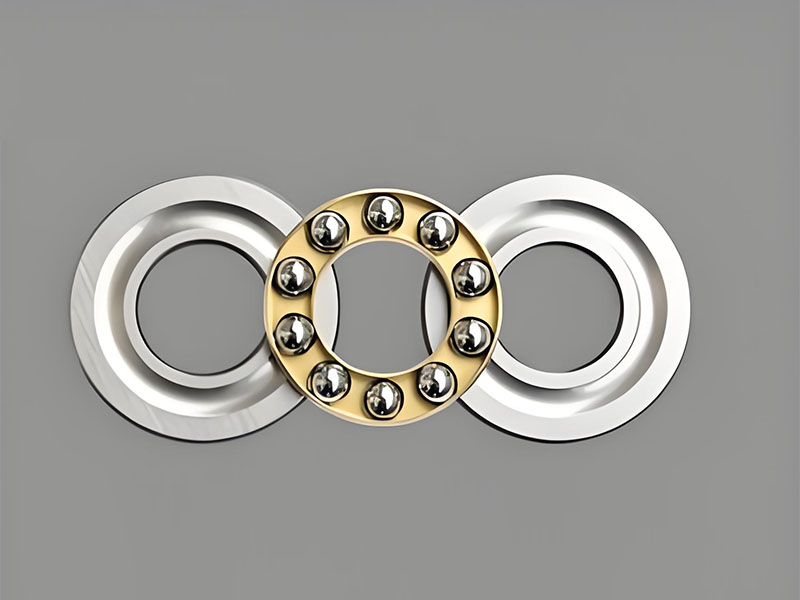
A thrust bearing, also known as an axial bearing, is specifically designed to support loads that are parallel (axial) to the shaft. Its primary role is to handle the pushing force along the axis of rotation, preventing the shaft from moving back and forth. Thrust bearings are crucial for applications like a car’s transmission, where gears exert significant axial forces, or a helicopter’s main rotor, which must manage massive thrust loads.
1.3 Core Differences at a Glance
| Feature | Radial Bearing | Thrust Bearing |
| Load Direction | Perpendicular (90°) to the shaft | Parallel to the shaft |
| Structural Design | Generally simpler; uses rolling elements between two races | More complex; often features a specialized raceway (e.g., grooved washers) |
| Primary Function | Support rotating shafts under radial force | Limit axial shaft movement and support axial force |
| Quick Tip | If you can picture the load “squashing” the bearing, it’s radial. | If you can picture the load “pushing” the bearing apart along the shaft, it’s thrust. |
2. Detailed Comparison: Advantages and Disadvantages
To choose correctly, you need to understand the strengths and weaknesses of each type.
2.1 Radial Bearings
Advantages:
- Excellent Radial Load Capacity: They are unmatched in handling high radial loads.
- High-Speed Capability: Their simple structure, especially with ball elements, allows for very high rotational speeds with minimal friction.
- Cost-Effective: They are generally simpler to manufacture, making them a more economical choice for many applications.
- Good Misalignment Tolerance: Certain types, like self-aligning ball bearings, can accommodate slight shaft deflections or mounting errors without failing.
Disadvantages:
- Limited Axial Load Capacity: While they can handle some axial load, they are not designed for heavy or sustained axial forces.
2.2 Thrust Bearings
Advantages:
- Exceptional Axial Load Capacity: They are the go-to choice for applications requiring support of heavy, constant axial loads.
- Precise Axial Positioning: They excel at keeping a shaft in its exact designed position, which is critical for gear meshing and overall system accuracy.
- Fills a Critical Gap: They provide the axial load capacity that radial bearings lack, making them essential in complex machinery.
Disadvantages:
- Poor Radial Load Capacity: They cannot handle significant radial loads and will fail quickly if such loads are present.
- Misalignment Sensitivity: Most thrust bearings are very sensitive to shaft misalignment, requiring precise mounting and alignment.
- Efficiency Loss: Due to their larger contact surfaces, they can generate more friction, leading to higher energy consumption and heat generation.
2.3 Key Selection Criteria for Engineers
Selecting the correct bearing involves evaluating several key factors:
- Load Type: What is the primary load? If it’s radial, choose a radial bearing. If it’s axial, choose a thrust bearing. For combined loads, a radial bearing with a thrust bearing or a specialized angular contact bearing may be necessary.
- Load Magnitude: Is the load light, moderate, or heavy? This influences the size, type (ball vs. roller), and number of bearings needed.
- Rotational Speed: High-speed applications typically favor radial ball bearings due to their lower friction.
- Space Constraints: Can you accommodate a single bearing or a complex assembly of both types?
- Cost and Maintenance: Consider the initial purchase cost, installation complexity, and long-term lubrication and maintenance requirements.
3. How Do Radial and Thrust Bearings Impact System Efficiency?
Efficiency is paramount in modern machinery, and the choice between bearing types has a direct impact.
3.1 Efficiency of Radial Bearings
Because their primary design focuses on minimizing rolling friction for radial loads, radial bearings are inherently more efficient. This makes them the standard for high-speed, energy-sensitive applications like electric motors, pumps, and automotive wheel hubs. Less friction means less energy wasted as heat, leading to lower operating costs.
3.2 Efficiency of Thrust Bearings
By design, thrust bearings often have a larger surface area in contact with the rolling elements to support heavy axial forces. This structural complexity can result in higher friction and, consequently, greater energy loss. This lost energy is typically converted into heat, which must be managed to prevent lubricant degradation and premature bearing failure.
3.3 Efficiency Optimization Tips
Regardless of the type, you can maximize efficiency with these practices:
- Proper Selection: Ensure the bearing type precisely matches the primary load. Over-specifying a thrust bearing for a radial-dominant application will waste energy.
- Optimized Lubrication: Using the correct lubricant (oil or grease) in the right quantity is the most critical factor in reducing friction. Consider synthetic lubricants for extreme conditions.
- Precision Mounting: Accurate installation ensures the load is distributed correctly, preventing parasitic friction and localized stress that reduces efficiency.
4. Industry Applications: Where Each Bearing Type Excels
Understanding real-world applications makes the theoretical differences clear.
4.1 Automotive Industry
- Radial Bearings: These are ubiquitous. Deep groove ball bearings are used in alternators, starter motors, and most critically, automotive wheel hub bearings. They support the vehicle’s weight (radial load) while enabling smooth, high-speed wheel rotation.
- Thrust Bearings: Thrust bearings are vital inside automatic and manual transmissions, where they manage the axial forces from helical gears and clutch packs. They are also found in differentials to manage the side-thrust from ring and pinion gears.
4.2 Aerospace Industry
- Radial Bearings: High-precision radial bearings are used in jet engines, where they support the main shaft within the compressor and turbine sections under extreme speeds and temperatures.
- Thrust Bearings: Perhaps the most critical application is in helicopter rotor systems, where massive thrust bearings (or specialized angular contact bearings) support the entire weight and lift of the aircraft while allowing the rotor blades to spin. They also manage axial loads in propeller systems and auxiliary power units.
4.3 Industrial Machinery
- Radial Bearings: In factories, radial bearings are the backbone of pumps, compressors, electric motors, and high-speed spindles for CNC machines.
- Thrust Bearings: Heavy industrial applications rely on thrust bearings. Large thrust bearings support the main screws in hydraulic presses, the drums in heavy-duty lifting winches, and the massive gearboxes found in mining equipment and marine propulsion systems.
Conclusion
The decision between a radial bearing and a thrust bearing comes down to one fundamental question: What direction is the primary load?
If your application involves supporting a rotating shaft under a perpendicular load, a radial bearing is likely the correct and most efficient choice. If your primary challenge is managing a heavy pushing or pulling force along the shaft’s axis, a thrust bearing is indispensable.
For many real-world applications, especially in automotive and industrial gearboxes, the best solution is to use both types in concert—radial bearings to support the rotating shaft and thrust bearings to manage the axial forces.