Needle bearings or roller bearings? For mechanical engineers and procurement professionals, this isn’t just a casual question—it’s a fundamental design decision that affects performance, reliability, and cost. As we approach 2026, the demand for compact, high-efficiency machinery makes this choice even more critical.
DUHUI provides a clear, practical framework for making the right decision. We’ll explore the unique characteristics of needle bearings, compare them directly with cylindrical, tapered, and spherical roller bearings, and help you match each bearing type to your specific application requirements.
1. Understanding the Roller Bearing
Before diving into specifics, it’s essential to establish a common understanding of what roller bearings are and the advantages they share.
1.1 What Are Roller Bearings?
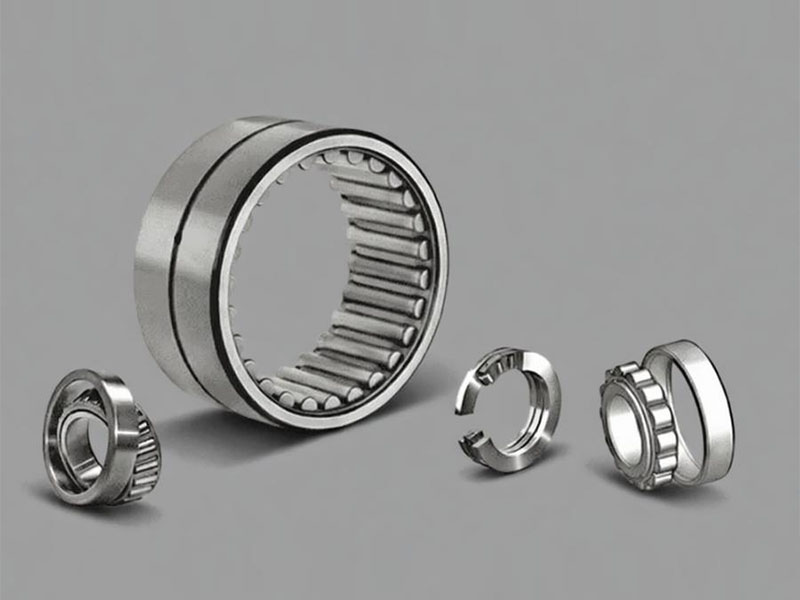
Roller bearings are a type of rolling-element bearing that uses cylindrical rollers to maintain the separation between moving parts. Unlike ball bearings, which use spherical balls, the line contact of rollers provides a much larger contact area. This fundamental difference allows roller bearings to support significantly higher loads than ball bearings of similar size.
1.2 The Common Advantages of Roller Bearings
All roller bearings share a set of core benefits that make them indispensable in heavy-duty applications:
- High Load Capacity: Their line contact design translates to superior radial and, in some cases, axial load capacity.
- High Rigidity: Roller bearings offer excellent resistance to deformation under load, which is crucial for precision applications.
- Durability: Designed for long service life in demanding environments, they are built to withstand continuous operation.
1.3 The Five Main Types of Roller Bearings
The roller bearing family is diverse, with each member optimized for specific tasks:
- Cylindrical Roller Bearings: Ideal for very high radial loads and high speeds.
- Tapered Roller Bearings: Designed to handle combined radial and axial loads (thrust) simultaneously.
- Spherical Roller Bearings: Self-aligning and perfect for applications with shaft misalignment or deflection under heavy loads.
- Thrust Roller Bearings: Specifically engineered to support high axial loads.
- Needle Roller Bearings: Characterized by their long, thin rollers (needles), they are the space-saving specialists of the family.
2. A Deep Dive into Needle Roller Bearings
Needle bearings are not just another roller bearing; they are a solution born from the need for compact, high-capacity designs.
2.1 Design Features & Construction
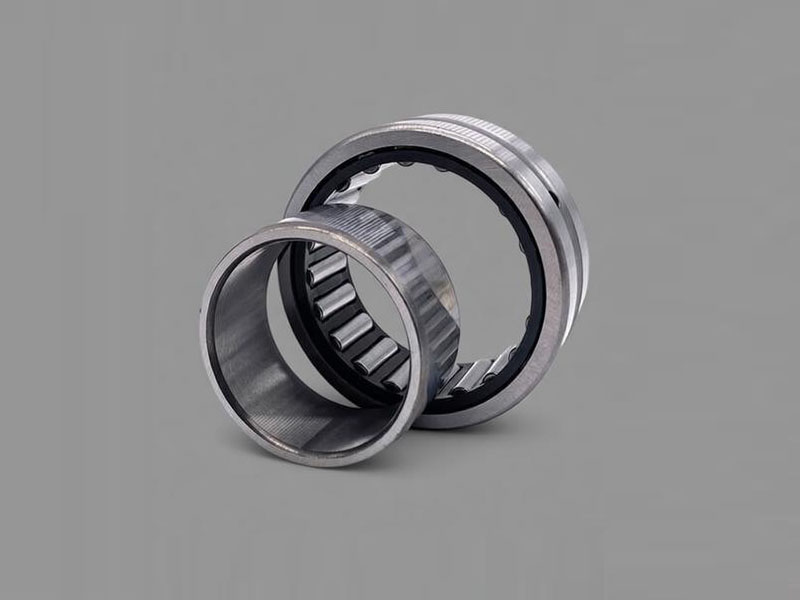
A needle roller bearing is defined by rollers that are long and slender, with a length-to-diameter ratio typically between 3:1 and 10:1. This unique geometry is packaged in several common forms:
- Drawn Cup Needle Bearings: Feature a thin, deep-drawn outer ring, offering an extremely compact and economical solution.
- Machined Ring Needle Bearings: Have thicker, precision-machined rings for higher load capacity and accuracy.
- Caged Needle Roller Assemblies: Consist of only a cage and needle rollers, designed to be used directly against a hardened and ground shaft and housing, minimizing space to the absolute limit.
2.2 Key Advantages: The “Thin” Edge
- Minimal Radial Space: This is their defining feature. They allow engineers to significantly reduce the size and weight of housings and surrounding components.
- Highest Load Capacity for a Given Radial Space: When space is tight, no other rolling element bearing can match the load-carrying capability of a needle bearing.
- High Rigidity: The large number of small-diameter rollers provides numerous contact points, resulting in very high radial stiffness.
- Excellent High-Speed Performance: With precision-guided cages, needle bearings can operate efficiently at high speeds, especially with oil lubrication.
2.3 Limitations & Design Considerations
While powerful, needle bearings have limitations that must be respected:
- Limited Axial Load Capacity: Standard radial needle bearings cannot carry axial loads. If axial location is needed, they must be used with separate thrust bearings or combined needle/thrust bearing assemblies.
- Sensitivity to Misalignment: They require precise alignment between the shaft and housing. Misalignment can lead to edge loading and premature failure.
- Susceptibility to Shock Loads and Contamination: The thin cross-section of the rollers and, in some cases, the outer ring, makes them vulnerable to sudden impact loads and particulate contamination.
3. Needle Bearings vs. Other Roller Bearings
To make the right choice, we must see how needle bearings stack up against the competition.
3.1 Needle Bearings vs. Cylindrical Roller Bearings
This is a classic trade-off between space and pure radial capacity. Choose needle bearings when radial space is at a premium and you need to minimize housing dimensions. Choose cylindrical roller bearings when you need the absolute highest radial load capacity and speed capability, and space constraints are less severe. Cylindrical roller bearings also offer variants that can accommodate some axial displacement.
3.2 Needle Bearings vs. Tapered Roller Bearings
Tapered roller bearings are the go-to solution for combined radial and axial loads. If your application involves significant thrust in one direction—such as in automotive wheel hubs or helical gearboxes—a tapered bearing is necessary. Needle bearings, in their standard form, excel only in pure radial load, space-constrained environments and cannot replace tapered bearings where axial forces are present.
3.3 Needle Bearings vs. Spherical Roller Bearings
This comparison highlights precision versus forgiveness. Needle bearings demand and provide high precision and rigidity, making them ideal for well-aligned, high-stiffness systems. Spherical roller bearings are the champions of handling misalignment and heavy shock loads. If your shaft is prone to deflection or your housing has alignment issues, spherical roller bearings are the reliable choice despite their larger cross-section.
3.4 Quick Reference Comparison Table
| Feature | Needle Roller Bearings | Cylindrical Roller Bearings | Tapered Roller Bearings | Spherical Roller Bearings |
| Primary Load | Radial only | Radial (some axial variants) | Combined (Radial & Axial) | Radial & Moderate Axial |
| Space Efficiency | Excellent (Thinnest section) | Good | Moderate | Poor (Larger cross-section) |
| Speed Capability | High | Excellent | Medium | Medium |
| Misalignment Tolerance | Extremely Low | Low | Low | Excellent (Self-aligning) |
| Installation Complexity | High (Precision fit critical) | Medium | High (Requires setting) | Medium |
| Relative Cost | Low | Medium | Medium-High | High |
| Best For… | Compact spaces, linkages, transmissions | Machine tool spindles, electric motors | Wheel hubs, gearboxes, combined loads | Misaligned shafts, heavy machinery, vibrating screens |
4. Application-Based Selection Guide
Theory is helpful, but application reality dictates the final choice.
4.1 The Golden Rules for Choosing Needle Bearings
Choose a needle bearing when:
- Radial Space is the Number One Constraint: If you’re designing a compact gearbox, a small engine, or any application where the housing diameter must be minimized, needle bearings are your solution.
- The Motion is Oscillating: Applications like piston pins in engines, universal joints, rocker arms, and linkage systems are ideal for needle bearings due to their high load capacity in a compact form. The oscillating motion also mitigates some of their lubrication challenges.
- High Rigidity is Required in a Tight Spot: For precision applications like cam followers, needle bearings provide excellent stiffness that ensures accurate performance.
Typical Industrial Applications:
- Automotive transmissions and differentials
- Piston pins and connecting rods
- Compressors and pumps
- Industrial robots and automation equipment
- Motorcycle engines and off-highway vehicles
4.2 When to Choose Other Roller Bearing Types
Consider other options if your application involves:
- Combined or Heavy Axial Loads: A gearbox with helical gears creates thrust. Here, a tapered roller bearing or a thrust bearing is mandatory.
- Significant Shaft Misalignment or Deflection: If the shaft is long and prone to bending, or if housing misalignment is likely during operation, a spherical roller bearing is the safe, self-aligning choice.
- High Axial Thrust Loads: For applications like screw drives or vertical shafts carrying heavy loads, thrust roller bearings (cylindrical or spherical) are specifically designed for this purpose.
- Severe Shock Loads or Heavy Contamination: In heavy construction, mining, or steel mill equipment, the robustness of a spherical or cylindrical roller bearing is preferred over the more delicate needle bearing.
- Extreme Precision Applications with Combined Loads: While needle bearings offer precision for radial loads, applications like machine tool spindles often require specially designed cylindrical or angular contact bearings for combined precision, speed, and load handling.
5. Technical Selection Essentials & Best Practices
Once you’ve narrowed down the bearing type, proper specification is key to success.
5.1 Load Calculation & Bearing Life
Always perform a life calculation to ensure your selected bearing will meet the required service life. The basic rating life (L10) for roller bearings is calculated as:L10 = (C/P)^(10/3)
Where:
- L10 is the basic rating life (in millions of revolutions) – the life that 90% of a group of identical bearings can achieve or exceed.
- C is the basic dynamic load rating (provided by the manufacturer).
- P is the equivalent dynamic bearing load (calculated based on actual applied radial and axial forces).
- p = 10/3 is the life exponent for all roller bearings (ball bearings use p=3).
5.2 Installation & Fitting Requirements
The performance of a needle bearing is highly dependent on its surroundings:
- Shaft and Housing Tolerances: Correct ISO fits are critical. Needle bearings typically require a hardened and ground shaft (minimum 58-60 HRC) if used directly as a raceway.
- Geometric Accuracy: Pay close attention to the roundness, cylindricity, and surface finish of mating components. Any deviation will directly affect bearing performance and life.
- Mounting Procedures: Never apply force through the rolling elements during installation. Use appropriate tools to press on the correct ring.
5.3 Lubrication Strategy
Proper lubrication is the lifeblood of any bearing, but especially for needle bearings due to their sliding contact characteristics:
- Grease Lubrication is common for simplicity, maintenance-free operation, and lower speeds. Choose greases with good base oil viscosity and appropriate thickeners for the operating temperature.
- Oil Lubrication (oil bath, circulation, or mist) is often necessary for very high speeds or when heat dissipation is critical. Oil ensures better cooling and flushing of contaminants.
- Lubricant Selection: Base your choice on operating temperature, speed (DN value), and load. Higher loads require higher viscosity oils.
5.4 Sealing & Protection
For needle bearings, effective sealing is paramount. Their thin rollers are highly sensitive to debris, and contamination is one of the leading causes of premature failure. Consider:
- Integral Seals: Many needle bearings come with built-in seals or shields for protection.
- Housing Seals: Ensure your housing design includes effective contact or labyrinth seals to keep contaminants out and lubricant in.
- Operating Environment: In dirty or wet environments, invest in higher-grade sealing solutions.
5.5 Why Partner with DUHUI Bearing?
Navigating these technical complexities can be challenging. At DUHUI Bearing, we understand that every application is unique. As a specialized Chinese manufacturer of automotive wheel hub bearings and a wide range of other bearing types, we don’t just supply components—we provide solutions.
- Manufacturing Expertise: With years of experience in precision bearing manufacturing, we ensure consistent quality and performance.
- Technical Support: Our engineering team can assist you in validating your selection, calculating bearing life, and optimizing your design for both performance and cost.
- Comprehensive Range: From needle bearings to cylindrical, tapered, and spherical roller bearings, we have the right solution for your application.
- Customization Capabilities: Need a non-standard size or special feature? We can develop customized solutions to meet your exact requirements.
Conclusion
Choosing between needle bearings and other roller bearings ultimately comes down to your application’s specific demands. Needle bearings deliver unmatched space efficiency and high load capacity in compact radial spaces—ideal for transmissions, linkages, and oscillating motions. Cylindrical roller bearings excel in pure radial heavy-load applications. Tapered roller bearings are the clear choice for combined radial and axial loads. And spherical roller bearings provide the misalignment tolerance needed for heavy machinery and vibrating equipment.