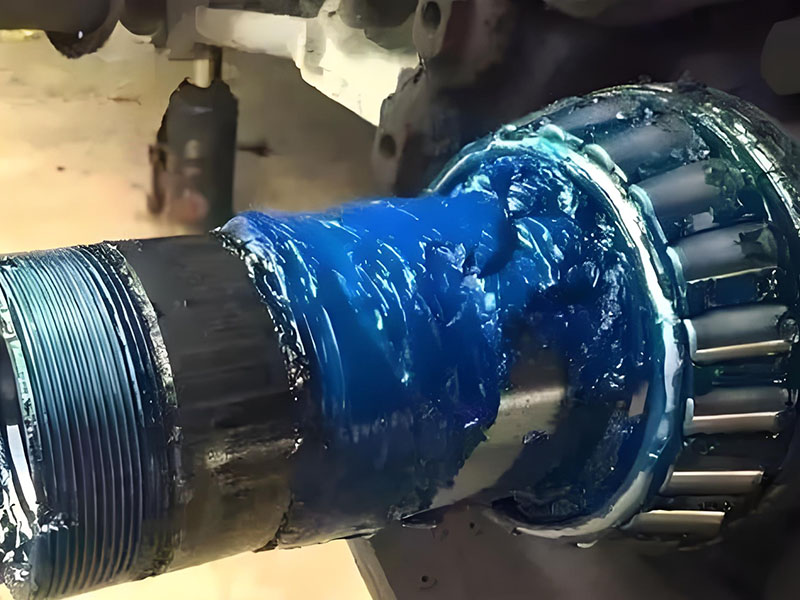
As a bearing manufacturer, we know that bearing clearance is one of the most important parameters. It is not a mistake, but a strategic performance aspect that influences the life of the bearing, thermal rise, vibration, and total system accuracy.
The clearance shown on the drawing is not the same as the operational clearance of the bearing. The actual functional clearance is determined and altered by the combination of the fit clearance, temperature impact and applied load, instantaneously.
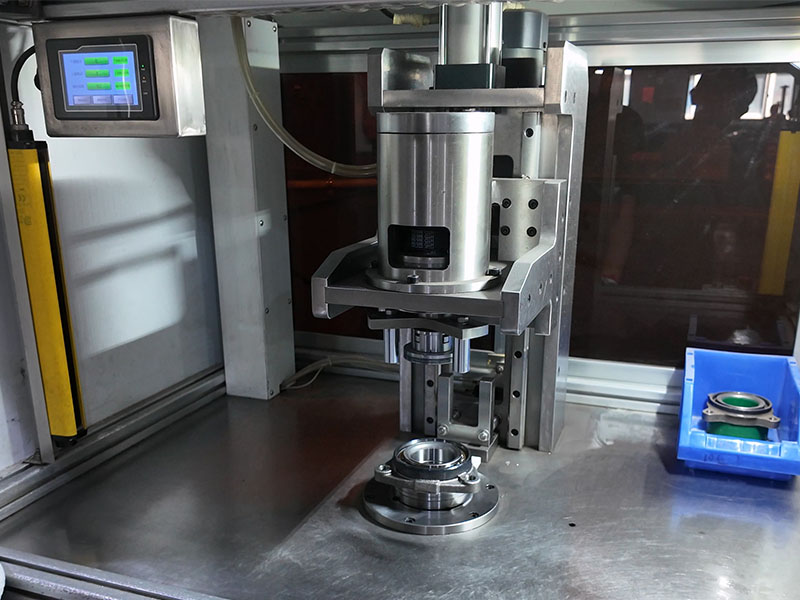
Bearing Clearance Selection Principles
There is no specific rule to select bearing clearance. The basic principle is to make the system stiff and operations flexible. Here are some guidelines of choice based on normal use cases.
When to Choose Larger Bearing Clearance?
Bearing clearance such as C3, C4 or bigger should be applied to those working conditions in which the environment neutralizes the clearance or there is a higher adaptability need.
- Compensating interference fit: Clearance in the tight fits is significantly reduced due to the expansion of an inner ring and contraction of an outer ring. This can be estimated that 5-8 m of clearance is lost per 0.01 mm of interference. Guidance: Initial clearance should be increased in proportion to the tightness of the fit.
- Adapting Thermal Expansion and Temperature Changes: When the temperature of the bearing housing is much greater than that of the shaft (for instance, the outer ring is heated, or has a cold shaft end), the thermal expansion of the outer ring will take up the space. This is particularly significant in automotive wheel hubs or electric motors.
- Coping misplaced connection and impact: When the system is set up incorrectly, the shaft bends, or there are vibrations and impacts (such as in construction machinery and gearboxes), a greater distance provides protection and stops the movement of parts from becoming stuck, and it can be regenerated in some limited way on its own.
When to Choose Smaller Bearing Clearance?
When the application demands precision, rigidity, and quiet operation, smaller clearance groups such as C2, CN (standard), or even smaller clearance groups should be preferred.
- High rotational accuracy required: In the ex Machine Tool Spindle and Precision Instrument applications, minor clearance controls run-out and variation, in order to ensure smooth operation. High System Rigidity Required: Small clearance may increase the rigidity of the axial support where bearings are required to withstand allied axial forces or- shaft location.
- To Prevent Drifting Under Light Loads And High Speeds-Under centrifugal force, the rolling elements tend to be thrown out, hence an increase of the working space. A minimal starting clearance would eliminate this tendency, to ensure that the motion path is maintained well.
- To minimize noise in operations. In such cases as in miniature motors and home appliances, a small clearance is usually associated with reduced noise.
Practical Points and Common Misconceptions
- Default Choice: Unless there are special requirements, the standard clearance group (CN/C0) is a reliable starting point.
- The Wisdom of “Negative Clearance”: In applications with extreme demands on rigidity and precision, such as machine tool spindles and high-end automotive differentials, preloading (i.e., “negative clearance”) is often used. However, this requires precise calculations and strict temperature control, making it a double-edged sword.
- Not Directly Measurable: The clearance after installation cannot be simply measured with a feeler gauge; it must be estimated through engineering calculations considering factors such as fit and temperature differences.
Driving forces that influence Clearance
Bearing Inner Ring and Shaft Fit
The inner ring expansion due to a 0.01mm rise in interference fit results in a decrease of radial clearance of about 0.005-0.008mm (based on the size and structure of the bearing).
Suggestion: The clearance at the beginning should be greater with the tighter fit.
Bearing Outer Ring and Housing Bore Fit
The reduction of clearance is caused by the contraction of the outer ring due to the outer ring interference fit. Thin-walled or light alloy housings are particularly significant in this respect.
Temperature l influence
Various thermal expansion values of metals (e.g., steel and aluminium) combined with non-uniform heating of the inner and outer rings produce variation of operating clearance.
Experimental Formula (Rough Estimate): The clearance varies by about 0.001 × the inner diameter of the bearing (mm) for every 10° C temperature difference.
Additional Important Elements.
This is the reaction of the different bearings to clearance: Angular contact ball bearings are normally used in pairs and squeezed tight, self-aligning bearings utilize clearance to re-align, cylindrical roller bearings require clearance and do not like it.
Heavy impact loads require large clearances, light and constant loads allow to use small clearances.
The amount of oil lubricated heat decreased and when the grease was overfilled it raised its temperature, which also modified the clearance.
The materials of shaft and housing and structure: The heat distribution, and the expansion of aluminum housings and hollow shafts, and so on, are not the same and should be evaluated separately.
Note:
The amount of radial clearance reduction is related to the actual effective interference of the mating parts, the size of the mating shaft diameter, and the wall thickness of the housing bore.
Actual effective interference (inner ring) should be: △dy = 2/3△d – G* where △d is the nominal interference and G* is the flattening dimension for the interference fit.
Actual effective interference (outer ring) should be: △Dy = 2/3△D – G* where △D is the nominal interference and G* is the flattening dimension for the interference fit.
Generated heat will cause the internal temperature of the bearing to rise, subsequently leading to the expansion of the shaft, housing, and bearing components. The clearance may increase or decrease, depending on the materials of the shaft and housing, as well as the temperature gradient between the bearing and its supporting parts.
Clearance Marking and Common Standards
ISO standards: Divided into C1, C2, CN (normal), C3, C4, and C5 groups, with clearances increasing sequentially (CN is the most commonly used standard clearance).
Old standards (e.g., GB/T 4604): The corresponding relationship is C1/C2/C0 (normal)/C3/C4/C5.
Special clearances: Non-standard clearances can be customized according to application requirements.
Clearance Calculation Formulas:
About Influence of Fit
Bearing inner ring and solid steel shaft: △j = △dy * d / h
Bearing inner ring and hollow steel shaft: △j = △dy * F(d)
F(d) = d/h * [(d/d1)² – 1] / [(d/d1)² – (d/h)²]
Bearing outer ring and solid steel housing: △A = △Dy * H / D
Bearing outer ring and thin-walled steel housing: △A = △Dy * F(D)
F(D) = H/D * [(F/D)² – 1] / [(F/D)² – (H/D)²]
Bearing outer ring and grey cast iron housing: △A = △Dy * [F(D) – 0.15]
Bearing outer ring and light metal housing: △A = △Dy * [F(D) – 0.25]
Where:
△j — Expansion amount of the inner ring raceway shoulder diameter (µm).
△dy — Effective interference at the journal (µm).
d — Nominal bore diameter of the bearing (mm).
h — Inner ring raceway shoulder diameter (mm).
B — Bearing width (mm).
d1 — Inside diameter of the hollow shaft (mm).
△A — Contraction amount of the outer ring raceway shoulder diameter (mm).
△Dy — Actual effective interference of the housing bore diameter (µm).
H — Outer ring raceway shoulder diameter (mm).
D — Nominal diameter of the bearing outer ring and housing bore (mm).
F — Outside diameter of the housing (mm).
About Influence of Temperature
△T = Гb * [De * (T0 – Ta) – di * (Ti – Ta)]
Where:
Гb — the coefficient of linear expansion (for bearing steel: 11.7 * 10⁻⁶ mm/mm/°C)
De — the raceway diameter of the outer ring.
di — the raceway diameter of the inner ring.
Ta — the ambient temperature.
T0 — the temperature of the bearing outer ring.
Ti — the temperature of the bearing inner ring.
Relationship between Axial Clearance and Radial Clearance:
Ua = [4(fe + fi – 1) * Dw * Ur – Ur² ] ^(1/2)
Since the radial clearance Ur is very small, Ur² is negligible.
Therefore, Ua ≈ 2 * [(fe + fi – 1) * Dw * Ur ] ^(1/2)
Where:
fe — the outer ring groove curvature coefficient.
fi — the inner ring groove curvature coefficient.
Dw — the ball diameter.
Talk to DUHUI Bearing — Your Reliable Manufacturer
Don’t just pick from a catalog. Provide your bearing supplier with the real application conditions: fits, expected temperature range, load spectrum, and required performance. A good manufacturer will use this data to recommend not just a bearing, but the exact clearance needed to make your design reliable. That’s the difference between buying a component and engineering a solution.
What DUHUI can do: By controlling the grinding process, we can control the clearance within a very narrow range specified by you (for example, 0.005mm smaller than the upper limit of the standard C2 group).
It might be to optimize the system’s resonant frequency, achieve ultimate temperature control stability, or match a special elastic support system. When you discuss custom clearance with us, we prefer to understand your ultimate system performance goals, not just a number, so that we can provide the most valuable solution.