Have you ever wondered what allows a car wheel to spin millions of times smoothly, or what enables a high-speed CNC machine to carve metal with microscopic precision? The unsung hero is the ball bearing.
Often seen as simple metal rings, ball bearings are actually marvels of precision engineering. Manufacturing a bearing that can operate flawlessly for 100,000 kilometers in an automobile requires rigorous control over materials, geometry, and heat treatment.
In this guide, DUHUI will take you behind the scenes to explore exactly how raw steel is transformed into a high-performance ball bearing, and why these details matter for your machinery.
1. Understanding Ball Bearings: Components and Function
Before diving into manufacturing, it’s essential to understand the “anatomy” of a ball bearing. Its primary function is to reduce rotational friction while supporting both radial and axial loads.
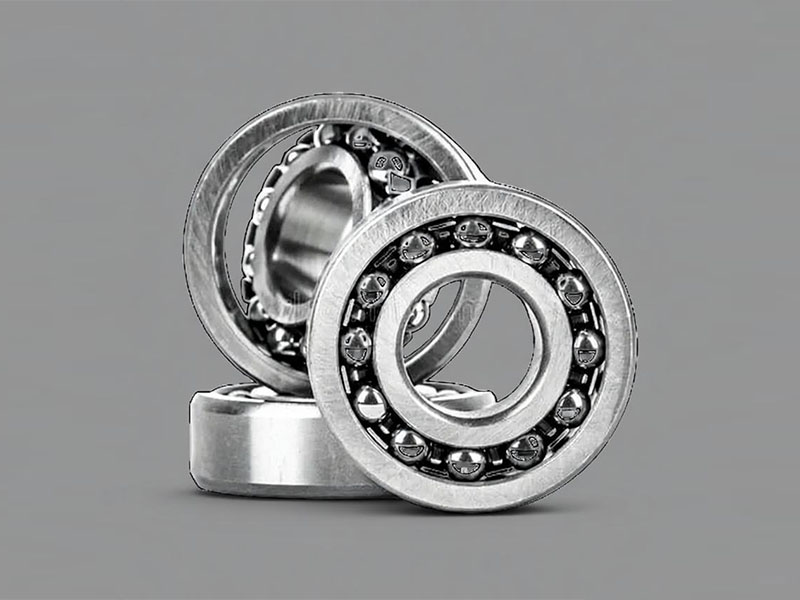
A standard deep groove ball bearing consists of four key components:
- Outer Ring: The large ring that fits into the housing.
- Inner Ring: The smaller ring that fits onto the rotating shaft.
- Balls (Rolling Elements): The spheres that separate the rings and carry the load. Their roundness is critical.
- Cage (Retainer): This component keeps the balls evenly spaced, preventing them from rubbing against each other and ensuring proper lubricant distribution.
- Seals/Shields: Optional but common, these protect the internal components from contaminants like dust and water while retaining grease.
2. The Step-by-Step Ball Bearing Manufacturing Process
The journey from raw steel to a finished bearing involves several sophisticated stages:
2.1 Material Selection (The Foundation)
Everything starts with high-quality steel. Most bearings are made from high-carbon chromium steel (such as GCr15, 100Cr6, or SUJ2). For corrosive environments, stainless steel (440C) is used. At DUHUI, we source steel with strict control over non-metallic inclusions, as impurities here can lead to premature fatigue failure later.
2.2 Forging & Cold Heading
For rings, the process often begins with forging. Hot steel is pressed into shape, creating a grain flow that follows the contour of the ring, which significantly enhances strength. For the balls themselves, a process called “cold heading” is used—wire is fed into a machine that hammers it into a spherical slug at room temperature.
2.3 Heat Treatment (The Core Strength)
Raw rings are relatively soft. To achieve the necessary hardness (typically 60-67 HRC), they undergo heat treatment. This involves:
- Austenitizing: Heating to a high temperature.
- Quenching: Rapid cooling to form a hard martensitic structure.
- Tempering: Reheating to a lower temperature to relieve internal stresses and improve toughness.
2.4 Precision Grinding
Heat treatment causes slight deformation. To restore precise geometry, the rings undergo grinding. Computer-controlled grinders shape the raceways (the grooves where the balls sit) to tolerances measured in microns—thinner than a human hair.
2.5 Super-finishing (Honing)
To achieve the mirror-like surface inside the raceways, we use a honing process. This removes the final microscopic peaks from the surface, drastically reducing friction and noise. A smoother surface also holds lubricant better.
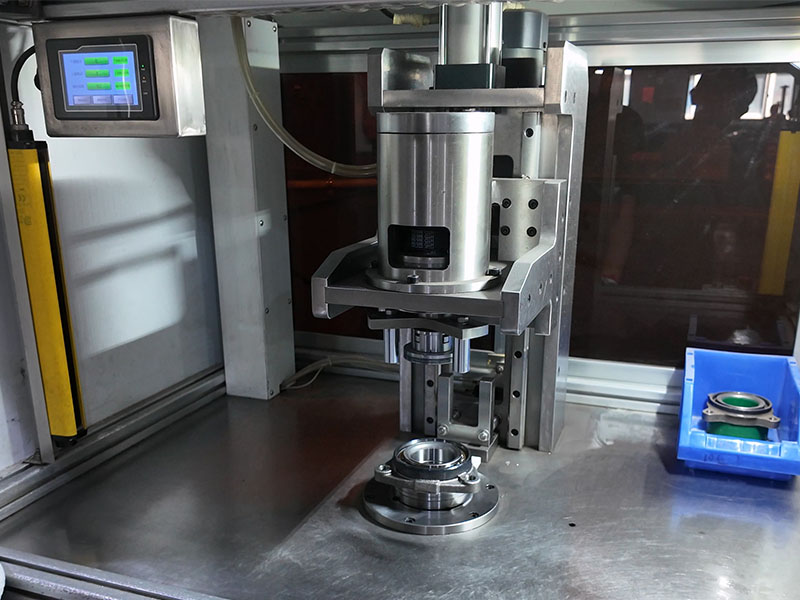
2.6 Assembly & Lubrication
The precision parts are brought together:
- Balls are inserted between the rings.
- The cage is riveted or snapped into place.
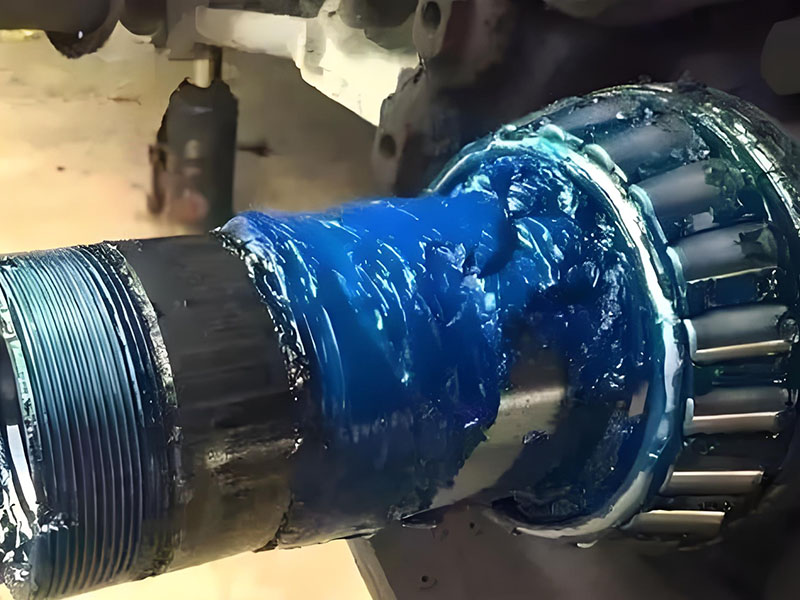
- A precise amount of grease is injected. Too little causes wear; too much causes overheating.
- Finally, the seals or metal shields are pressed in to lock the lubricant and keep contaminants out.
3. Stringent Quality Control & Testing Protocols
At DUHUI, we don’t just test bearings; we certify them. Every batch undergoes rigorous inspection to ensure it meets international standards.
- Dimensional Accuracy: Using air gauges and laser micrometers, we measure bore diameter, outer diameter, and width to ensure they fit perfectly in your assembly.
- Roundness & Runout: We measure the deviation from a perfect circle. High roundness is essential for high-speed applications.
- Surface Roughness Analysis: We verify the super-finishing quality of the raceways.
- Noise & Vibration (Anderson Testing): This is one of the most critical tests. Bearings are spun in a vibration meter to detect any irregularities. We classify bearings into grades (e.g., Z1, Z2, Z3) based on this test. A quieter bearing means a higher quality bearing.
- Hardness Testing: Ensuring the heat treatment process was successful.
- Non-Destructive Testing (NDT): Magnetic particle or eddy current testing is used to detect any subsurface flaws invisible to the naked eye.
- Durability Testing: We run bearings under simulated loads to predict their lifespan and ensure they meet our L10 life calculations.
4. Decoding Precision Grades: ABEC and ISO Standards
Not all bearings are created equal. The Annular Bearing Engineers Committee (ABEC) has established a scale to rate bearing precision.
- ABEC 1 & 3: Suitable for general applications where precision is less critical, such as some conveyor systems or simple agricultural equipment.
- ABEC 5: The standard for most automotive and industrial electric motors. This is where our core expertise lies.
- ABEC 7 & 9: Ultra-precision bearings used in machine tool spindles, aerospace instrumentation, and high-speed robotics.
As a manufacturer, DUHUI Bearing has the capability to produce across this spectrum, ensuring we match the right bearing to the right application.
5. Key Applications Across Industries
Our 20 years in the industry have taught us that context matters. Here is how bearings perform in different environments:
- Automotive Industry (Our Specialty): In wheel hub bearings, the design must handle both the weight of the car (radial load) and the forces of cornering (axial load). In transmissions, bearings must operate smoothly under varying speeds and oil temperatures.
- Industrial Machinery: Electric motors demand exceptionally quiet bearings to reduce overall machine noise. Precision machine tools require bearings with minimal runout to ensure the cutting tool produces perfect parts.
- Aerospace & Robotics: These sectors demand the highest reliability. Bearings here often require special materials and coatings to handle extreme temperatures or vacuum environments.
Conclusion
Understanding how bearings are manufactured helps you make better purchasing decisions. A bearing made with inferior materials or poor grinding will fail early, leading to costly downtime and repairs.
If you are looking for a partner who understands the intricacies of bearing manufacturing and can deliver consistent, high-quality products, contact DUHUI Bearing today to discuss your requirements or request a sample. We don’t just sell bearings; we provide reliability.