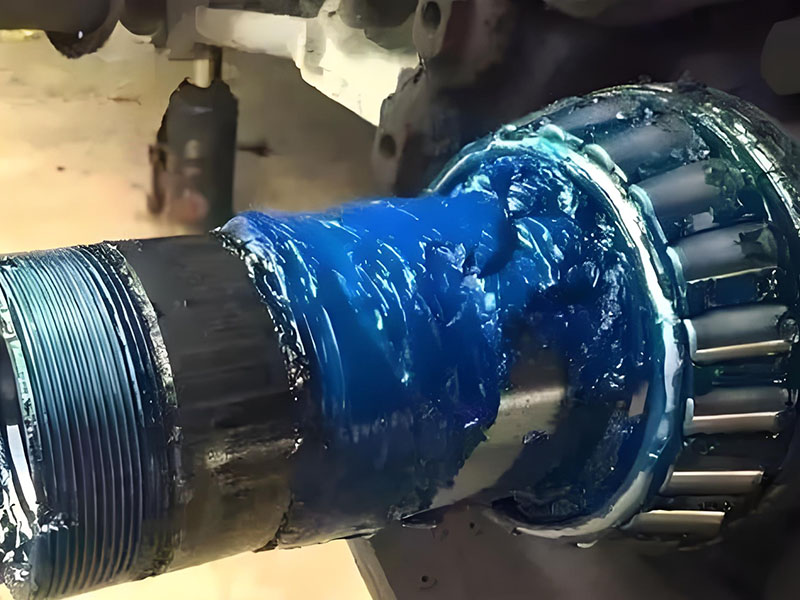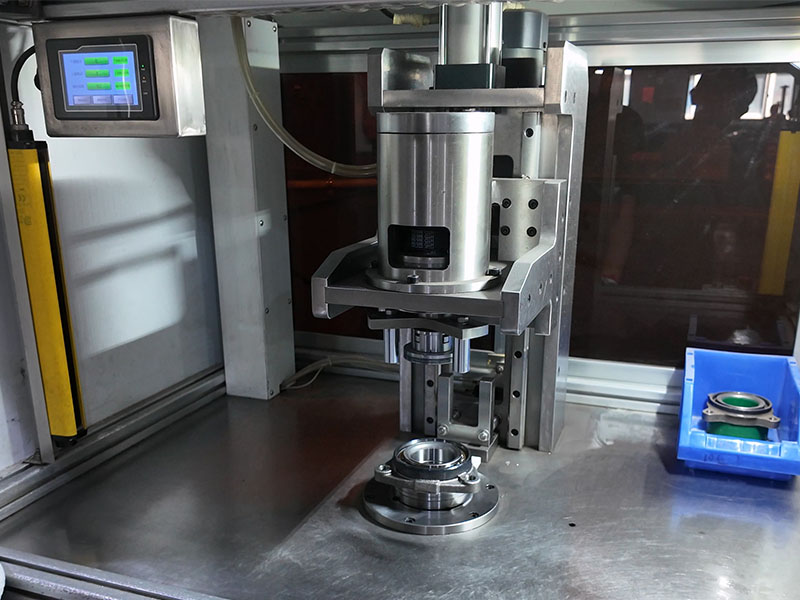
In rotating machinery, bearing preload refers to the intentional introduction of a constant internal load into a bearing assembly before the application of any external operational load. This technique eliminates internal clearance and generates an initial elastic deformation within the rolling elements and raceways. Applications requiring high rigidity and positional accuracy—such as precision machine tool spindles, automotive wheel hubs, and high-speed rotating equipment—commonly employ preloaded bearings. Readers new to this topic often ask: Why is preload necessary, and how does it differ from standard bearing mounting? DUHUI will address those questions by covering the definition, types, calculation methods, and practical procedures of bearing preload.
1. What Is Bearing Preload?
Bearing preload is defined as a compressive force applied to a bearing, either axially or radially, to remove the inherent internal clearance. In a standard unmounted bearing, small gaps exist between the rolling elements and the raceways. Under load, these gaps allow microscopic displacement, which can reduce system precision. Preloading ensures that rolling elements maintain constant contact with the raceways, even when external forces are minimal. This technique is used in applications where stiffness, vibration control, and rotational accuracy are critical. Common scenarios include high-speed spindles, automotive wheel bearings, and aerospace actuators.
2. Types of Bearing Preload
Preload can be applied in two principal directions, depending on the bearing type and operational requirements.
Radial Preload
Radial preload applies force perpendicular to the shaft axis, pressing the rolling elements against the raceways in the radial direction. This type is less common and typically used in specific designs such as cylindrical roller bearings with tapered bore or special internal geometry. Radial preload helps reduce radial runout and improve load distribution.
Axial Preload
Axial preload is applied parallel to the shaft axis. It is the most widely used form of preload, especially for angular contact ball bearings, tapered roller bearings, and thrust bearings. By pushing one bearing ring axially relative to the other, the rolling elements are forced into tighter contact, eliminating axial play. Axial preload significantly increases axial rigidity and is essential in machine tool spindles and automotive wheel hubs.
3. Methods of Applying Bearing Preload
Three common methods are used to achieve the desired preload level in bearing assemblies.
Spring Preload
A coil spring or wave spring exerts a constant axial force on the bearing outer ring. This method accommodates thermal expansion and minor misalignments, as the spring maintains preload even when components change length due to temperature variations. Spring preload is suitable for applications with varying operating temperatures, such as electric motor bearings.
Fixed-Position (Spacer or Shim) Preload
Ground spacers or precision shims of calculated thickness are placed between bearing rings or between the bearing and housing shoulders. This method creates a fixed axial displacement, producing a predictable preload. Fixed-position preload offers high stiffness and is commonly used in precision spindles and wheel hub assemblies. However, it is sensitive to thermal expansion; mismatched materials may alter preload at elevated temperatures.
Torque Preload (for Angular Contact Bearings)
In paired angular contact bearings (e.g., DB or DF arrangements), tightening the locknut to a specified torque induces a known axial preload. The torque–preload relationship is determined empirically and provided by bearing manufacturers. This method is often applied in high-speed spindles where assembly and disassembly are required.
4. Why Is Bearing Preload Important?
Applying the correct amount of preload delivers multiple performance benefits, but excessive preload can be detrimental. The following points explain both the advantages and the need for balance.
Preventing Bearing Misalignmen
Preload reduces the internal clearance that could otherwise allow rolling elements to skew or tilt under fluctuating loads. This maintains proper alignment between the shaft and housing.
Reducing Vibration and Noise
Elimination of internal clearance prevents rolling elements from impacting raceways during unloaded rotations. Lower vibration levels translate to quieter operation, which is especially valuable in automotive wheel bearings and precision machinery.
Enhancing Bearing Rigidity
Preloaded bearings exhibit higher stiffness because the initial elastic deflection requires greater force to produce further displacement. This improves machining accuracy in spindles and steering precision in vehicle wheel hubs.
Extending Bearing Life
Proper preload prevents skidding and sliding of rolling elements, which can cause adhesive wear (smearing). By promoting pure rolling motion, preload reduces localized stress and fatigue. However, excessive preload increases contact stress and friction, leading to premature fatigue and heat generation.
Preventing Overheating (Moderation Required)
A moderate preload prevents slip-induced heating. But if preload exceeds design limits, friction rises exponentially, causing overheating and lubricant degradation. Therefore, preload values must be calculated and verified carefully.
5. How to Calculate Bearing Preload
Several methods exist to determine the required preload. The following three are most common in engineering practice.
Axial Displacement Method
This method relies on the axial deflection vs. load relationship of the bearing, typically provided by the manufacturer. For a given target preload force Fₐ, the corresponding axial displacement δₐ is read from the bearing’s stiffness curve. The assembly is then adjusted to achieve that displacement. This approach is accurate but requires precise measurement instruments.
Spring Preload Calculation
When using a spring to apply preload, Hooke’s law applies:
F = k × Δx
where F is the desired preload force (N), k is the spring constant (N/mm), and Δx is the spring compression (mm). The designer selects a spring with suitable k and compresses it by Δx to generate F. This calculation assumes the spring operates within its linear elastic range.
Fixed Preload (Shim Thickness) Calculation
For fixed-position preload, the spacer or shim thickness is determined by the bearing’s internal geometry. After measuring the actual bearing width and housing dimensions, the required preload displacement δ (from manufacturer’s data) is used to calculate shim thickness:
Shim thickness = Measured gap − δ
The gap is measured when the bearings are mounted without preload. This method is widely used in mass production, such as in automotive wheel hub bearing units.
6. Typical Procedure for Applying Preload
The following steps outline a general process for applying axial preload using a fixed-position method (e.g., with shims or locknuts).
Step 1 – Initial Assembly
Mount the bearings onto the shaft and into the housing without any preload spacer. Ensure all components are clean and properly lubricated.
Step 2 – Apply Preload Force
Temporarily apply a known axial force (e.g., using a hydraulic press or torque wrench on a locknut) to bring the bearings into the desired preload condition. The force value is obtained from calculations or manufacturer tables.
Step 3 – Measure Displacement
Measure the axial displacement that occurred between the bearing faces or between the housing shoulder and the bearing outer ring. Dial gauges or laser displacement sensors provide accurate readings.
Step 4 – Final Adjustment
Based on the measured displacement, determine the exact thickness of a spacer or shim that will maintain that displacement after the temporary force is removed. For locknut methods, record the torque value.
Step 5 – Verification
Reassemble with the calculated spacer or torque. Measure running torque (bearing drag) or temperature rise during a test run. If values fall within expected ranges, the preload is correct. If not, disassemble and adjust.
7. Common Applications of Bearing Preload
Automotive Industry
Wheel hub bearings, especially those in driven wheels, use preload to reduce play and improve steering response. Tapered roller bearings in truck axles also require precise preload to handle combined radial and axial loads while maintaining low noise levels.
Aerospace
Aircraft engine main shafts, control surface actuators, and landing gear wheel bearings operate under extreme temperature and speed variations. Preload prevents skidding and maintains alignment, contributing to flight safety.
Machine Tools
High-speed spindles for milling, grinding, and drilling demand exceptional rigidity and minimal thermal growth. Angular contact ball bearings with fixed-position preload are standard in these applications. Even small preload deviations can affect surface finish and tool life.
Conclusion
Bearing preload is a deliberate and controlled method of removing internal clearance to enhance rigidity, reduce vibration, and improve rotational accuracy. The choice between radial or axial preload, as well as the selection of spring, fixed-position, or torque methods, depends on the application’s speed, load, and thermal conditions. While correct preload extends bearing life and prevents overheating, excessive preload produces the opposite effect. Engineers must calculate preload using displacement data, spring formulas, or shim thickness calculations, followed by verification through drag torque or temperature monitoring. Understanding these basics enables proper bearing specification in automotive, aerospace, and industrial machinery.