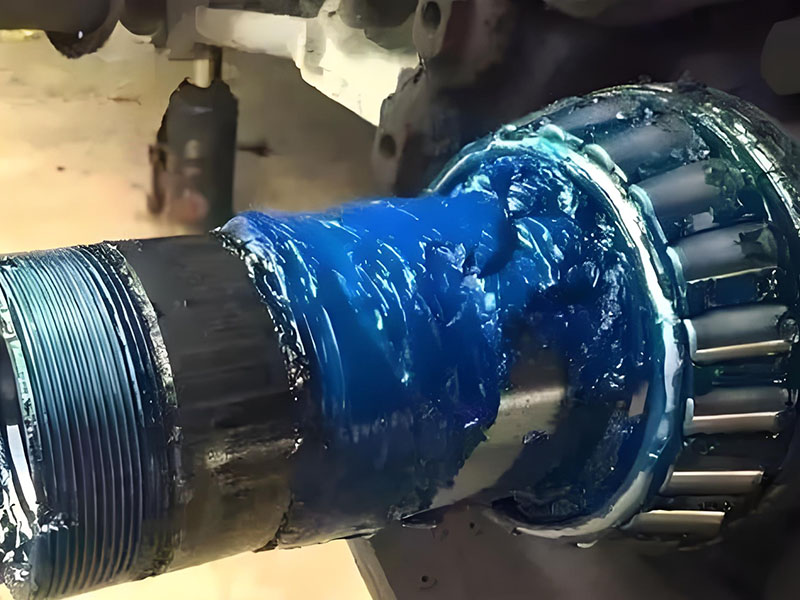
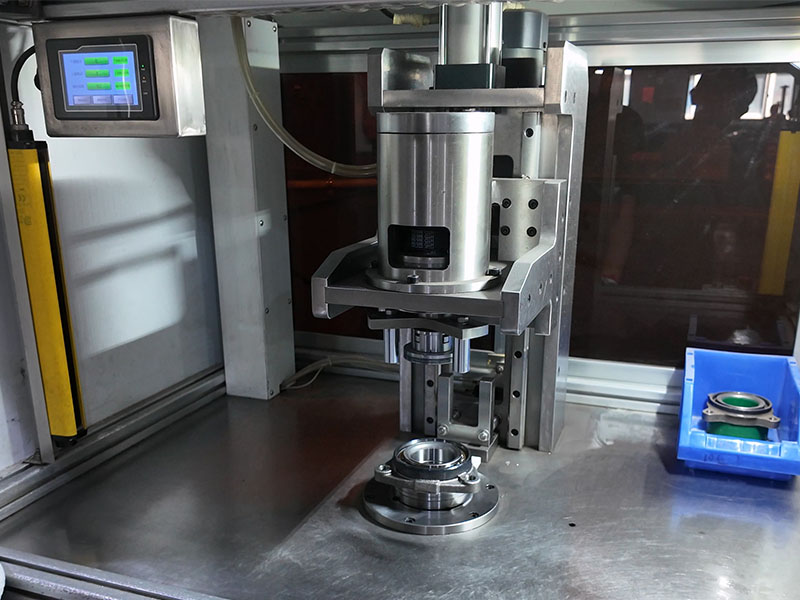
Rolling bearing wear is the progressive removal of material from bearing surfaces—raceways, rolling elements, or cages—caused by mechanical interaction under load. The four primary wear mechanisms in rolling bearings are abrasive wear, adhesive wear, fretting wear, and false brinelling. This article describes the operating conditions that trigger each wear type, outlines diagnostic methods for early detection, and provides structured guidance on grease selection to minimize wear-related failure.
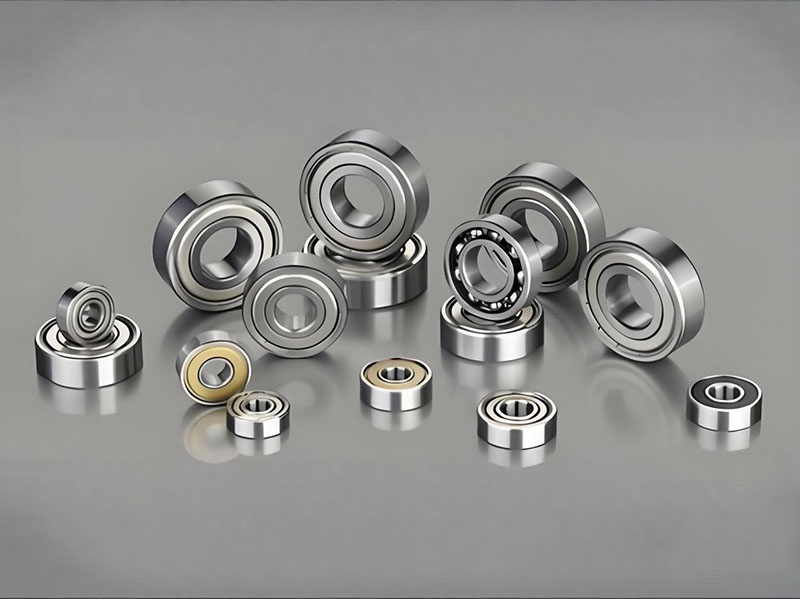
Types of Rolling Bearing Wear
Abrasive Wear
Abrasive wear occurs when hard particles—such as sand, metal fines, or process contaminants—enter the bearing and become trapped between rolling elements and raceways. These particles act as cutting agents, progressively removing material as the bearing rotates. In rolling bearing tribology, a distinction is drawn between two-body abrasion, where a fixed asperity plows the counter-surface, and three-body abrasion, where free particles roll and slide between surfaces. Prolonged abrasive wear eventually leads to surface fatigue or spalling as the damaged raceway topography accelerates crack initiation.
Key visible indicators include a high-lustre mirror-like finish on raceways, increased radial internal clearance, and—in advanced cases—visible scoring lines parallel to the rolling direction. Primary causes include inadequate sealing, improper housing cleaning prior to mounting, and ineffective lubricant filtration in circulation systems. Preventive measures focus on seal integrity, filtered lubricant supply, and the selection of greases with sufficient base oil viscosity to maintain an elastohydrodynamic film under operating load.
Adhesive Wear
Adhesive wear—often documented in bearing failure manuals as smearing or scuffing—results from direct metal-to-metal contact between the rolling elements and the raceways. When the lubricant film thickness falls below the composite surface roughness of the contacting bodies, microscopic junctions form and are immediately sheared, transferring material from one surface to another.
Visual signs include scoring, smeared streaks, or deposited material oriented along the sliding direction. Root causes typically include insufficient lubricant delivery, excessive mechanical loads that extrude the lubricant film, or rapid acceleration that disrupts film reformation. The primary countermeasure is maintaining a lubricant film of adequate thickness, achieved by selecting a grease with appropriate base oil viscosity and, for high-contact-stress applications, Extreme Pressure (EP) additives.
Fretting Wear and False Brinelling
Fretting wear develops at the interface of tightly fitted components—typically the bearing bore-shaft junction or housing-outer ring interface—under conditions of small-amplitude oscillatory motion. The micromotion generates wear debris that rapidly oxidizes, producing characteristic reddish-brown or black oxide deposits on the bearing’s outer diameter, bore, or face.
False brinelling, despite its name, is a subset of fretting wear rather than an impact indentation. It occurs when a stationary bearing is subjected to external vibration, which prevents the formation of a protective oil film, allowing rolling elements to wear shallow, polished depressions precisely spaced at the rolling element pitch. This mechanism is frequently observed in machinery transported over long distances by road or rail.
Prevention strategies require distinct approaches: For fretting, solutions include specifying tighter interference fits to limit micromotion, increasing shaft rigidity, and following precise mounting instructions. For false brinelling, the shaft should be securely locked during transport, and—for in-service applications—greases with robust anti-wear additive packages can provide a sacrificial boundary layer.
Diagnostic Methods for Bearing Wear
Modern condition monitoring enables detection of wear mechanisms before functional failure. Three complementary methods are widely deployed.
Visual and microscopic inspection remains the definitive method for failure analysis. Each wear type leaves a surface topography—polished depressions in false brinelling, reddish oxide stains in fretting, scoring lines in adhesive wear, and ground mirror finishes in abrasive conditions—that maps directly to the root cause.
Vibration analysis serves as an in-situ, non-invasive monitoring tool. As bearing wear progresses, it generates characteristic frequency signatures in the vibration spectrum. Specific frequency bands correspond to rolling element pass frequencies, cage rotation, and surface defects, allowing maintenance teams to schedule repairs before damage becomes critical.
Wear debris and oil analysis provides granular information about wear progression in real-time. The quantity, size distribution, morphology, and elemental composition of particles in the lubricant reveal not only what is wearing but also how rapidly and under what operating regime. In circulating oil systems, trended particle counts enable predictive maintenance without disassembly.
Lubricant Selection for Bearing Wear Prevention
Correct lubricant selection is the most effective engineering measure for mitigating bearing wear. For most rolling bearing applications, grease is preferred due to its relative simplicity, sealing properties, and ability to stay in place over extended intervals.
Grease Composition Parameters
A grease functions through three co-dependent components:
- Base oil – Forms the load-bearing film. Viscosity is the single most important property; higher viscosity for larger bearings, lower for high-speed operation.
- Thickener – Holds base oil, acts as reservoir. Lithium complex (general purpose), polyurea (high temperature), calcium sulfonate (water resistance).
- Additives – Chemically protect surfaces. EP (Extreme Pressure) for high load, AW (Anti-Wear) for boundary regimes, corrosion inhibitors, oxidation inhibitors.
- NLGI grade – Consistency. NLGI 2 is standard; NLGI 1 or 0 for centralized systems.
Application-Based Selection
The following table summarizes engineering decisions for grease selection:
| Application Parameter | Selection Consideration |
|---|---|
| Bearing geometry | Ball bearings (point contact) are less demanding; roller bearings (line contact) require higher base oil viscosity (ISO VG 150–460) and often EP additives. |
| Operating speed | High speed → lower viscosity base oil to reduce viscous drag and operating temperature. |
| Operating temperature | Continuous >80–100°C → synthetic base oils (PAO, esters) to prevent oxidation; thickener with elevated dropping point. |
| Mechanical load | High static/dynamic loads → high-viscosity base oil to maintain film thickness; EP additives. |
| Environmental conditions | Water washout exposure → calcium sulfonate thickener with strong corrosion resistance; food contact → NSF H1-registered grease. |
| Relubrication interval | Application-specific, based on bearing size, speed, and operating temperature; condition monitoring data (vibration, ultrasound, temperature) should guide schedules. |
Conclusion
Rolling bearing wear is not a single failure mechanism but a family of distinct damage modes—abrasive, adhesive, fretting, and false brinelling—each requiring specific preventive measures. Regular visual inspection, vibration monitoring, and wear debris analysis enable early detection and intervention. Proper grease selection—considering base oil viscosity, NLGI grade, thickener type, and application-specific additive packages—remains the most effective strategy for extending bearing service life.
Frequently Asked Questions
Q1: What are the most common types of rolling bearing wear?
A1: The four principal wear mechanisms are abrasive wear (caused by hard particle contamination), adhesive wear or smearing (metal-to-metal contact due to lubricant film collapse), fretting wear (micromotion at fitted interfaces), and false brinelling (vibration-induced wear in stationary bearings).
Q2: How can field engineers distinguish between false brinelling and true brinelling?
A2: False brinelling produces polished, wear-like depressions with no material displacement, whereas true brinelling results in plastic indentations caused by impact overload or excessive static loading. False brinelling involves progressive material loss; true brinelling is a surface indentation without material removal.
Q3: What NLGI grade is standard for rolling bearing grease?
A3: NLGI 2 is the industry standard for most ball and roller bearings. NLGI 1 or 0 may be specified for centralized lubrication systems where pumpability is required. NLGI 3 is sometimes selected for high-temperature or high-vibration applications where greater consistency is desired.
Q4: How does operating temperature affect grease selection for bearing wear prevention?
A4: At continuous operating temperatures above 80–100°C, conventional mineral oils oxidize rapidly. Synthetic base oils (PAO, ester, or polyglycol) maintain viscosity and resist thermal degradation. The thickener must also have a dropping point at least 30–50°C above the maximum operating temperature.
Q5: Can greases with different thickener types be mixed in a bearing?
A5: Mixing greases with incompatible thickeners (e.g., lithium complex with polyurea) can cause softening, hardening, or oil separation, leading to lubrication failure. When changing grease types, the bearing and housing should be thoroughly cleaned before applying the new lubricant.
Q6: What is the typical relubrication interval for a rolling bearing operating under normal conditions?
A6: Relubrication intervals depend on bearing bore diameter, rotational speed, operating temperature, and environmental cleanliness. General formulas (e.g., SKF or FAG relubrication calculators) provide baseline estimates. Condition monitoring using vibration or ultrasound can extend intervals safely by confirming grease condition.
Q7: What are the critical parameters for selecting a bearing grease for a roller bearing application?
A7: The four critical parameters are base oil viscosity (ISO VG 150–460 for roller bearings), NLGI grade (typically 2), thickener type (lithium complex for general duty, polyurea for high temperature, calcium sulfonate for water resistance), and additive package (EP additives for high load or shock conditions). Each parameter interacts with bearing size, rotational speed, and operating temperature.