Flat bearings, also known as thrust plain bearings or axial sliding bearings, are mechanical components designed to support loads parallel to the axis of a rotating shaft. Unlike radial bearings that support perpendicular forces, flat bearings primarily manage axial thrust while facilitating smooth rotational or sliding motion between two surfaces. This article provides a comprehensive overview of flat bearings, covering their types, functions, advantages, applications, and maintenance practices. Whether you are selecting bearings for automotive, industrial, or power generation equipment, understanding these fundamentals will guide informed decision-making.
What is a Flat Bearing?
A flat bearing is a type of plain bearing (also referred to as a sliding bearing) that utilizes two flat surfaces sliding against each other to support axial loads and restrict axial movement of a shaft. In the context of bearing engineering, the term “flat bearing” typically refers to thrust bearings with flat raceways or sliding surfaces, as opposed to grooved, tapered, or tilting-pad designs.
Unlike rolling element bearings such as ball or roller bearings, which use rolling elements to separate moving parts, flat bearings operate on the principle of sliding friction. A shaft rotates within a stationary bearing surface, with a lubricant film—oil, grease, or solid lubricant—separating the two surfaces to minimize friction and wear. This sliding mechanism allows flat bearings to handle substantial axial loads in a compact form factor.
Flat bearings are distinct from radial bearings in that their load‑bearing surfaces are oriented perpendicular to the shaft axis, making them specifically suited for thrust load applications. They are widely used in automotive transmissions, industrial pumps, agricultural machinery, and turbine systems where axial force management is critical.
Functions of Flat Bearings
Flat bearings serve several essential functions in mechanical systems:
- Support axial loads. The primary function of a flat bearing is to accommodate axial thrust—forces acting parallel to the shaft’s axis. This includes supporting the weight of rotating components and counteracting forces generated during operation, such as those in a propeller shaft or turbine rotor.
- Reduce friction and wear. By providing a low-friction sliding interface between moving parts, flat bearings minimize energy loss and prolong component life. A properly lubricated flat bearing reduces direct metal-to-metal contact, preventing rapid wear and surface damage.
- Provide positioning and guidance. Flat bearings help maintain precise axial positioning of shafts, preventing excessive endplay or axial movement that could disrupt machinery operation. In applications such as machine tool spindles, accurate positioning is essential for maintaining tolerances.
- Assist in heat dissipation. Frictional heat generated during operation is carried away by the lubricant flowing across the bearing surface. Grooved or pocketed designs improve heat removal, which is particularly important in high-speed or high-load applications where temperature management directly affects bearing life.
Types of Flat Bearings
Flat bearings are available in several configurations, each suited to specific operating conditions. The selection of a particular type depends on factors such as load magnitude, rotational speed, lubrication method, and environmental constraints.
Flat plate thrust bearing. This is the simplest type, consisting of two flat plates—one stationary and one rotating—that slide directly against each other. The stationary plate often incorporates radial grooves for oil distribution. While straightforward and cost‑effective, this design has limited load capacity and is primarily used in light‑duty applications such as positioning or sealing.
Grooved flat bearing. Grooves are machined into the sliding surfaces to improve lubricant distribution and enhance load‑carrying capacity. Common groove patterns include radial, spiral, and herringbone designs. Under proper lubrication, grooved flat bearings can achieve significantly higher load capacity compared to flat plate designs.
Stepped / tapered-land thrust bearing. This design features a series of segments with a flat land extending from the trailing edge of each pad. The stepped geometry creates converging wedges that generate hydrodynamic pressure during rotation, improving load capacity. Tapered‑land bearings are commonly found in mid‑ to large‑sized high‑speed machinery such as turbines, compressors, and pumps.
Tilting pad thrust bearing. Comprising multiple independently pivoted pads that automatically adjust their angle relative to the rotating thrust collar, tilting pad bearings maintain an optimal oil wedge across varying speeds and loads. This design offers superior stability, high load capacity, and wide operating speed range. They are the standard choice for large thrust bearings in hydroelectric generators, marine propulsion systems, and industrial compressors.
Self-lubricating / maintenance‑free flat bearing. These bearings incorporate solid lubricants—typically PTFE (polytetrafluoroethylene) or other polymer composites—into the bearing material, eliminating the need for external lubrication. Self‑lubricating flat bearings are particularly suitable for applications where maintenance access is difficult, where contamination from liquid lubricants must be avoided, or where intermittent operation occurs.
Advantages of Flat Bearings
Flat bearings offer several distinct advantages that make them a preferred choice for many engineering applications:
- Simple construction. Flat bearings consist of relatively few components—typically a bearing pad (or thrust disc) and a housing. This simplicity translates to lower manufacturing costs, easier installation, and fewer potential points of failure compared to rolling element bearings.
- High load capacity. Despite their compact size, flat bearings can handle substantial axial loads. The load‑carrying capacity is determined by the bearing’s projected area, material properties, and lubrication conditions. Basic load ratings, including dynamic (Cr / Ca) and static (C0r / C0a) values, are key specifications that vary by manufacturer and must be matched to application requirements.
- Low maintenance. Many flat bearings, particularly those with self‑lubricating materials, require minimal routine maintenance. Even conventional lubricated flat bearings have fewer moving parts than rolling bearings, reducing inspection and servicing frequency.
- Quiet operation. The sliding contact of flat bearings produces significantly less noise than rolling element bearings, making them suitable for noise‑sensitive environments such as medical imaging equipment, office machinery, and residential appliances.
- Compact design. Flat bearings occupy minimal axial space compared to thrust ball or roller bearings of equivalent load capacity. This space‑saving characteristic is valuable in applications with tight packaging constraints.
Applications of Flat Bearings
Flat bearings are employed across a diverse range of industries, each with specific performance requirements.
Automotive industry. Flat bearings are found in transmissions, clutches, differentials, and suspension systems. In steering systems, they support steering column rotation for smooth and flexible vehicle control. In braking systems, flat bearings support brake disc rotation to enable safe and effective braking. Engine applications include crankshaft thrust washers, camshaft thrust plates, and transmission thrust bearings—all of which reduce friction and manage axial movement under high loads.
Industrial machinery. Conveyor systems, pumps, mixers, and rotating machinery rely on flat bearings to support axial loads and ensure reliable operation under continuous use. Their low maintenance requirements contribute to reduced downtime and improved operational efficiency.
Agriculture equipment. Tractors, combine harvesters, and other agricultural machinery employ flat bearings for their load‑bearing capabilities in demanding field conditions, where exposure to dirt, moisture, and vibration is common.
Aerospace. Aircraft landing gear systems and control surfaces utilize flat bearings where precision and reliability are critical. Self‑lubricating designs are particularly valued in aerospace applications due to their predictable performance and elimination of lubricant‑related contamination risks.
Medical equipment. The low friction and quiet operation of flat bearings make them suitable for medical devices such as MRI and CT imaging machines, robotic surgical systems, and patient handling equipment where noise reduction and smooth motion are essential.
Power generation. Turbines, generators, and hydroelectric facilities use flat bearings—particularly tilting pad and tapered‑land designs—to manage axial shaft movements during high‑speed rotation. In hydropower applications, self‑lubricating flat bearings are increasingly used in guide vanes and turbine runners, offering resistance to water, dirt, and UV exposure.
Railway industry. Flat bearings are used in railway axle boxes, traction motor mounts, and braking systems where they withstand heavy axial loads and shock loading while maintaining reliable operation over extended service intervals.
Lubrication and Maintenance
Proper lubrication and regular maintenance are essential to maximizing flat bearing service life and preventing premature failure.
Importance of Lubrication
Lubrication serves three critical functions in flat bearings. First, it separates the sliding surfaces with a fluid film (oil, grease, or solid lubricant), preventing direct metal‑to‑metal contact that leads to rapid wear. Second, it dissipates frictional heat generated during operation, preventing thermal damage to bearing materials. Third, it flushes away wear debris and contaminants that could otherwise embed in the bearing surface and accelerate deterioration.
Lubrication Methods
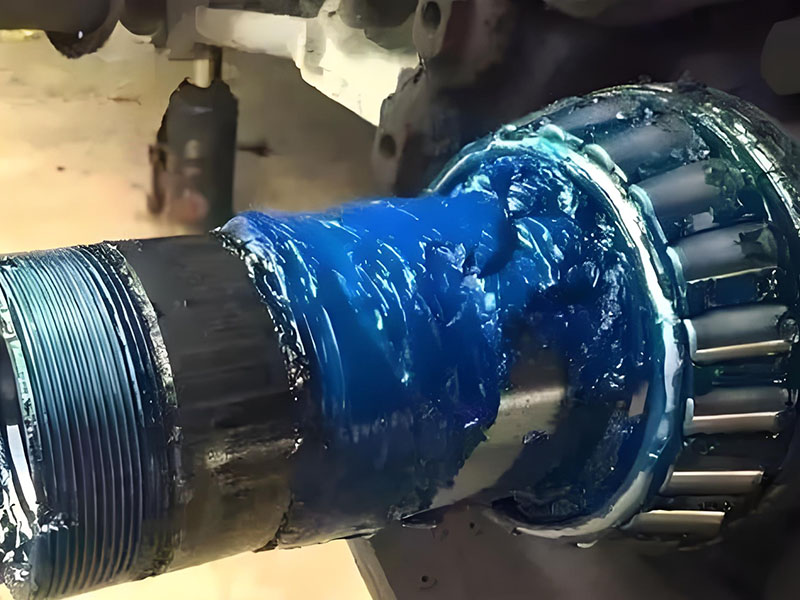
Flat bearings can be lubricated using several approaches. Oil lubrication is the preferred method for high‑speed applications, with oil circulated through grooves or supplied via pressure systems. Grease lubrication offers better sealing and longer retention, making it suitable for moderate‑speed applications and environments where oil leakage is undesirable. Solid lubrication, using materials such as PTFE or graphite embedded in the bearing, provides maintenance‑free operation for intermittent or low‑speed applications where liquid lubricants are impractical. As a general guideline: oil for high speed, grease for moderate speed and easy sealing, and solid lubricants for maintenance‑free or vacuum environments.
Monitoring and Troubleshooting
Regular monitoring helps detect potential issues before they lead to bearing failure. Key indicators to observe include operating temperature (sudden increases suggest lubrication degradation or excessive loading), noise and vibration (unusual sounds may indicate surface damage or misalignment), and visual inspection (discoloration, scoring, or pitting on bearing surfaces).
Common causes of flat bearing failure include metal fatigue, misalignment, localized rapid wear, and trapped dirt forming grooves in the bearing components. Poor lubrication—whether insufficient lubricant or use of incorrect lubricant—can cause rapid wear concentrated in one spot until the surface completely breaks down.
Preventive Maintenance Practices
To extend flat bearing service life, implement these preventive measures: regularly check lubricant levels and replenish as needed, using the type and viscosity specified by the bearing manufacturer; clean bearing surfaces periodically to remove contaminants before they embed; avoid overload conditions that exceed the bearing’s rated load capacity; conduct periodic inspections for signs of wear, misalignment, or damage; and replace bearings showing significant wear rather than attempting continued operation. Following proper installation procedures—including cleaning bearing and housing surfaces before mounting—is also critical for preventing premature failure.
Conclusion
Flat bearings are fundamental mechanical components that support axial loads while enabling smooth rotational or sliding motion. Their simple construction, high load capacity, low maintenance requirements, and quiet operation make them indispensable across industries ranging from automotive and industrial machinery to aerospace and power generation. Understanding the various types—from basic flat plate designs to sophisticated tilting pad configurations—allows engineers to select the optimal bearing for specific operating conditions. Proper lubrication and regular monitoring are essential for maximizing service life and preventing common failure modes such as wear, misalignment, and contamination. Whether in a vehicle transmission, a medical imaging system, or a hydroelectric turbine, flat bearings continue to provide reliable performance in demanding applications worldwide.
Frequently Asked Questions (FAQs)
Q1: What is the difference between a flat bearing and a thrust bearing?
A1: These terms are largely synonymous. “Flat bearing” typically emphasizes the flat sliding surfaces of the bearing, while “thrust bearing” specifies the bearing’s function of supporting axial (thrust) loads. Most flat bearings are thrust bearings, and most thrust bearings with flat raceways can be described as flat bearings.
Q2: Can flat bearings be used without lubrication?
A2: Yes, self‑lubricating flat bearings incorporate solid lubricants such as PTFE or graphite into the bearing material, enabling operation without external oil or grease. However, conventional metal‑on‑metal flat bearings require proper lubrication to prevent rapid wear and failure. For dry or intermittent applications, polymer‑based self‑lubricating bearings are often the preferred solution.
Q3: What materials are used for flat bearings?
A3: Common materials include bronze and brass alloys for conventional lubricated bearings; PTFE‑based composites and polymers for self‑lubricating applications; steel with Babbitt lining for high‑load hydrodynamic bearings; and advanced ceramics for extreme temperature or corrosive environments. Material selection depends on load, speed, temperature, and lubrication conditions.
Q4: How to choose the right flat bearing for an application?
A4: Consider the following factors: magnitude and direction of axial load, rotational speed, available lubrication method, operating temperature range, environmental conditions (moisture, contaminants, chemicals), space constraints, and required service life. For high‑speed applications, grooved or tilting pad designs are generally preferred. For low‑speed, heavy‑load conditions, flat plate or stepped bearings may suffice. For maintenance‑limited installations, self‑lubricating bearings are recommended.
Q5: What causes flat bearing failure?
A5: Common causes include insufficient or incorrect lubrication, misalignment between shaft and bearing surfaces, overloading beyond rated capacity, contamination from dirt or debris, metal fatigue from cyclic loading, and improper installation. Poor lubrication is the most frequent cause, often appearing as localized rapid wear leading to surface breakdown.
Q6: How often should flat bearings be lubricated?
A6: Lubrication intervals depend on bearing type, operating speed, load, and environment. Self‑lubricating bearings require no routine lubrication. For conventional oil‑lubricated bearings, intervals range from daily for high‑speed or heavily loaded applications to monthly or quarterly for moderate duty. Grease‑lubricated bearings typically require relubrication every 2,000 to 5,000 operating hours. Always follow the bearing manufacturer’s specifications and monitor operating temperature and noise as indicators of lubrication condition.