Motor bearings are among the most stressed components in electric motors. Users frequently search for answers: How often should motor bearings be regreased? What is the difference between a sealed and shielded bearing? Why does a VFD motor suffer bearing fluting? DUHUI will provide detailed, technical answers to these questions. It covers motor bearing definitions, load types, material options, failure diagnostics, and maintenance procedures. The information is based on ISO standards and bearing manufacturers’ technical data. Whether you specify bearings for a 0.5 kW fan motor or a 500 kW industrial pump, we will help you select and maintain the correct bearing.
What Are Motor Bearings?
Definition
A motor bearing is a precision mechanical component that supports the motor shaft, allows it to rotate with minimal friction, and maintains proper alignment between the rotor and stator. Bearings are mounted in the motor end shields or housing.
Load Types Handled by Motor Bearings
- Radial Load: Acts perpendicular to the shaft axis. For a horizontal motor, the rotor weight and belt tension create radial loads. Example: A 30 kW induction motor with a pulley drive may impose 800–1200 N radial load on the drive-end bearing.
- Axial Load (Thrust Load): Acts parallel to the shaft axis. Vertical motors (e.g., well pumps) or motors with helical gears generate axial loads. Axial capacity depends on bearing contact angle (e.g., 15° or 40° for angular contact bearings).
Typical Applications
- Industrial motors: Pumps, fans, compressors, conveyors (bearing sizes 6204 to 6312 common).
- Automotive motors: Starter motors (needle roller bearings), alternators (small deep groove bearings 6201–6203), EV traction motors (high-speed ceramic hybrids).
- Home appliances: Washing machine motors (self-aligning or deep groove), HVAC fan motors (sealed 608 or 6202).
The Main Functions of Motor Bearings
- Reducing Friction: Rolling friction coefficient of steel bearings is 0.001–0.002, compared to 0.05–0.15 for sliding bearings. This reduces power loss and heat.
- Supporting Loads: Bearings transmit forces from the shaft to the motor frame without plastic deformation. The dynamic load rating C (kN) defines the load that yields 1 million revolutions of life.
- Enabling Precision: Radial runout of a P0 (ABEC 1) bearing is typically ≤ 10 μm. For precision motors (e.g., spindle motors), P5 or P6 grades with ≤ 5 μm runout are used.
Types of Motor Bearings
Ball Bearings
Ball bearings are the first choice for motors from 0.1 kW to 200 kW due to low friction and high speed capability.
- Deep Groove Ball Bearings
Structure: Single-row, uninterrupted raceways. Available with snap ring grooves for axial location.
Common series: 60xx, 62xx, 63xx (e.g., 6204 for 1.5 kW motor; 6308 for 15 kW motor).
Load capacity: Radial loads up to C = 10–60 kN depending on size. Moderate axial load up to 0.5× radial load.
Applications: General-purpose electric motors, fans, pumps. - Angular Contact Ball Bearings
Contact angles: 15° (C), 25° (AC), 40° (B). Higher angle = greater axial capacity.
Usually mounted in pairs (DB back-to-back or DF face-to-face) to absorb bidirectional axial loads.
Applications: Pump motors with heavy thrust, vertical motors, servo motors. - Self-Aligning Ball Bearings
Outer ring raceway is spherical, allowing 2–3° misalignment between shaft and housing.
Applications: Long-shaft motors, woodworking machinery, or motors with flexible frames.
Roller Bearings
Roller bearings are specified when deep groove ball bearings cannot handle the required radial load or when shock loads exist.
- Cylindrical Roller Bearings
Separable design: inner ring with rollers can be removed from outer ring, simplifying assembly.
High radial capacity: For the same bore diameter (e.g., 65 mm), a cylindrical roller bearing (NU213) has C≈ 95 kN vs. a deep groove ball bearing (6213) C≈ 55 kN.
Applications: Large industrial motors (> 100 kW), traction motors, rolling mill drives. - Needle Roller Bearings
Very small cross-section (needle rollers with length/diameter ratio > 4).
Applications: Automotive starter motors (where space is limited), small DC motors. - Tapered Roller Bearings
Combined load capacity: Can handle high radial and high axial loads simultaneously.
Single row bearings accept axial load in one direction; two rows for bi-directional.
Applications: Heavy-duty conveyor motors, hoist motors, some EV gearbox-integrated motors.
Motor Bearing Materials & Cage Options
Bearing Rings & Rolling Elements
| Material | Characteristics | Typical Motor Use |
|---|---|---|
| Chrome steel (GCr15 / 100Cr6) | Hardness 60–64 HRC, good fatigue life | Standard motors, –20°C to +120°C |
| Stainless steel (440C / X65Cr13) | Corrosion resistance, lower load capacity | Motors in humid or washdown environments |
| Silicon nitride (Si3N4) hybrid | Electrical insulation, lower friction, higher speed | VFD motors > 10 kW, high-speed spindles |
Cages (Retainers)
- Stamped steel: Economic, suitable for temperatures up to 150°C. Common in 62xx and 63xx series.
- Machined brass: High strength, can tolerate misalignment and high acceleration. Used in large motors or high-vibration environments.
- Polyamide (PA66): Lightweight, quiet, but maximum continuous temperature 120°C. Do not use in motors with frequent hot restarts.
Sealed, Shielded & Open Motor Bearings
| Closure Type | Code | Protection | Friction | Grease Retention | Best For |
|---|---|---|---|---|---|
| Double contact seal (rubber) | 2RS | IP54 equivalent, prevents dust and water spray | High (adds 30–50% friction torque) | Excellent | Outdoor motors, agricultural equipment, dusty factories |
| Metal shield (non-contact) | ZZ / 2Z | Stops particles > 50 μm, no liquid seal | Low (adds <5% friction) | Good | Indoor motors, fans, pumps in clean environments |
| Open | – | None | Lowest | N/A (requires external lubrication system) | Motors with oil mist lubrication or sealed housings |
Practical advice: For general-purpose motors up to 30 kW in indoor conditions, ZZ shields are preferred. For motors with unknown maintenance or dusty locations, use 2RS seals, but expect a 5–10°C higher operating temperature.
Common Motor Bearing Failure Indicators
Excessive Vibration
Causes: Brinelling (false or true), raceway waviness, imbalance, looseness.
Detection: ISO 10816-3 vibration severity. For a 15 kW motor, velocity > 2.8 mm/s RMS indicates bearing degradation.
Noise
Sound levels: EMQ bearings are tested for noise (V2, V3, V4 grades). Grinding noise = lubrication failure. Squealing = insufficient radial clearance or misalignment. Rumbling = raceway fatigue or pitting.
Use an electronic stethoscope to compare with a known-good bearing.
Overheating
Maximum allowed temperature for standard grease: 100°C (bearing ring). If housing temperature exceeds 80°C, investigate.
Overheating causes: over-greasing (churning), under-greasing (metal contact), excessive preload, wrong clearance.
Stiffness or Roughness
Rotate the shaft by hand after motor cool-down. Any “gritty” feeling suggests debris contamination or corrosion.
Motor Bearing Maintenance & Lubrication
Regular Inspection Schedule
- Monthly: Listen for abnormal noise, measure housing temperature with infrared gun.
- Quarterly: Measure vibration velocity. Record baseline at installation.
Bearing Lubrication – Detailed
For grease-lubricated motor bearings, follow these steps:
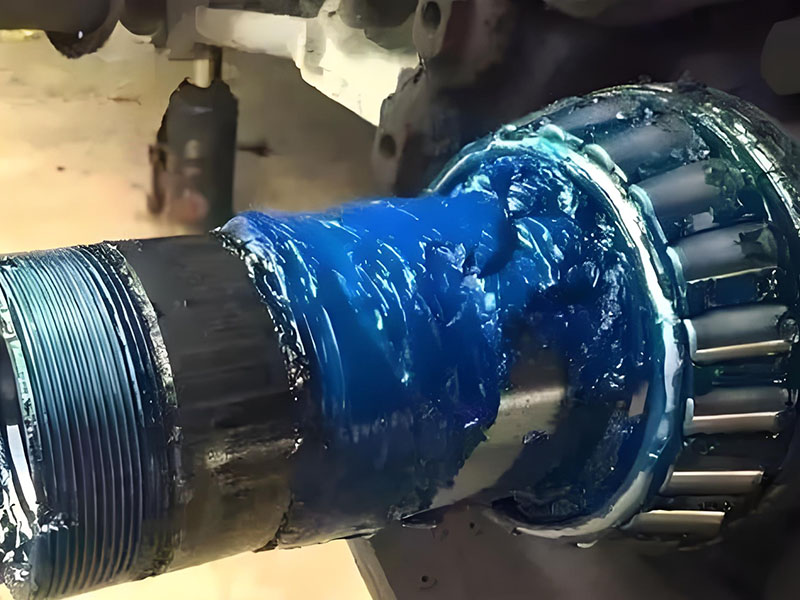
- Relubrication interval: In practice, for a typical 1500 rpm motor with a 40 mm bore bearing, regrease every 4000 operating hours or every 6 months, whichever comes first. For higher speeds or higher temperatures (>70°C), reduce the interval by half.
- Grease quantity (g) = 0.005 × bearing outside diameter (mm) × width (mm).
Example: Bearing 6205 (OD=52mm, width=15mm) → 0.005×52×15 ≈ 3.9 grams.
Grease selection by temperature
| Bearing Temperature | Recommended NLGI Grade | Base Oil Viscosity (40°C) | Example Products |
|---|---|---|---|
| -20 to 80°C | 2 (lithium) | 100–150 cSt | Mobil Polyrex EM, Shell Gadus S2 |
| 80–120°C | 2 or 3 (polyurea) | 150–220 cSt | Mobil Polyrex EM (same), Kluber Isoflex |
| 120–150°C | 2 (synthetic, PTFE) | 300 cSt | DuPont Krytox, Molykote BG20 |
Temperature Monitoring
Install a PT100 sensor in the bearing housing. A sudden 15°C rise above steady-state baseline indicates a problem.
Alignment
Shaft-to-motor misalignment > 0.05 mm causes additional axial load and heat. Use laser alignment tools.
Contamination Control
- Keep new bearings in unopened packages until installation.
- Use clean gloves; do not wash out factory grease unless specified.
- For open bearings, use a clean assembly area with air filtration.
Motor Bearing Life & Load Rating Basics
The basic rating life L10 (hours) = (C/P)³ × (10⁶ / (60 × n)) for ball bearings, where:
- C = dynamic load rating (from bearing catalog, in kN)
- P = equivalent dynamic bearing load (in kN)
- n = rotational speed (rpm)
Example: A 6308 deep groove ball bearing (C = 40.5 kN) in a 15 kW motor running at 2900 rpm, with radial load P = 5 kN.
L10 = (40.5/5)³ × 10⁶ / (60×2900) ≈ 531 × 10⁶ / 174000 ≈ 3050 hours.
This is relatively short; for long life, select a larger bearing or reduce load.
For most industrial motors, design target L10 life is 20,000–50,000 hours.
Quick Selection Guide for Motor Bearings
| Motor Type | Speed | Load Condition | Recommended Bearing | Sealing |
|---|---|---|---|---|
| General-purpose, 0.5–30 kW, horizontal | 1500–3000 rpm | Moderate radial | Deep groove ball (62xx or 63xx) | ZZ / 2Z |
| Pump motor, vertical | 1500 rpm | High axial + radial | Angular contact pair (back-to-back) | 2RS |
| VFD motor > 10 kW | Variable, up to 6000 rpm | Electrical risk | Hybrid ceramic (Si3N4 balls) | ZZ or open with grounding |
| Heavy duty conveyor | 1000 rpm | High radial shock | Cylindrical roller (NU series) | Open with oil bath |
| Automotive starter | Intermittent, high torque | Compact space | Needle roller + deep groove | Open (integrated) |
Frequently Asked Questions (FAQs)
Q1: How long should motor bearings last in normal service?
With proper lubrication and contamination control, 40,000 operating hours or 5–7 years is typical. VFD motors may see shorter life due to electrical fluting.
Q2: Can I replace a sealed bearing with a shielded one?
Yes, but only if the motor operates in a clean, dry environment. Sealed bearings offer better protection but higher friction.
Q3: What is the most common mistake when greasing motor bearings?
Over-greasing. Excess grease causes churning, temperature rise, and eventual seal damage. Follow the calculated quantity.
Q4: How do I select the right internal clearance (C3, C4)?
Use CN (normal) for motor temperatures below 70°C and normal fits. Use C3 for temperatures >70°C, interference fits on the inner ring, or high-speed motors (>3600 rpm).
Q5: What is bearing fluting and how to prevent it?
Fluting is electrical discharge machining (EDM) damage on raceways of VFD-driven motors. Prevention: hybrid ceramic bearings (insulated) or shaft grounding rings.
Q6: Are stainless steel motor bearings necessary?
Only when motors are regularly washed down (food industry) or operate in high humidity (>90%) without enclosure protection.
Q7: What does “EMQ” mean on a bearing label?
Electric Motor Quality. EMQ bearings meet low noise and low vibration standards (V2, Z2 or better). Most 62xx and 63xx series bearings are manufactured to EMQ standard.
Q8: Can I mix different greases in a motor bearing?
No. Incompatible thickeners (lithium vs. polyurea) can cause softening, oil separation, and failure. Flush out old grease before changing type.
Q9: How should I store unused motor bearings?
Keep horizontally in original packaging, temperature 10–30°C, humidity <65%. Shelf life for greased bearings: 2–3 years.
Q10: Why does my motor bearing make noise only when cold?
Insufficient radial clearance (CN instead of C3) or grease with high base oil viscosity at low temperatures. Switch to C3 clearance and a lower-viscosity grease.
Q11: Do I need to lubricate sealed-for-life bearings?
No. Sealed bearings are pre-greased for the expected life (typically 20,000–30,000 hours). Regreasing will damage the seals.
Q12: How to measure motor bearing clearance after installation?
Feeler gauge method for open bearings: insert feeler between rolling element and raceway. Not possible for sealed bearings – rely on pre-installation measurement.
Conclusion
Effective motor bearing selection and maintenance rely on understanding load direction, speed, temperature, and contamination risk. Deep groove ball bearings (62xx, 63xx) suffice for most general-purpose motors. Use angular contact or tapered roller bearings when axial loads are significant, and cylindrical rollers for heavy radial loads. Sealing choice – sealed, shielded, or open – must match the motor’s operating environment. The leading cause of premature failure is improper lubrication (over-greasing or wrong grease type). Implement a routine inspection of vibration, noise, and temperature, and adhere to calculated regreasing intervals. For VFD-driven motors, consider hybrid ceramic bearings to eliminate electrical fluting damage. DUHUI Bearing manufactures motor bearings in all common series, materials, and clearance grades to ISO and ABEC standards. Refer to our product catalog for dimensional tables and load ratings.