Selecting the wrong needle bearing is a costly mistake. It leads to premature wear, shaft damage, and unexpected downtime. Unlike standard ball bearings, needle rollers use cylindrical rollers to handle heavy loads in a compact space—making precision measurement absolutely critical.
This step-by-step selection guide is designed to walk you through the entire process. DUHUI will move from understanding your application’s basic requirements to taking precise measurements and, finally, matching your data to the ideal bearing type.
Step 1: Understand Your Operating Parameters
Before you pick up a caliper, you must define the mechanical environment. Measuring a physical part is only half the equation.
Analyze Load Type:
- Radial Load: Is the force perpendicular to the shaft? This is the most common application for needle bearings.
- Axial Load: Is there thrust along the shaft? You may need a thrust needle bearing or a combination bearing.
Determine Speed Requirements:
- High-speed applications require caged needle bearings to reduce friction and heat.
- Full-complement designs (without a cage) handle higher loads but are suited for slower speeds.
Evaluate Environmental Conditions:
Consider temperature, lubrication type (oil or grease), and contamination risk. These factors influence the need for seals, shields, or special internal clearances.
Step 2: Measure Your Needle Bearing Dimensions
You have two paths here. If the old bearing is intact, start with Method A. If it is damaged or unmarked, use Method B.
Method A: Decode the Reference Number
Manufacturers typically stamp a part number on the outer ring or shield.
- Clean the surface thoroughly to remove grease.
- Use magnification—numbers can be tiny.
- Cross-reference the code with a reputable bearing manufacturer catalog (like DUHUI’s technical sheets). This can give you the exact ISO standard dimensions instantly.
Method B: Take Precision Measurements
If the number is worn off, you must measure physically.
Tools Required:
- Digital caliper for general dimensions
- Micrometer for high-precision shaft and housing fit
- Magnifying glass for reading faint markings
Critical Dimensions to Measure:
| Dimension | What to Measure | Pro Tip |
| Bore Diameter (d) | Inner diameter that fits onto the shaft | Measure at multiple points to check for out-of-roundness |
| Outer Diameter (D) | Housing diameter | If bearing is worn, measure near the outer ring’s edge where wear is minimal |
| Width (B or C) | Overall thickness | Ensure your caliper is perfectly parallel to the faces |
| Needle Roller Dimensions | Diameter and length of individual rollers | Use a micrometer—even 0.01mm deviation can cause failure |
Step 3: Match Measurements to the Correct Bearing Type
Now combine your dimensions (d, D, B) with your operating parameters (load/speed) to select the optimal structural type.
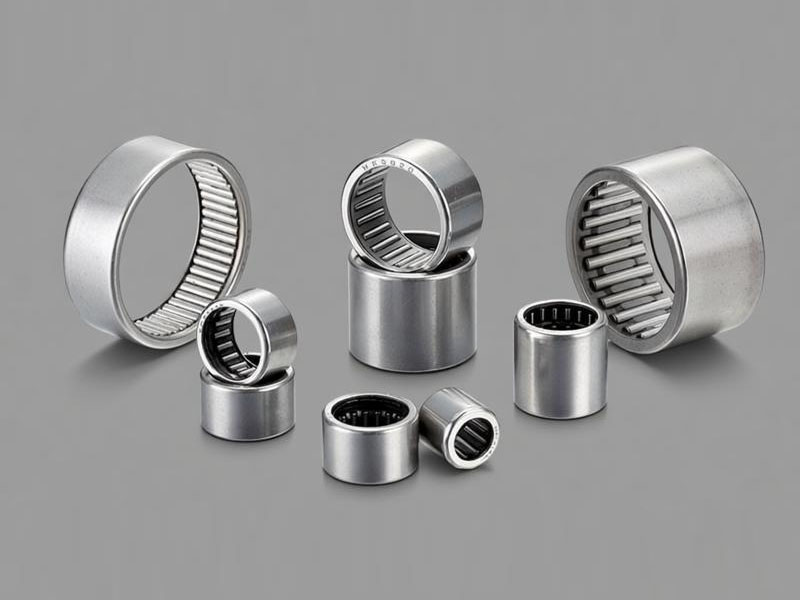
Drawn Cup Needle Roller Bearings
Best for: Applications with limited space and moderate loads (e.g., automotive transmissions).
Characteristics: Thin-walled, stamped steel outer ring. Cost-effective and space-saving.
Match when: Your housing bore is not hardened and you need a simple press-fit solution.
Machined Ring Needle Bearings
Best for: Heavy-duty applications with high shock loads (e.g., construction equipment, gearboxes).
Characteristics: Thicker rings machined from steel. Higher precision and speed capability.
Match when: Your measurements indicate a heavier cross-section and your application requires high rigidity.
Thrust Needle Roller Bearings
Best for: Purely axial loads (e.g., automotive steering columns, transmissions).
Characteristics: Cage and needle assembly sandwiched between washers.
Match when: Your load analysis shows significant axial force but you have minimal axial space.
Combination Bearings
Best for: Applications where a single shaft experiences forces from multiple directions.
Characteristics: Integrates radial needle bearings with thrust bearings in one compact unit.
Match when: You need to handle complex loads in a single, space-efficient package.
Full Complement vs. Caged Designs
| Feature | Full Complement (No Cage) | Caged Design |
| Load Capacity | Highest (maximum rollers) | Moderate |
| Speed Capability | Lower | Higher |
| Best Use Case | Oscillating or slow rotation | Continuous high-speed operation |
Step 4: Verify with Bearing Experts
Even with precise measurements, bearing selection involves nuances like internal clearance (C0, C2, C3) and tolerance classes (P0, P6, P5). These details can make the difference between a bearing that runs smoothly and one that fails prematurely.
At DUHUI Bearing, we specialize in translating your measurements into the exact engineering solution. With 20 years of exporting experience and a full range of manufacturing capabilities, we ensure that the bearing you order matches the precise specifications of your equipment.
Conclusion: Precision Leads to Performance
Measuring needle bearing dimensions accurately—from the bore diameter to the roller length—is the first step toward mechanical efficiency. By combining these measurements with a clear understanding of your load and speed requirements, you can confidently select the perfect bearing for your machinery.