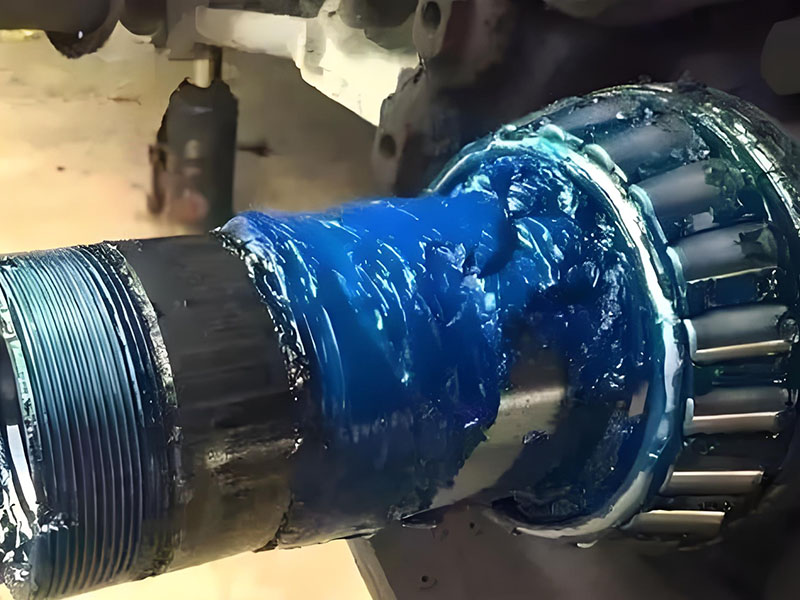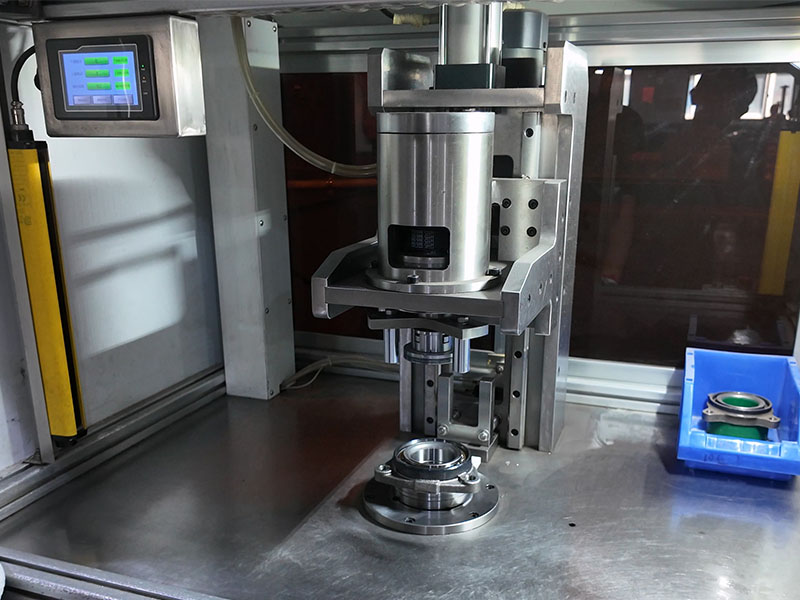
Quick answer: What’s the difference between radial and axial loads on bearings? A radial load pushes perpendicular to the shaft—like a car’s weight on a wheel bearing. An axial load pushes parallel to the shaft—like the thrust from braking or cornering. Deep groove ball bearings handle mostly radial loads. Thrust bearings handle purely axial loads. For combined loads (common in automotive hubs), use angular contact ball bearings or tapered roller bearings with a specific contact angle.
For engineers, maintenance teams, and buyers, the distinction between radial and axial loads is not just theory—it’s the fundamental pillar of bearing selection and machine reliability. As a Chinese automotive wheel hub bearing manufacturer with over 20 years of production and 15 years of global export experience, we have seen firsthand that misapplying a bearing to the wrong load type is a leading cause of premature failure.
This guide moves beyond textbook definitions. We will dissect radial and axial loads from an application engineering perspective, share insights from real-world automotive case studies, and provide you with a clear, actionable framework to make the correct choice—ensuring longevity, performance, and safety in your projects.
Understanding Radial Loads: The Perpendicular Force
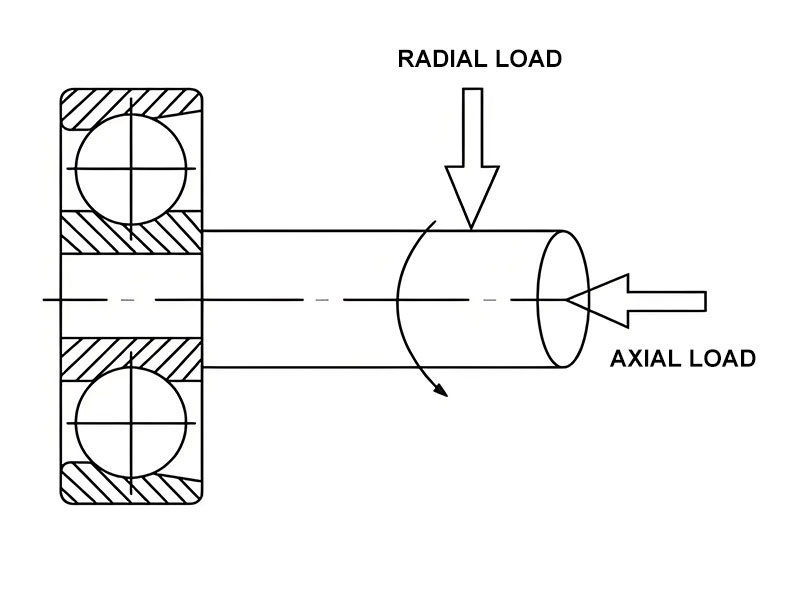
Definition: A radial load is a force acting perpendicular (at 90 degrees) to the axis of a rotating shaft. It is the most common load in machinery, attempting to “bend” the shaft sideways.
Real-World Applications:
- Automotive Wheel Hubs: Supporting the static weight of the car.
- Electric Motor Bearings: Resisting the rotor’s weight and magnetic forces.
- Conveyor Pulleys: Handling the tension from belts or chains.
How It Works & Its Impact:
The force is transferred from the shaft, through the bearing’s inner ring, and distributed across a set of rolling elements (balls or rollers) within a loaded zone (typically 120-150 degrees of the bearing’s circumference), before reaching the outer ring and housing. Insufficient capacity leads to increased stress, brinelling (surface indentations), and fatigue spalling.
Suitable Bearing Types for Radial Loads:
- Deep Groove Ball Bearings: The most versatile and common choice.
- Cylindrical Roller Bearings: For heavier radial loads (e.g., gearboxes).
- Spherical Roller Bearings: Excellent for applications with shaft misalignment.
Expert Insight from Our Floor: A frequent mistake we see is using a bearing with standard internal clearance in a high-temperature application. Thermal expansion can eliminate clearance, creating destructive preload, rapid heat generation, and seizure—a failure mode we’ve resolved in numerous industrial fan applications.
Understanding Axial Loads: The Parallel Thrust Force
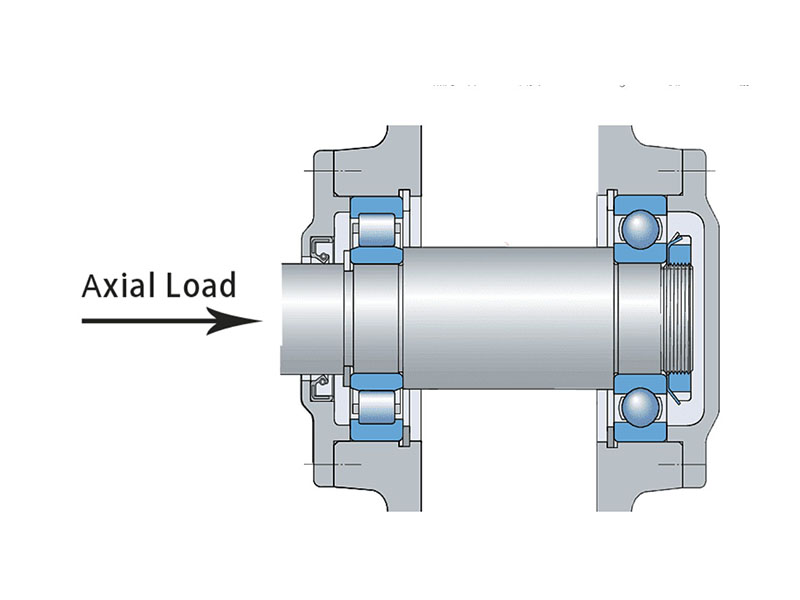
Definition: An axial load (or thrust load) is a force acting parallel to the axis of rotation, attempting to “push” the shaft along its length.
Real-World Applications:
- Automotive Clutch Release Bearings: Actuating the pressure plate.
- Helical Gearboxes: Resisting thrust generated by the gear teeth.
- Vertical Pumps: Supporting the weight of the impeller and shaft.
How It Works & Its Impact:
This load is carried along the shaft’s axis. The force is transmitted through specially designed raceway shoulders or dedicated thrust washers. Standard radial bearings cannot support pure axial loads. Incorrect application causes skidding, severe wear on bearing ribs, and catastrophic “walkout.”
Suitable Bearing Types for Axial Loads:
- Single Direction Thrust Ball Bearings: For moderate axial loads at higher speeds.
- Thrust Roller Bearings: For heavy axial loads.
- Angular Contact Ball Bearings: The premier choice for combined radial and axial loads.
A Lesson from Our Customer Support: We once analyzed a failed worm gear reducer where the specified bearing had inadequate axial capacity. The result was bearing walkout and complete gear failure in under 400 hours—a costly outage that proper selection would have prevented.
Radial Load vs. Axial Load: A Direct Comparison
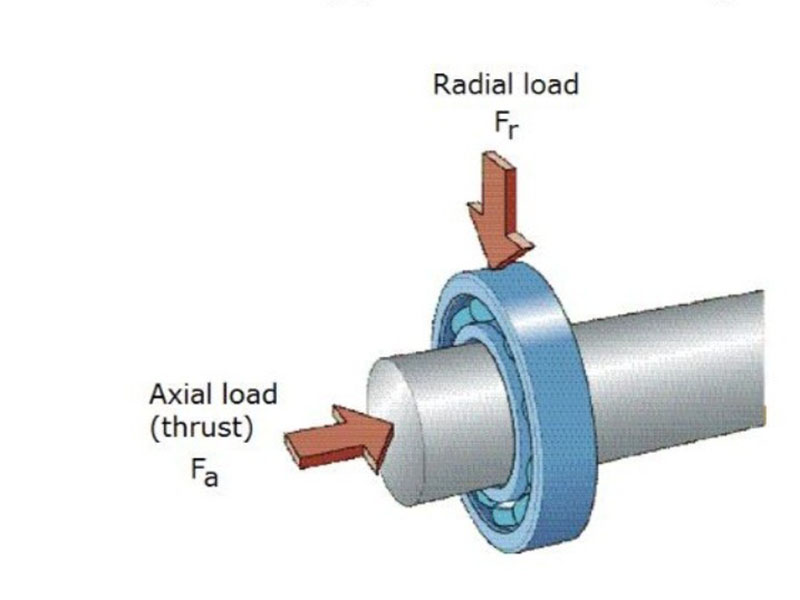
| Comparison Aspect | Radial Load | Axial Load |
|---|---|---|
| Force Direction | Perpendicular (90°) to the shaft. | Parallel (0°) to the shaft. |
| Load Distribution in Bearing | Across rolling elements in a specific arc of the raceway. | Across the entire face of the raceway or washer. |
| Primary Effect on Shaft | Causes bending stress. | Causes compressive or tensile stress. |
| Typical Bearing Examples | Deep Groove Ball Bearing, Cylindrical Roller Bearing. | Thrust Ball Bearing, Angular Contact Ball Bearing. |
| Simple Analogy | The weight on a bicycle wheel. | The force pushing a boat propeller forward. |
Combined Loads in Real-World Applications: The Automotive Wheel Hub Case
In practice, bearings almost always experience combined loads. The automotive wheel hub bearing is the perfect case study, and it’s where our expertise is core.
A modern Generation 3 hub unit must withstand:
- Constant High Radial Load: The vehicle’s weight.
- Dynamic Radial Load: Impacts from roads and cornering forces (2-3x static load).
- Variable Axial Load: Forces from braking, acceleration, and sharp turns.
The Engineering Solution We Manufacture:
This is why modern hubs use pre-adjusted, double-row angular contact ball bearings (DAC) or tapered roller bearings (TRB). Their precisely calculated contact angle (e.g., 25°-40°) provides an optimal balance of radial and axial capacity. Factory-set preload ensures zero clearance, giving the rigidity required for precise handling and ABS/ESP system function.
Beyond Load Type – Other Critical Factors:
- Material: While standard SAE 52100 chrome steel is excellent, for demanding applications we use vacuum-degassed steels (like 100Cr6) for superior fatigue life and purity.
- Lubrication & Sealing: High-performance grease and integrated low-friction seals are non-negotiable for achieving the calculated service life in harsh environments.
How Load Type Directly Governs Bearing Fatigue Life
Bearing life is not a guess; it’s a statistical calculation (ISO 281) where load is the most critical variable.
The core equation is: L₁₀ = (C / P)^p
- C = Basic Dynamic Load Rating (bearing’s capacity).
- P = Equivalent Dynamic Load (your actual load).
- p = exponent (3 for ball bearings, 10/3 for rollers).
The Exponential Reality: For a ball bearing, a 25% increase in load reduces theoretical life by nearly 50%.
The Immediate Danger of Misapplication:
- Putting a heavy axial load on a deep groove ball bearing overloads its small ribs, leading to rapid heat and failure.
- Putting a heavy radial load on a thrust bearing jams the rollers, causing immediate brinelling or fracture.
Our Perspective: While the L10 life predicts fatigue, over 90% of failures we analyze are premature, caused by improper selection, contamination, or installation—highlighting why correct load analysis is paramount.
How to Select the Right Bearing for Radial, Axial, and Combined Loads
Follow this practical, field-tested methodology derived from our application engineering support:
Step 1: Quantify the Loads. Determine magnitudes of Radial (Fr) and Axial (Fa) forces. Calculate the Fa/Fr ratio.
Step 2: Match the Bearing to the Load Ratio.
- Fa/Fr < 0.3 (Primarily Radial): Deep Groove Ball or Cylindrical Roller Bearings.
- Fa/Fr between 0.3 – 1.5 (Combined Load):
- For high speed/precision: Angular Contact Ball Bearings (choose 15°/25°/40° contact angle).
- For high load/robustness (e.g., wheel hubs, axles): Tapered Roller Bearings – a core product in our automotive lineup.
- Fa/Fr > 1.5 (Primarily Axial): Dedicated Thrust Bearings.
Step 3: Finalize with Reality Checks. Verify load ratings, consider installation, environment, and sealing.
FAQs
How to visually determine whether a load is radial or axial?
- Radial load: The force direction is perpendicular to the shaft axis, pointing toward or away from the axis.
- Axial load: The force direction is parallel to the shaft axis, acting along the axis.
Why can some bearings withstand both radial and axial loads, while others cannot?
The ability to handle combined loads depends on the bearing’s internal contact angle and raceway geometry. Bearings with a contact angle (e.g., angular contact ball bearings, tapered roller bearings) can support axial loads. Deep groove ball bearings have limited axial capacity. Cylindrical roller bearings with no flanges on the rings cannot support axial loads at all.
How do you determine whether bearing failure is caused by radial or axial overload?
Radial overload indicators:
- Uniform or symmetrical spalling bands in the middle of the raceway.
- Fatigue spalling in the middle of rollers (cylindrical roller bearings).
- Circumferential cracks on inner or outer rings.
Axial overload indicators:
- Wear or fracture of raceway flanges.
- Abnormal wear on rolling element end faces.
- Cage deformation or fracture due to axial force.
- Indentation or spalling on one side of the raceway edge.
What changes occur in radial and axial loads under installation errors or shaft deformation?
- Shaft bending or misalignment: Converts part of the radial load into an additional axial load, causing uneven stress distribution.
- Thermal expansion: If the shaft expands axially and the bearing has no provision for axial movement (e.g., fixed bearing arrangement), a large unintended axial force develops.
- Installation misalignment: Creates edge loading, which acts as a localized radial overload but can also induce an axial thrust component.
When do axial forces occur in mechanical systems?
Axial forces occur in applications where thrust is transmitted along the shaft axis. Common examples:
- Automotive wheel hubs during cornering (axial force from vehicle dynamics).
- Helical or bevel gearboxes (gear teeth generate axial thrust).
- Screw drives and linear actuators.
- Construction equipment with rotating platforms (cranes, excavators).
Which industries mainly use radial load systems?
Almost all industries. Specific examples: machine tool manufacturing (spindles), automotive industry (wheels, transmissions), industrial gearboxes, material handling (conveyor rollers), electric motors, and pumps. Many of these actually use radial-axial combination systems (e.g., a pair of angular contact bearings).
How does the contact angle affect a bearing’s axial load capacity?
The contact angle (e.g., 15°, 25°, 40°) determines the proportion of axial load the bearing can support. A larger contact angle increases axial load capacity but reduces permissible speed. For example, a 40° contact angle tapered roller bearing can support much higher axial loads than a 15° angular contact ball bearing of similar size.
What bearing types are best for applications with high axial loads but low radial loads?
Thrust ball bearings or thrust roller bearings are designed specifically for pure axial loads. However, if there is any radial load present, a tapered roller bearing or an angular contact ball bearing should be used instead, as pure thrust bearings cannot tolerate significant radial forces.
Conclusion: Partner with Experience for Unshakeable Reliability
Understanding the difference between radial and axial loads is the first step. The real engineering begins with applying this knowledge to complex, real-world duty cycles, thermal expansions, and material specifications.
For over two decades, DUHUI has not just manufactured bearings—we’ve solved application puzzles. Our 20 years of manufacturing precision and 15 years of serving global clients have taught us how to ensure reliability in the most demanding conditions, especially in automotive wheel hub assemblies and drivetrain components.
Let’s Turn This Knowledge Into Your Solution:
- Download Our Best-Selling Bearing Catalog – Our salesman will provide you with a catalog of best-selling bearings that best match your market.
- Send Us Your Failed Bearing – Our engineers offer complimentary preliminary failure analysis to diagnose root causes like load misapplication.
- Consult with Our Technical Team – Share your load data, application sketches, or performance requirements. Let us co-engineer a bearing solution that delivers longevity and value.
Contact us today to leverage our expertise for your next project.