As an importer or distributor, you know that a single wheel bearing failure can trigger a costly chain reaction of warranty claims, logistics issues, and damaged reputation. In a competitive global market, your success isn’t just about the price you negotiate—it’s about the quality and reliability of the China wheel bearing manufacturer you choose to partner with.
But how do you separate a true technical partner from a simple parts supplier? A generic factory tour won’t reveal the truth. You need a structured, technical audit. This guide provides a 7-point framework to evaluate any potential automotive wheel bearing supplier, helping you build a supply chain based on verified quality and long-term reliability.
The Shift to Integrated Hub Units: Why Your Supplier’s Strategy Matters
The automotive aftermarket has undergone a fundamental shift. The era of traditional press-fit bearings is giving way to integrated wheel hub bearings (WHBs) , particularly Gen 3 units with integrated ABS sensors. This is critical because WHBs eliminate the #1 cause of premature failure: installation error.
Before you dive into a technical audit, assess your supplier’s strategic alignment. A forward-looking hub unit bearings manufacturer will have a clear strategy for these complex, sensor-integrated components. A supplier stuck in the past may lack the precision machining, advanced sealing, and engineering capabilities these modern units demand. Partnering with the right one is your first step in reducing warranty claims.

7 Key Technical Points for Auditing Your Wheel Bearing Supplier
Material Provenance: The Foundation of Bearing Longevity
The Risk: Inconsistent or substandard steel (typically SAE 52100/GCr15) is the root cause of premature fatigue and spalling. The danger lies in untraceable materials and a lack of rigorous incoming inspection.
Questions to Ask:
- Can you provide the steel mill’s vacuum degassing (VD) certificate, per heat batch?
- What is your incoming inspection process? Do you perform spectroscopic analysis to verify the chemical composition?
- How do you segregate and trace steel batches throughout your production process?
Why This Matters: A top-tier bearing manufacturer treats material provenance as non-negotiable. For example, at DUHUI Bearing, we refuse anonymous steel. Every batch arrives with full documentation, and our in-house lab performs spectroscopic verification. We maintain full traceability from raw material to finished bearing, ensuring consistent core strength that meets IATF 16949 standards.
Heat Treatment: Creating a Hard Shell with a Tough Core
The Risk: Inconsistent heat treatment leads to soft surfaces (rapid wear) or brittle cores (catastrophic fracture). Many workshops rely on dated, manually-controlled furnaces that cannot guarantee uniformity.
Questions to Ask:
- May I see the temperature charts and process logs from your continuous carburizing furnace?
- What is your daily SPC (Statistical Process Control) for case depth and surface hardness?
- How often do you perform destructive testing on finished samples to validate core toughness?
Why This Matters: The most reliable automotive bearing suppliers use computer-controlled, atmosphere-regulated furnaces with tight temperature tolerances. At DUHUI, we maintain a tolerance of ±5°C. We perform daily destructive tests—cutting, polishing, and micro-hardness mapping—to guarantee a deep, consistent hardened case and a ductile core. This data is available for review, demonstrating our commitment to process control.
Grinding & Superfinishing: The Secret to Quiet Operation
The Risk: Poor raceway geometry and rough surface finish are the direct causes of rolling element noise—the #1 driver of customer complaints and comebacks.
Questions to Ask:
- Do you perform 100% profilometer inspection on critical raceways, or just sampling?
- What is your controlled surface roughness (Ra value) for premium “quiet series” bearings?
- Can you show me the grinding wheel and superfinishing stone specification log?
Why This Matters: Industry leaders achieve a surface finish of Ra ≤ 0.4 µm to meet and exceed OE noise performance standards. At DUHUI, we utilize 100% in-line profilometry (e.g., MarSurf systems) to ensure perfect raceway geometry. Our “Quiet Series” bearings consistently achieve this standard, and our tool maintenance is a scheduled, documented procedure—not an afterthought.
Sealing Systems: The First Line of Defense Against Failure
The Risk: Over 50% of premature bearing failures begin with a seal breach, allowing contamination ingress. Many suppliers use generic, off-the-shelf seals without application-specific validation.
Questions to Ask:
- Do you design your own sealing systems, or purchase standard seals?
- What environmental durability tests do you perform? (e.g., salt spray, dust, water jet).
- How do you match lip material (NBR, FKM) to the destination market’s climate?
Why This Matters: The best China wheel hub bearing manufacturers engineer seals as integrated systems. Their validation goes far beyond basic standards. At DUHUI, our validation includes dynamic 500-hour salt spray tests and mud slurry exposure tests in climate chambers. We select seal compounds based on your market’s specific temperature and road conditions, ensuring long-term protection.
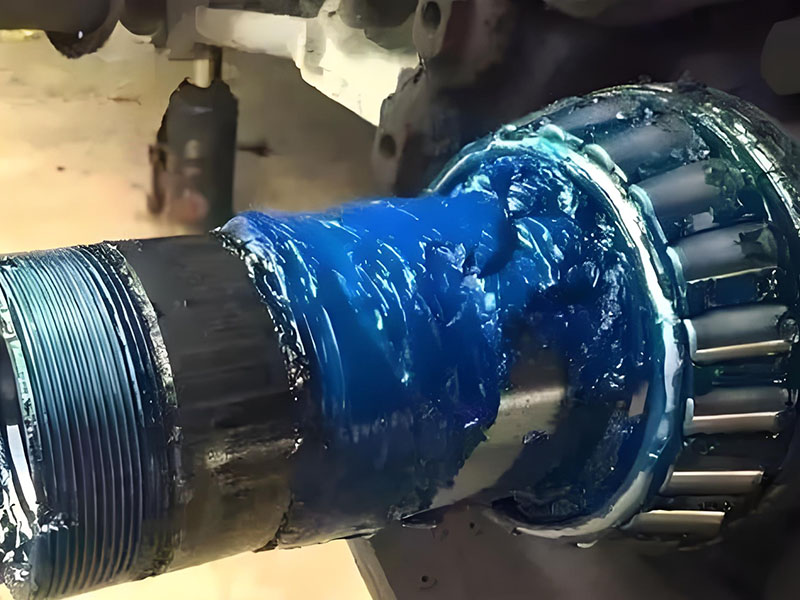
Grease Technology: The Lifeblood of Your Bearings
The Risk: Incorrect or inconsistently applied grease leads to early lubricant breakdown, causing wear, noise, and premature failure.
Questions to Ask:
- Who formulates your grease? Is it tailored for wheel bearing applications (high RPM, wide temperature range)?
- Is grease application automated and weight-verified, or done manually?
- Can you provide the grease’s technical datasheet with performance parameters (dropping point, thickener type, base oil viscosity)?
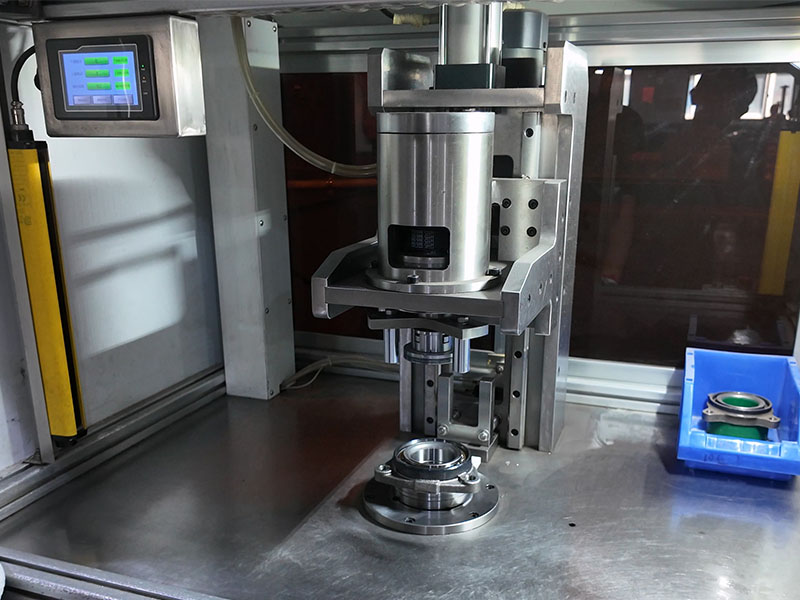
Why This Matters: A quality-focused supplier will partner with leading lubricant companies to develop application-specific formulas. At DUHUI, our automated filling stations ensure ±1% weight accuracy for every single unit. This guarantees optimal lubrication from the first revolution to end of life, a level of precision unattainable with manual methods.
In-Process QC & Traceability: From Steel to Finished Unit
The Risk: Defects are caught too late, or worse, shipped. Lack of traceability makes root cause analysis impossible and leaves you liable for field failures.
Questions to Ask:
- What are the key in-process inspection points (e.g., after grinding, after assembly)?
- What is your DPMO (Defects Per Million Opportunities) or PPM rate for finished goods audit?
- Does each box or bearing have a unique lot code that traces back to the production date, steel batch, and assembly line?
Why This Matters: An IATF 16949 certified quality system mandates checkpoints at every critical operation. For us, final audit PPM is a key performance indicator we continuously monitor. Every hub unit we ship has a laser-etched code, providing full digital traceability. This allows us—and you—to conduct rapid root cause analysis on any quality inquiry, protecting your brand.
Packaging & Technical Support: Protecting Your Investment
The Risk: “Transport Brinelling”—permanent raceway dents caused by vibration during shipping—creates “Dead-On-Arrival” units. Even perfect bearings fail if installed incorrectly, often by using a hammer instead of a press.
Questions to Ask:
- Packaging: How does your packaging prevent movement and absorb vibration? Have you performed ISTA transit testing?
- Installation Support: Do you provide detailed installation guides (mandrel use, torque specs, warnings against hammering)? How do you educate distributors/installers?
Why This Matters: A premium bearing supplier in China treats packaging as part of the product. At DUHUI, we engineer packaging to pass rigorous ISTA transit tests. We also provide comprehensive installation resources, including detailed guides and torque specifications. This dual focus reduces DOA claims and preventable installation failures, directly protecting your margin and reputation.
Beyond the Checklist: How a True Partner Handles Failure
A superior partner doesn’t just make bearings; they analyze why failures happen. This turns returns into improvement opportunities.
Questions to Ask:
- “What is your failure analysis (FA) process for returned bearings?”
- “Do you follow a standard triage: visual inspection, manual rotation, and clearance measurement?”
- “Can you provide FA reports that distinguish manufacturing defects from installation/application issues?”
At DUHUI, we treat every return as a case study. Our lab can perform root cause analysis, including metallurgical examination, and we share transparent findings to prevent recurrence. This transforms a potential problem into a trust-building opportunity.
Your Next Step: From Checklist to Partnership
Auditing with these questions shifts the conversation from price to value and risk mitigation. A supplier confident in their processes will welcome this discussion. At DUHUI Bearing, we don’t just pass this audit; we invite you to verify our processes firsthand.
Ready to take the next step? We’ve created resources to help you make a confident decision:
- Download Our Factory Audit Scorecard: A detailed spreadsheet to rate and compare potential suppliers side-by-side.
- Request a Sample Failure Analysis Report: See exactly how we diagnose field returns to translate findings into product improvements.
- Schedule a Brief Technical Call: Let our engineering team discuss your specific quality challenges.