In the world of precision machinery, engineers constantly grapple with a fundamental challenge: how to achieve higher rigidity, greater rotational accuracy, and superior load capacity within an increasingly compact space. Standard bearings often fall short when faced with complex loads like combined radial, axial, and moment forces.
Enter the cross roller bearing. Designed with a unique arrangement of cylindrical rollers, this specialized bearing type has become the cornerstone of modern precision applications, from industrial robots to CNC rotary tables. But what exactly makes them so advantageous?
In this comprehensive guide, DUHUI will delve deep into the core advantages of cross roller bearings. We’ll compare them against other common bearing types and provide the insights you need to make an informed selection for your next project.
1. The 5 Key Advantages of Cross Roller Bearings
Let’s explore the fundamental benefits that set cross roller bearings apart.
1.1 Unparalleled Rotational Accuracy and Smoothness
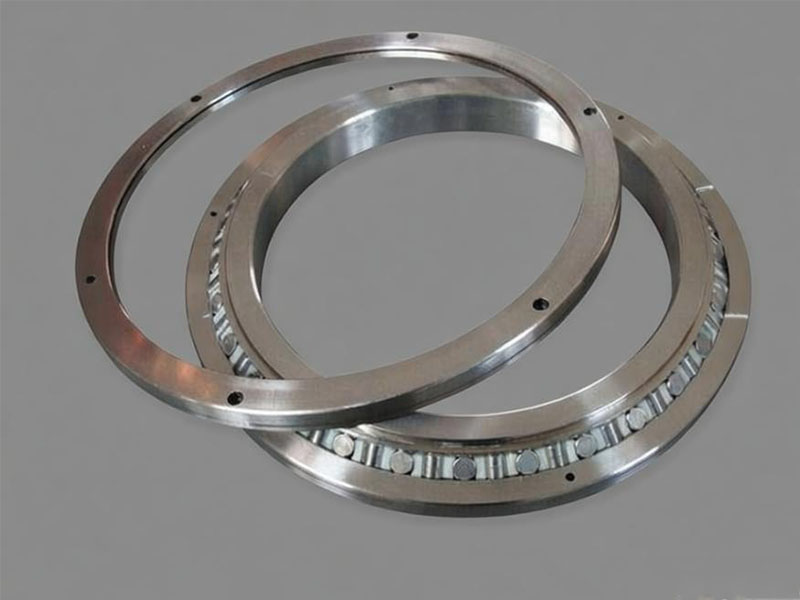
The defining feature of a cross roller bearing is its arrangement of cylindrical rollers. They are positioned perpendicularly to each other in a V-shaped groove, separated by spacers. This unique cross-arrangement effectively eliminates roller skewing and sliding, which are common sources of inaccuracy in other bearing types.
Result: This design ensures exceptionally low rotational runout and ultra-smooth motion characteristics, making it ideal for applications demanding the highest levels of precision, such as in index tables and optical inspection equipment. At DUHUI, our precision grinding and assembly processes are fine-tuned over two decades to guarantee this level of performance.
1.2 Superior Combined Load Capacity
Unlike bearings designed for only radial or axial forces, the cross roller bearing excels at handling complex loads. The orthogonal roller arrangement allows a single bearing to simultaneously support substantial radial loads, axial loads (from both directions), and high tilting moment loads.
Why it matters: This high rigidity is crucial for applications like robot joints, where the bearing must withstand forces from multiple angles, or in machining centers, where it resists deformation during heavy cutting. The line contact of the rollers provides significantly higher rigidity compared to the point contact of ball bearings.
1.3 Extreme Space and Weight Savings
In modern engineering, miniaturization is key. Cross roller bearings feature an ultra-thin-walled design and a minimal cross-sectional height.
The Advantage: This compact construction allows engineers to design smaller, lighter, and more streamlined equipment. A single cross roller bearing can often replace a more complex and space-consuming combination, like a pair of back-to-back mounted angular contact ball bearings, freeing up valuable real estate inside machinery.
1.4 Simplified Installation and Maintenance
Many cross roller bearing series feature a split design, where either the inner or outer ring is divided into two parts. This is not a sign of weakness, but a clever engineering advantage.
Ease of Use: This split structure allows for the easy adjustment of preload, enabling the user to achieve the optimal balance between rigidity and rotational smoothness. It also significantly simplifies the mounting process, reducing assembly time and the risk of installation errors. Furthermore, most cross roller bearings come pre-filled with high-quality grease and fitted with integrated seals, often resulting in a “lifelong lubrication” design and drastically extended maintenance intervals.
1.5 Wide-Ranging Application Versatility
The unique combination of precision, rigidity, and compactness makes the cross roller bearing the preferred choice across a diverse range of industries:
- Industrial Robotics: The go-to bearing for robot joints (shoulders, wrists) due to its ability to handle complex loads and ensure precise motion.
- Machine Tools: Essential for high-precision rotary tables and dividing heads in CNC milling and grinding machines.
- Medical Technology: Found in CT scanners, X-ray equipment, and surgical robots where smooth, quiet, and precise movement is critical.
- Precision Measurement & Optics: Used in coordinate measuring machines (CMMs) and optical inspection systems for their vibration-free accuracy.
2. Cross Roller Bearings vs. Other Bearing Types: A Comparative Analysis
To truly understand the value of a cross roller bearing, it’s helpful to see how it stacks up against the alternatives.
| Feature | Cross Roller Bearing | Angular Contact Ball Bearing | Double-Row Ball Bearing |
| Load Capacity & Rigidity | Excellent for radial, axial, and moment loads due to line contact. | Good for combined loads but lower rigidity due to point contact. | Good for moment loads, but can suffer from uneven load distribution. |
| Rotational Accuracy | Superior. The cross arrangement ensures minimal runout and high smoothness. | High, but requires precise pairing and mounting. | Good, but accuracy can be affected by manufacturing tolerances between rows. |
| Space Efficiency | Excellent. A single bearing handles all loads, saving significant space. | Lower. Typically requires two bearings mounted together, taking up more space. | Moderate. More compact than a pair of angular contacts, but less so than a cross roller. |
| Installation & Adjustment | Simplified. Split rings allow for easy preload adjustment and simple mounting. | Complex. Requires careful shimming or grinding to achieve correct preload. | Moderate. Preload is usually fixed by the manufacturer. |
The Verdict: While other bearings have their place, the cross roller bearing is the definitive choice for applications where high precision, high rigidity, and compact design are non-negotiable.
3. How to Choose the Right Cross Roller Bearing
Selecting the optimal bearing is crucial for performance and longevity. Key considerations include:
- Load & Moment Requirements: Calculate the exact radial, axial, and moment forces your application will encounter.
- Precision Class: Determine the required accuracy (e.g., standard, P5, P4, P2). Higher precision classes are essential for machining and measurement.
- Installation Space: The compact dimensions of cross roller bearings are a given, but you must still match the shaft and housing diameters precisely.
Leverage DUHUI’s Expertise
With 20 years of experience, DUHUI Bearing offers more than just standard products. We understand the nuances of bearing performance. We provide a full range of standard cross roller bearings, and our engineering team is equipped to develop customized solutions to meet your unique design challenges—be it special materials, coatings, or non-standard dimensions. Our commitment to quality control and global standards ensures that every DUHUI bearing delivers the reliability your application demands.