A one-way bearing—also referred to as an overrunning clutch, one-way clutch, or freewheel bearing—is a mechanical component that allows rotational motion in one direction while locking to prevent reverse rotation. This function is critical in power transmission systems where uncontrolled backward movement can cause equipment damage, safety hazards, or production downtime.
Engineers and procurement professionals often ask: What is the difference between a sprag clutch and a roller ramp clutch? How do speed and torque influence bearing selection? What lubrication interval ensures reliable operation? This article provides technical answers to these questions, covering one-way bearing types, working principles, applications, selection criteria, and maintenance practices.
Types Of One-Way Bearings
Sprag-Type One-Way Bearing
Sprag clutches use asymmetrically shaped wedging elements (sprags) between inner and outer races. When rotation occurs in the locking direction, sprags tilt and wedge against both raceways, creating a solid mechanical connection. This design allows a high density of wedging elements, delivering exceptional torque capacity relative to envelope size. Sprag types are preferred for high-speed overrunning applications, reliably operating up to 10,000+ RPM where centrifugal forces would compromise roller designs.
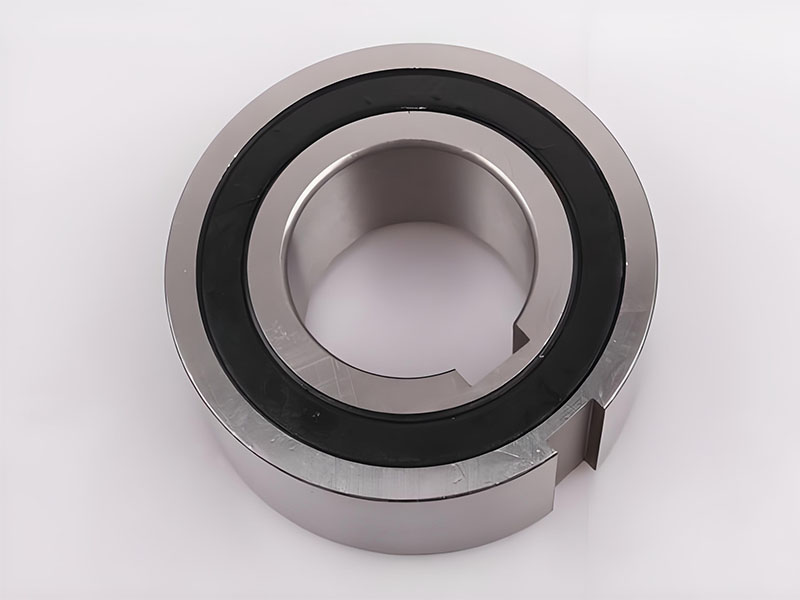
Roller Ramp-Type One-Way Bearing
Roller ramp clutches feature an inner race with precision-machined ramps and spring-loaded cylindrical rollers. Rotation in the locking direction forces rollers into the narrowing wedge gap, producing a self-energizing lock. This design offers simplicity and low manufacturing cost but has speed limitations: when the inner race overruns above approximately 800 RPM, centrifugal force can lift rollers off the ramp, delaying engagement. Roller ramp clutches are suitable for low-speed indexing, anti-reverse devices, and applications where the outer race overruns.
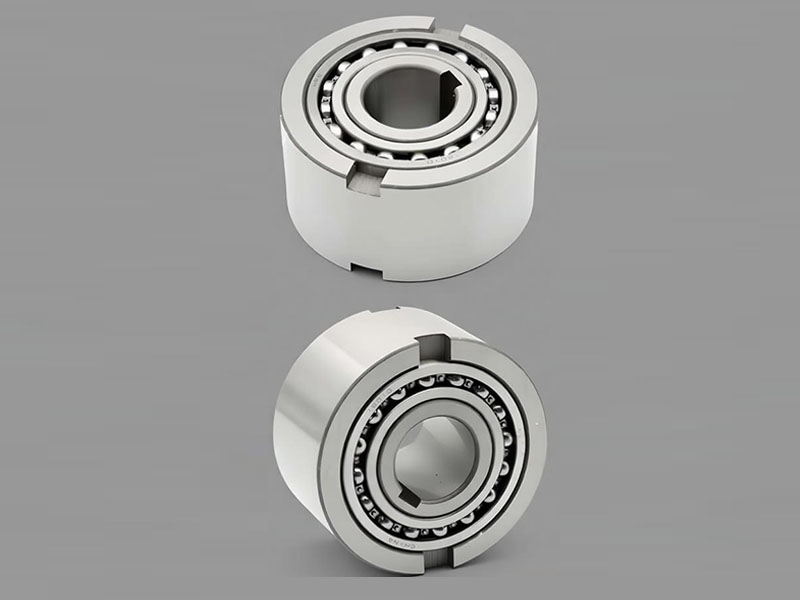
Drawn Cup (Needle Roller) One-Way Bearing
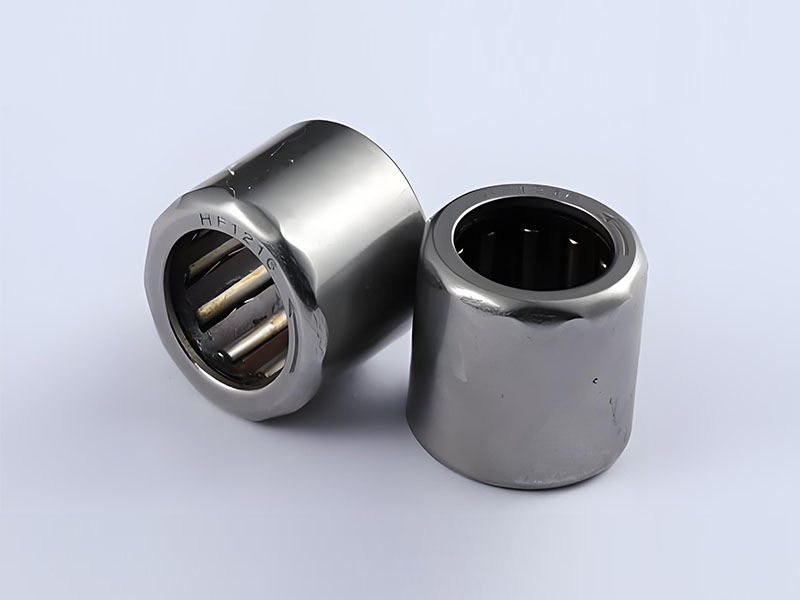
These bearings integrate one-way clutch function into a thin-walled drawn cup outer ring with needle rollers. The compact radial envelope suits tight installation spaces where separate bearing and clutch assemblies would not fit. Common applications include office equipment, exercise machines, and small power tools.
Comparison Table
| Feature | Sprag Type | Roller Ramp Type | Drawn Cup Needle Type |
|---|---|---|---|
| Torque density | High | Medium | Low-Medium |
| Max overrunning speed (inner race) | >10,000 RPM | <800 RPM | <1,000 RPM |
| Engagement response | Instantaneous | Instantaneous | Instantaneous |
| Radial space | Standard | Standard | Minimal |
| Typical applications | Transmissions, high-speed machinery | Low-speed indexing, anti-reverse | Compact mechanisms |
How Does A One-Way Bearing Work?
The operating principle relies on the wedging effect (self-locking angle). The space between inner and outer races incorporates ramps or eccentric geometries that create a converging gap, where rolling elements (sprags or rollers) reside.
Locking Mechanism (Torque Transmission Mode)
When the driving shaft rotates in the transmission direction, friction and spring preload push the wedging elements toward the narrow region of the converging gap. The elements become tightly jammed between inner and outer races, creating a mechanical interference lock. In this state, the one-way bearing transmits torque as a solid unit. The self-locking angle is critical: its tangent must remain smaller than the friction coefficient to ensure reliable engagement under load.
Freewheeling Mode (Overrunning Mode)
When the driven component rotates faster than the driver, or when relative rotation reverses, the wedging elements move toward the wider clearance area, compressing return springs. The mechanical interference disappears, allowing races to rotate independently. This disengagement is automatic and instantaneous, requiring no external control. In automotive starter applications, once the engine runs faster than the starter motor, the one-way bearing automatically overruns, preventing engine torque from driving the starter into destructive overspeed.
Common Industrial Applications Of One-Way Bearings
Automotive Starter Motors
The one-way bearing (often called starter clutch or overrunning starter clutch) transmits torque from the starter motor pinion to the engine flywheel during cranking. After engine start, when engine speed exceeds starter speed, the bearing overruns, decoupling the starter motor. Without this function, the engine would drive the starter motor far beyond its design limits, causing rapid failure.
Conveyor Systems & Anti-Reverse Devices
In inclined conveyors transporting bulk materials, power interruption can cause the belt to run backward under gravity, leading to material spillage, equipment damage, and safety hazards. One-way bearings installed on head shafts or geared motor outputs act as anti-reverse devices—permitting forward rotation while mechanically locking against any back-driving torque. The locking action is instantaneous, preventing even slight backward movement.
Indexing Drives & Packaging Machinery
Automated assembly and packaging lines use indexing mechanisms to advance workpieces through discrete stations. One-way bearings integrated into indexing drives permit incremental forward motion while preventing backward drift during stationary dwell periods. Packaging machinery (carton erectors, fill-seal machines, labelers) relies on them for film advancement, product registration, and cutoff mechanisms.
Textile & Printing Machinery
Textile equipment requires careful tension control during yarn winding, fabric take-up, and roll changing. One-way bearings enable unidirectional material movement while preventing reverse tension loss or slack. Printing presses similarly use them in paper feed and register control mechanisms to maintain consistent web tension across multiple color stations.
How To Choose The Right One-Way Bearing
Torque Capacity
Calculate both steady-state running torque and peak torque values during starting, braking, or sudden load changes. For applications with frequent load reversals or impact loading, sprag-type clutches provide higher torque density and more uniform stress distribution across multiple wedging elements compared to roller ramp designs.
Speed Limitations
When the inner race serves as the overrunning member, roller ramp clutches are limited to under 800 RPM to avoid roller lift-off from centrifugal force. For higher speeds, sprag-type clutches maintain spring-loaded sprag contact independent of rotational speed. For speeds exceeding 10,000 RPM, consult manufacturer engineering staff for specialized high-speed sprag clutches.
Environmental Conditions
Standard one-way bearings function properly within -20°C to +120°C in clean, dry conditions. Applications exposed to moisture, chemical washdown, dust, or temperature extremes require sealed configurations, corrosion-resistant materials (stainless steel races), and specialized lubricants (high-temperature or food-grade). Increase relubrication frequency in tropical, humid, or dusty environments.
Mounting Dimensions & Fits
Standard one-way bearings conform to ISO metric dimensions. Shaft and housing fits should follow manufacturer recommendations—typically press fits for inner races and clearance or light press fits for outer races depending on which race drives. Before installation, clean bearings to remove factory-applied preservation oil, then apply operational lubricant.
One-Way Bearing Maintenance & Best Practices
Lubrication Protocol
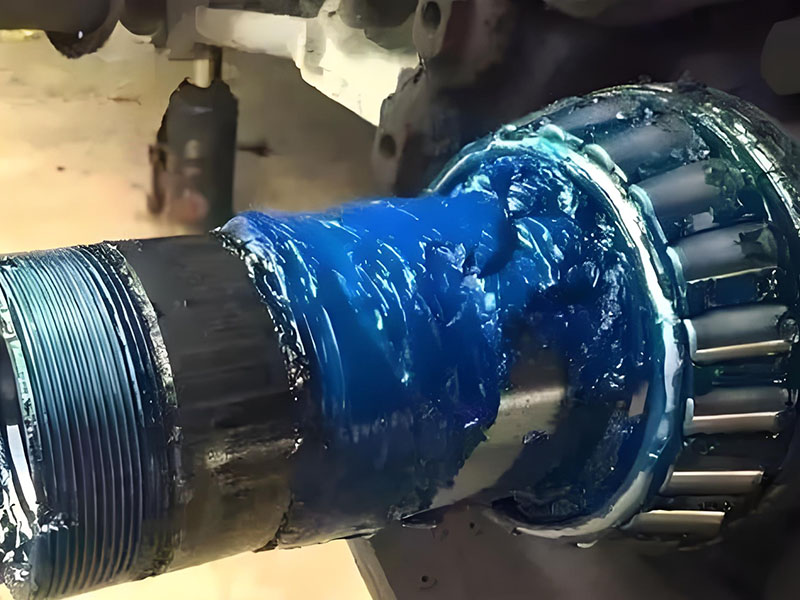
Use lubricants formulated for one-way clutch applications (NLGI Grade 1 or 2 greases with appropriate base oil viscosity). Apply the manufacturer-specified grease quantity—under-lubrication causes inadequate film strength, while over-lubrication increases drag torque.
In many industrial applications, relubrication is recommended every 3,000 to 5,000 operating hours, or every six months, depending on duty cycle and environmental conditions. For machinery stored long periods, add fresh grease before startup as the original lubricant may have separated.
Installation Practices
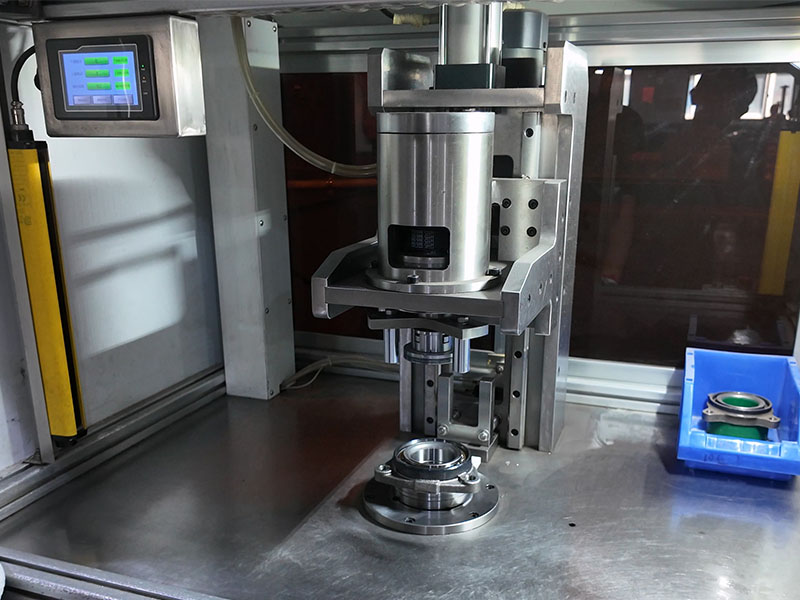
Bearings must be pressed squarely into housings or onto shafts using tools that contact the race being mounted. Applying force through rolling elements or wedging components will cause Brinelling (indentations) that permanently degrades engagement reliability. Verify shaft and housing dimensions, tolerances, and cleanliness before mounting.
Common Failure Modes & Troubleshooting
| Failure Symptom | Likely Cause | Corrective Action |
|---|---|---|
| Slipping (fails to lock) | Lubricant contamination or incorrect viscosity; raceway wear | Clean and relubricate with correct lubricant; replace if worn |
| Failure to overrun (remains locked) | Debris jamming wedging elements; spring damage | Disassemble and inspect; remove debris; replace springs |
| Excessive noise | Wear debris in grease; misalignment | Replace bearing; verify alignment |
| Premature locking failure | Exceeded torque capacity; shock load damage | Upgrade to higher capacity bearing; review application loads |
Conclusion
The one-way bearing provides automatic, instantaneous directional control without external actuation. Understanding the differences between sprag, roller ramp, and drawn cup designs enables engineers to match selection to torque capacity, operating speed, space constraints, and environmental conditions. Proper selection and maintenance—correct lubrication intervals (3,000–5,000 hours), careful installation, and contamination control—directly influence system reliability.
DUHUI Bearing is a Chinese manufacturer with ISO 9001-certified production facilities, supplying one-way bearings, overrunning clutches, and anti-reverse devices to automotive OEMs and industrial clients worldwide. Leveraging two decades of manufacturing experience, DUHUI produces sprag-type and roller ramp-type one-way bearings in metric and custom configurations. For standard product inquiries or custom-engineered solutions based on your application torque and speed requirements, contact our technical sales team with your specifications.
Frequently Asked Questions (FAQs)
Q1: What is the difference between a one-way bearing and a one-way clutch?
They refer to the same functional component. “One-way bearing” is commonly used when the component also supports radial loads; “one-way clutch” emphasizes directional control. The terms are interchangeable in technical literature.
Q2: Can a one-way bearing support radial loads?
Some designs do. Drawn cup roller one-way bearings (e.g., HFL series) integrate radial load support. Standard sprag clutches without dedicated bearing races do not support significant radial loads and require separate radial bearings in the assembly.
Q3: How does a sprag clutch differ from a roller ramp clutch?
Sprag clutches use specially shaped wedging elements (sprags) allowing higher element density and torque per envelope size, plus higher overrunning speeds (>10,000 RPM). Roller ramp clutches use cylindrical rollers and ramps—simpler and lower cost but limited to <800 RPM when the inner race overruns.
Q4: What lubricant should be used in a one-way bearing?
Most require NLGI Grade 1 or 2 lithium-complex greases with ISO VG 68 to 150 base oil viscosity. Always follow the manufacturer’s lubrication recommendations. Using incorrect lubricant can cause slipping (insufficient friction coefficient) or premature wear.
Q5: Can a one-way bearing be used in both directions?
No. One-way bearings transmit torque in only one rotational direction while freewheeling in the opposite direction. Most bearings are marked or designed asymmetrically to indicate correct mounting orientation.
Q6: What is the typical lifespan of a one-way bearing?
Under proper selection and maintenance, industrial one-way bearings in moderate-duty applications commonly achieve 10,000 to 20,000 operating hours. Applications with high-frequency engagement, heavy shock loads, or contaminated environments experience reduced service intervals.
Q7: Where can I source quality one-way bearings from a reliable manufacturer?
DUHUI Bearing, based in China, manufactures sprag-type and roller ramp-type one-way bearings with ISO 9001 certification. For volume orders, custom bore/OD dimensions, or application-specific torque requirements, contact DUHUI directly for technical support and quotations.