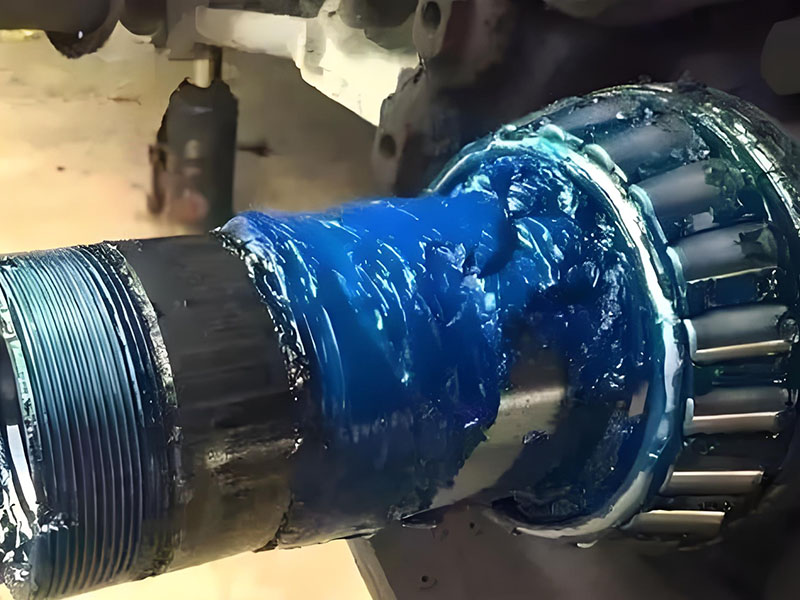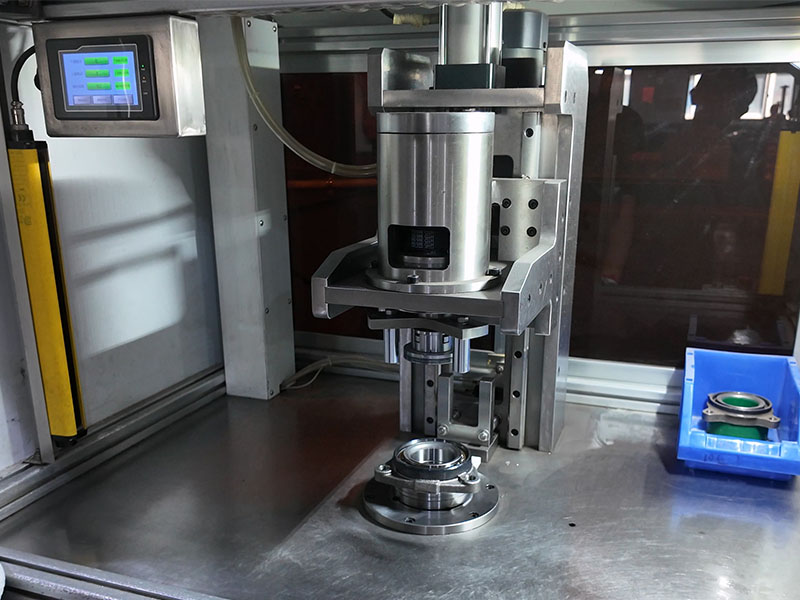
Whether you are an engineer sourcing for automotive applications or a procurement specialist evaluating suppliers, understanding the fundamentals of ball bearings is crucial for performance and longevity.
In this comprehensive guide, we’ll explore everything you need to know about ball bearings—from basic principles to advanced selection criteria. By the end, you’ll have the knowledge to make informed decisions that save time, reduce costs, and extend equipment life.
1. What is a Ball Bearing?
1.1 Definition
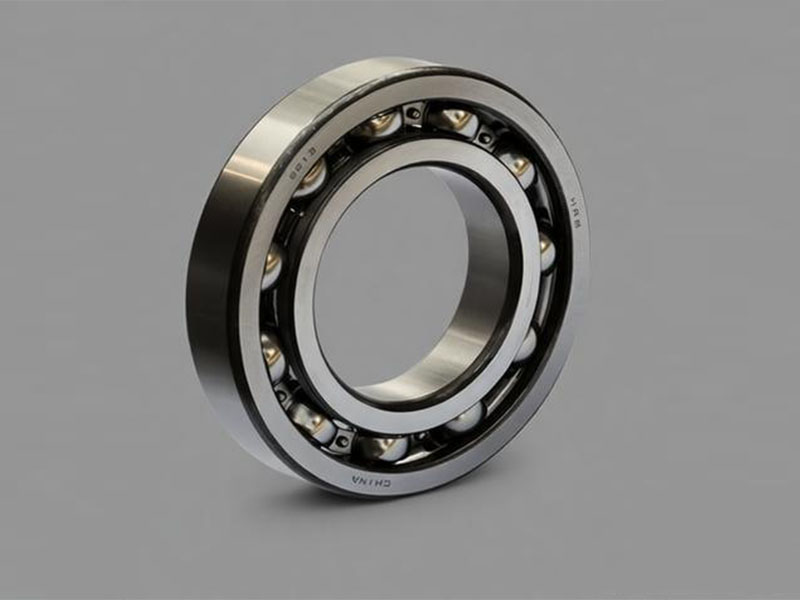
A ball bearing is a type of rolling-element bearing that uses spherical balls to maintain separation between moving parts of a machine—specifically between the rotating shaft and the stationary housing.
The primary purpose of a ball bearing is twofold: to reduce rotational friction and to support radial and axial loads. By using two concentric rings (called races) to enclose the balls and transmit loads through them, rolling motion generates significantly less friction than sliding motion.
1.2 Working Principle
Imagine trying to slide a heavy box across the floor—it’s difficult because of sliding friction. Now imagine putting that same box on rollers—it moves much easier. Ball bearings work on this same principle, but on a microscopic scale.
When a shaft rotates, the inner ring turns with it. The balls roll smoothly in the grooves between the inner and outer rings, transferring the load while minimizing resistance. This simple yet brilliant mechanism enables modern machinery to operate efficiently at high speeds.
1.3 Components of a Ball Bearing
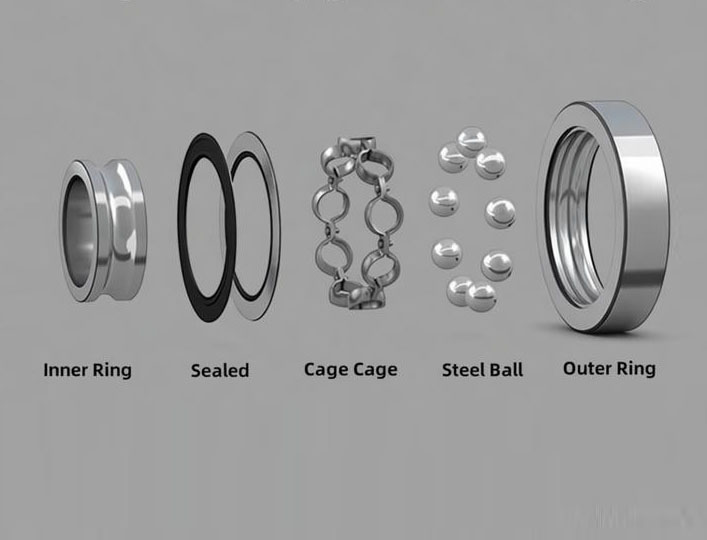
A standard ball bearing consists of five essential components:
| Component | Function | Material Options |
| Rolling Elements (Balls) | Carry the load; precision determines smoothness and speed | Chrome steel, stainless steel, ceramic |
| Cage (Retainer) | Separates balls, prevents friction, ensures even spacing | Steel, brass, polyamide |
| Outer Ring | Larger ring mounted into housing | Bearing steel, stainless steel |
| Inner Ring | Smaller ring mounted onto rotating shaft | Bearing steel, stainless steel |
| Shields/Seals | Protect against contamination; retain lubricant | Metal shields (ZZ), rubber seals (2RS), Teflon seals |
DUHUI Insight: The choice between shields and seals is critical. Metal shields (ZZ) provide protection against large debris while minimizing friction—ideal for high-speed applications. Rubber seals (2RS) offer superior protection against contamination and moisture but may have slightly higher friction.
2. Types of Ball Bearings
Understanding the different types helps you select the right bearing for your specific needs. Based on design, load direction, and application requirements, ball bearings fall into several categories:
2.1 By Load Direction
Deep Groove Ball Bearings
The most common and versatile type. They feature deep continuous grooves on the inner and outer rings, allowing them to handle both radial and moderate axial loads in either direction. Perfect for high-speed applications like electric motors, fans, and pumps.
Common series: 6000, 6200, 6300 series
Typical uses: Electric motors, gearboxes, household appliances
Designed to accommodate combined loads—simultaneous radial and axial loads. The contact angle (typically 15°, 25°, or 40°) allows them to handle higher axial loads in one direction. Often used in pairs for machine tool spindles and gearboxes.
Common series: 7200, 7300 series
Typical uses: Machine tool spindles, pumps, gearboxes、
Specifically designed for high axial loads but unsuitable for high speeds. Available in single-direction and double-direction designs.
Common series: 51000, 52000 series
Typical uses: Automotive steering systems, crane hooks, machine tool tables
2.2 By Design Feature
Self-Aligning Ball Bearings
Feature two rows of balls and a common spherical raceway on the outer ring. This design compensates for shaft misalignment or deflection—ideal for applications where perfect alignment is difficult to maintain.
Common series: 1200, 1300, 2200 series
Typical uses: Fans, textile machinery, agricultural equipment
Miniature Bearings
Small precision bearings (typically under 9mm outer diameter or under 10mm bore) used in precision instruments and compact equipment.
Common series: 6800, 6900 miniature series, inch series
Typical uses: Dental handpieces, small motors, medical devices
Feature a flange on the outer ring that simplifies axial location in the housing—eliminating the need for additional retaining rings or shoulders.
Common series: F6000, MF series
Typical uses: Gearboxes, conveyor rollers, office equipment
2.3 By Material
Chrome Steel Bearings
Standard for most applications—manufactured from GCr15 or SUJ2 steel. Offers excellent hardness (60-67 HRC), wear resistance, and fatigue life at economical cost.
Advantages: High load capacity, widely available, cost-effective
Limitations: Susceptible to corrosion
Stainless Steel Bearings
DUHUI Expertise: Essential for corrosive environments like food processing, marine applications, and medical equipment. Typically made from 440C or 316 stainless steel.
Advantages: Corrosion resistance, washdown compatible
Limitations: Slightly lower load capacity than chrome steel
Available as hybrid (steel rings with ceramic balls) or full ceramic (usually silicon nitride or zirconia). They are lighter, harder, and electrically insulating.
Advantages: Higher speeds, electrical insulation, longer life in clean environments
Limitations: Higher cost, sensitive to shock loads
2.4 By Precision Grade
Ball bearings are manufactured to various precision classes defined by ISO and ABEC standards:
| ABEC Grade | ISO Class | Typical Application |
| ABEC 1 | Normal | General industrial, conveyors |
| ABEC 3 | Class 6 | Electric motors, automotive |
| ABEC 5 | Class 5 | Machine tools, precision spindles |
| ABEC 7 | Class 4 | Aerospace, high-speed applications |
| ABEC 9 | Class 2 | Ultra-precision instruments |
2.5 By Size Range
| Category | Bore Diameter | Typical Applications |
| Miniature | < 10 mm | Medical devices, small motors |
| Small | 10-30 mm | Power tools, automotive accessories |
| Medium | 30-100 mm | Electric motors, pumps |
| Large | 100-200 mm | Industrial gearboxes |
| Extra Large | > 200 mm | Wind turbines, heavy machinery |
2.6 By Configuration
Single Row Bearings
Most common configuration—one row of balls. Simple, cost-effective, suitable for most applications.
Double Row Bearings
Two rows of balls providing higher load capacity in a compact width. Common in gearboxes and pumps where space is limited.
Paired Bearings
Angular contact bearings arranged in sets (back-to-back, face-to-face, or tandem) for specific load requirements.
3. Industries Using Ball Bearings
Ball bearings are fundamental to modern industry—they’re everywhere, often in places you’d never expect. Here are the key industries that rely on them:
3.1 Automotive Industry
The automotive sector is one of the largest consumers of ball bearings. Modern vehicles contain dozens of bearings in critical systems.
Key applications:
- Wheel hubs: Support vehicle weight and enable smooth rotation
- Transmissions: Handle complex loads during gear changes
- Alternators: High-speed operation with minimal friction
- Air conditioning compressors: Reliable sealing against refrigerant
- Power steering systems: Precise response and smooth operation
- Engine accessories: Water pumps, tensioners, idler pulleys
DUHUI Focus: As a specialized manufacturer, DUHUI brings particular expertise to automotive wheel hub bearings, understanding the unique demands of safety-critical applications where failure is not an option.
3.2 Aerospace Industry
Aerospace applications demand the highest reliability—bearings must perform flawlessly under extreme conditions.
Key applications:
- Jet engines: Main shaft bearings operating at high temperatures and speeds
- Landing gear: Handle massive impact loads during landing
- Flight control systems: Precision movement with zero play
- Auxiliary power units: Compact, reliable power generation
- Helicopter rotors: Complex load combinations
Requirements: Zero-defect manufacturing, exotic materials, rigorous testing
3.3 Industrial Manufacturing
Manufacturing equipment runs continuously, often 24/7, requiring bearings that deliver consistent performance.
Key applications:
- Electric motors: The heart of industrial machinery
- Conveyor systems: Thousands of bearings in a single facility
- Machine tool spindles: Extreme precision for metal cutting
- Robotics: Compact bearings for articulated joints
- Pumps and compressors: Handling various fluids and pressures
- Gearboxes: Transmitting power efficiently
3.4 Medical Industry
Medical devices require bearings that are precise, quiet, and often sterilizable.
Key applications:
- Dental handpieces: Ultra-high-speed bearings (>400,000 RPM)
- Surgical tools: Precision and sterilizability
- MRI machines: Non-magnetic materials required
- Patient lifts: Smooth, reliable operation
- Ventilators: Quiet, long-life performance
- Diagnostic equipment: Precision positioning
3.5 Energy Industry
The energy sector demands bearings that withstand harsh conditions and provide long service life.
Key applications:
- Wind turbines: Massive main shaft and generator bearings
- Solar tracking systems: Precision positioning in outdoor environments
- Hydroelectric turbines: Water-lubricated or sealed designs
- Oil and gas equipment: Extreme temperatures and pressures
- Nuclear power: Radiation-resistant materials
- Geothermal plants: Corrosive environments
3.6 Agriculture Industry
Agricultural equipment operates in dusty, wet, and challenging environments.
Key applications:
- Tractors: Heavy loads and impact resistance
- Harvesters: Exposure to dust and plant debris
- Irrigation systems: Continuous operation in moisture
- Balers: Shock loads and contamination
- Grain handling: Abrasive dust protection
3.7 Construction Industry
Construction equipment faces extreme loads and harsh conditions.
Key applications:
- Excavators: Swing bearings and track rollers
- Cranes: Large-diameter slewing rings
- Concrete mixers: Abrasion resistance
- Loaders: Impact and contamination resistance
- Pavers: High-temperature operation near hot asphalt
3.8 Railway Industry
Railway bearings must be reliable and safe over millions of miles.
Key applications:
- Axle boxes: Support train weight at high speeds
- Traction motors: High-speed electric motor bearings
- Door systems: Frequent operation
- Signaling equipment: Long-term reliability
3.9 Marine Industry
Marine environments combine corrosion, motion, and variable loads.
Key applications:
- Propeller shafts: Water-lubricated or sealed bearings
- Deck equipment: Corrosion-resistant materials
- Engine room: High temperatures and oil exposure
- Navigation equipment: Precision instruments
3.10 Food and Beverage Industry
Food processing requires bearings that withstand frequent washdown and resist corrosion.
Key applications:
- Processing equipment: Stainless steel bearings
- Packaging machines: High-speed operation
- Conveyors: Washdown-compatible designs
- Filling equipment: Food-grade lubricants
3.11 Textile Industry
Textile machinery runs at high speeds in dusty environments.
Key applications:
- Spinning frames: High-speed spindles
- Looms: Reciprocating motion
- Knitting machines: Precision small bearings
- Finishing equipment: Heat and moisture exposure
3.12 Printing Industry
Printing requires precise registration and consistent operation.
Key applications:
- Printing presses: High-speed rollers
- Paper handling: Precision positioning
- Finishing equipment: Consistent tension control
3.13 Sports and Recreation
Sports equipment demands lightweight, smooth-running bearings.
Key applications:
- Skateboards: Impact-resistant 608 bearings
- Inline skates: High-speed performance
- Fishing reels: Smooth drag systems
- Bicycles: Hub, bottom bracket, and headset bearings
- Fitness equipment: Exercise bikes, treadmills
4. Specific Application Examples
Let’s examine how ball bearings perform in real-world applications across different industries:
4.1 Automotive: Wheel Hub Assemblies
DUHUI Core Expertise
Wheel hub bearings represent one of the most demanding applications in the automotive industry. They must:
- Support the entire vehicle weight (radial load)
- Handle cornering forces (axial load)
- Withstand impact from potholes and curbs
- Operate reliably for 100,000+ miles
- Resist contamination from water, salt, and road debris
- Maintain proper wheel alignment
- Enable ABS sensor operation (in modern vehicles)
Modern wheel hub bearings have evolved from simple single-row bearings to integrated hub units that combine bearings, flanges, and sensors into a single maintenance-free assembly.
4.2 Skateboard Wheels
Skateboard bearings (typically ABEC-rated 608 size—8mm bore, 22mm outer diameter) must handle impact from jumps and curbs while maintaining high speed with minimal maintenance. They face unique challenges:
- Side loads during turns
- Impact loads from landing tricks
- Contamination from dirt and moisture
- Minimal maintenance intervals
4.3 Electric Motors
Electric motors represent the benchmark for ball bearing performance. Here, bearings must:
- Run quietly (noise is a key quality indicator)
- Handle both radial and axial loads
- Operate for thousands of hours without failure
- Accommodate thermal expansion
- Resist electrical pitting (in variable frequency drive applications)
Quiet operation and minimal vibration are key indicators of bearing quality—any roughness indicates premature wear or contamination.
4.4 Bicycle Hubs
Bicycle hub bearings face a unique challenge: they must roll smoothly to reduce rider fatigue while sealed against rain, dust, and road grime. High-quality bicycle bearings use precise tolerances to minimize rolling resistance—every watt of energy saved translates to faster riding.
4.5 Aircraft Engines
In aircraft engines, bearings operate under extreme conditions:
- Temperatures from -50°C to over 200°C
- Speeds exceeding 10,000 RPM
- Enormous loads during takeoff and landing
- Limited lubrication supply
- Zero failure tolerance
These bearings use specialized materials (M50 tool steel, advanced coatings) and sophisticated cooling systems to survive.
4.6 Conveyor Systems
Industrial conveyors rely on bearings that can run continuously for years with minimal maintenance. These applications favor sealed bearings that keep lubricant in and contaminants out. Conveyor bearings often feature:
- Extended inner rings for set-screw mounting
- Self-alignment capability
- Heavy-duty seals
- Relubrication fittings for long life
4.7 Medical Devices (Dental Drills)
Dental handpieces require ultra-high-speed bearings—often exceeding 400,000 RPM. Ceramic hybrid bearings are preferred here because they:
- Generate less heat than all-steel bearings
- Withstand repeated sterilization (autoclaving)
- Provide longer life at extreme speeds
- Maintain precision for accurate drilling
4.8 Robot Joints
Industrial robots need bearings that provide precise positioning while handling complex, multi-directional loads. Thin-section ball bearings are often used to save space while maintaining accuracy. Requirements include:
- Low friction for smooth motion
- High stiffness for positioning accuracy
- Compact design for space constraints
- Long life in continuous operation
4.9 Wind Turbines
Wind turbine bearings face unique challenges:
- Massive size (main shaft bearings can exceed 2 meters diameter)
- Variable loads from wind gusts
- Slow oscillation in yaw and pitch systems
- Remote locations requiring long maintenance intervals
- Cold starts and temperature variations
4.10 Home Appliances
From washing machines to vacuum cleaners, home appliances rely on ball bearings for quiet, efficient operation:
- Washing machines: Bearings must withstand vibration during spin cycles and resist detergent contamination
- Refrigerators: Compressor bearings run continuously for years
- Ceiling fans: Quiet operation is essential
- Power tools: High-speed operation with occasional impact loads
5. Advantages of Using Ball Bearings
Why choose ball bearings over other bearing types? Here are the key benefits:
5.1 High Efficiency
Ball bearings drastically reduce frictional torque compared to plain bearings. The coefficient of friction for ball bearings ranges from 0.001 to 0.005, compared to 0.05-0.15 for plain bearings. This efficiency translates to:
- Lower energy consumption
- Less heat generation
- Higher operating speeds
- Smaller motor requirements
5.2 Reduced Friction
The rolling contact between balls and races creates significantly less friction than sliding contact. This means:
- Cooler operation
- Longer lubricant life
- Reduced maintenance requirements
- Higher efficiency
5.3 Versatile Load Handling
Ball bearings can handle both radial loads (perpendicular to the shaft) and axial loads (parallel to the shaft):
- Deep groove designs: Handle moderate axial loads in both directions
- Angular contact designs: Handle higher axial loads in one direction
- Thrust designs: Handle pure axial loads
5.4 Cost-Effective Solution
Mass production makes ball bearings economical for high-volume applications. Despite their precision manufacturing (tolerances measured in microns), they remain one of the most cost-effective motion components available:
- Economical for high volumes
- Standardized dimensions reduce inventory costs
- Interchangeable between manufacturers
- Long service life reduces replacement costs
5.5 Long Service Life
When properly selected, installed, and maintained, ball bearings can operate for years—even decades—before replacement. Quality bearings from reputable manufacturers like DUHUI consistently achieve their rated L10 life.
5.6 Minimal Maintenance Requirements
- Properly sealed bearings can operate for their entire service life without relubrication
- Even relubricated bearings require only periodic attention
- Condition monitoring can predict maintenance needs
- Standardized sizes simplify replacement
5.7 Compact Design
Ball bearings provide high load capacity in a relatively small package:
- High load density (load capacity per unit volume)
- Minimal space requirements
- Lightweight compared to alternatives
- Allow compact machine designs
5.8 High-Speed Capability
Ball bearings excel at high speeds:
- Deep groove designs handle moderate speeds
- Angular contact designs with machined cages handle very high speeds
- Hybrid ceramic designs reach extreme speeds
- Precision grades enable higher speeds
5.9 Wide Temperature Range
Depending on materials and lubricants, ball bearings operate from:
- Low temperatures: -60°C with special lubricants
- High temperatures: +350°C with special materials
- Standard range: -20°C to +120°C for most applications
5.10 Availability and Standardization
Ball bearings benefit from worldwide standardization:
- ISO dimension series ensure interchangeability
- Multiple manufacturers produce identical sizes
- Global distribution networks
- Extensive technical documentation
6. Limitations and Considerations
While ball bearings offer many advantages, understanding their limitations helps in proper selection:
6.1 Load Limitations
- Point contact: Unlike roller bearings with line contact, ball bearings have point contact,
- limiting maximum load capacity
- Not ideal for: Extremely heavy loads where roller bearings perform better
- Shock loads: Ceramic balls are sensitive to impact
6.2 Speed Limitations
- Grease lubrication: Limits maximum speed due to churning
- Cage design: Stamped cages have lower speed limits than machined cages
- Heat generation: High speeds require careful thermal management
6.3 Misalignment Sensitivity
- Most ball bearings tolerate minimal misalignment (except self-aligning types)
- Misalignment causes premature wear and heat generation
- Requires precise mounting and alignment
6.4 Contamination Vulnerability
- Even small particles can cause damage
- Requires effective sealing in dirty environments
- Moisture can cause corrosion in standard steel bearings
6.5 Installation Requirements
- Requires proper tools and techniques
- Incorrect installation causes premature failure
- Press fits require precise tolerances
7. How to Choose the Right Ball Bearing
This section draws on DUHUI’s 20 years of manufacturing expertise to help you make informed decisions.
Selecting the right bearing involves evaluating multiple factors systematically:
7.1 Load Requirements
Radial Load: Perpendicular to the shaft
- Deep groove ball bearings excel here
- Check the Dynamic Load Rating (C) for continuous operation
- Check the Static Load Rating (C0) for shock loads
Axial Load: Parallel to the shaft
- Angular contact bearings for significant axial loads
- Thrust bearings for pure axial loads
- Deep groove bearings for light axial loads
Combined Load: Both radial and axial
- Angular contact bearings
- Deep groove bearings with light axial components
Load Calculations:
- Determine actual operating loads
- Include safety factors for shock loads
- Consider load direction and magnitude
- Calculate equivalent dynamic load (P)
7.2 Speed Requirements
Every bearing has a limiting speed—the maximum rotational speed at which it can operate continuously:
Factors affecting speed capability:
| Factor | Impact |
| Cage material | Machined brass > stamped steel > polymer |
| Precision grade | ABEC 7 > ABEC 5 > ABEC 1 |
| Lubrication type | Oil > grease |
| Lubrication method | Circulating oil > oil bath > grease pack |
| Heat generation | Higher speeds require cooling |
| Bearing size | Smaller bearings generally handle higher speeds |
Speed Calculation:
- Calculate required RPM
- Compare with bearing limiting speed
- Apply derating factors for temperature
- Consider lubrication method
7.3 Size Constraints
Critical dimensions:
- Bore diameter (d): Must match shaft size
- Outer diameter (D): Must fit housing
- Width (B): Must fit available space
- Corner radii: Must clear fillets and shoulders
Standardization:
- ISO dimension series ensure availability
- Metric sizes most common globally
- Inch sizes still used in some industries
- Verify tolerance classes (PN, P6, P5, P4)
7.4 Operating Environment
| Environment | Recommended Bearing Type | Special Considerations |
| High temperature (>120°C) | Heat-stabilized steel | Special lubricants, increased clearance |
| Low temperature (below -20°C) | Standard steel | Low-temperature grease |
| Corrosive | Stainless steel (440C) | Avoid standard chrome steel |
| Wet/washdown | Stainless steel with seals | Food-grade grease, FDA compliance |
| Vacuum | Ceramic or specialized | Low outgassing lubricants |
| Dusty | Deep groove with 2RS seals | Regular inspection, possible relube |
| Clean room | Stainless steel or ceramic | Minimal lubricant, special cleaning |
| Submerged | Stainless or hybrid | Water-compatible lubrication |
| Magnetic field | Non-magnetic (ceramic) | Avoid steel components |
7.5 Precision Requirements
When higher precision is needed:
- High-speed operation
- Low vibration requirements
- Precision positioning
- Quiet operation
- Thin section applications
When standard precision suffices:
- General industrial use
- Moderate speeds
- Standard tolerances acceptable
- Cost-sensitive applications
7.6 Lubrication Requirements
Lubrication selection factors:
| Factor | Grease | Oil |
| Speed | Moderate | High |
| Temperature | Moderate | Wide range |
| Maintenance | Minimal | Regular |
| Sealing | Simple | Complex |
| Cooling | Poor | Excellent |
| Cost | Low | Higher |
7.7 Sealing Selection
| Seal Type | Protection | Friction | Speed | Typical Use |
| Open | None | Lowest | Highest | Oil lubrication |
| Metal shield (ZZ) | Moderate | Very low | High | Clean environments |
| Non-contact rubber | Good | Low | High | General purpose |
| Light contact rubber | Very good | Moderate | Moderate | Dusty environments |
| Heavy contact rubber | Excellent | Higher | Low | Severe contamination |
DUHUI Tip: For dusty environments, 2RS seals are mandatory. For high-speed, low-torque applications, ZZ shields are often better despite offering less protection.
7.8 Material Selection
| Material | Advantages | Limitations | Typical Applications |
| Chrome steel (GCr15) | High capacity, economical | Corrodes easily | General industrial |
| Stainless steel (440C) | Corrosion resistant | Lower capacity | Food, medical, marine |
| Hybrid ceramic | High speed, insulation | Higher cost | Machine tools, EVs |
| Full ceramic | Extreme performance | Very high cost, brittle | Aerospace, specialty |
| Cage: Steel | Strong | Higher inertia | General use |
| Cage: Brass | High speed, quiet | Higher cost | Precision applications |
| Cage: Polymer | Quiet, chemical resistant | Temperature limited | Quiet applications |
7.9 Internal Clearance
Internal clearance affects bearing performance and life:
| Clearance Class | Code | Application |
| Normal (CN) | C0 | General purpose |
| C2 | C2 | Precision, temperature stable |
| C3 | C3 | Interference fits, temperature differences |
| C4 | C4 | High temperature, large interference |
| C5 | C5 | Extreme conditions |
Selection guideline:
- C3 for most applications with press fits on shaft
- C3 or C4 when operating temperature differs between inner and outer rings
- C2 for precision applications with minimal temperature variation
7.10 Cage Type Selection
| Cage Type | Speed | Strength | Noise | Cost | Applications |
| Stamped steel | Moderate | Good | Moderate | Low | General purpose |
| Machined brass | High | Excellent | Low | High | High speed, precision |
| Polymer (injection) | Moderate | Moderate | Lowest | Low | Quiet running |
| Polymer (machined) | High | Good | Low | Moderate | Specialty |
| Steel riveted | Moderate | Excellent | Moderate | Moderate | Heavy loads |
7.11 Quality vs. Cost Considerations
As a manufacturer, we know that cheaper bearings often mean:
- Lower-grade steel with more impurities
- Poor heat treatment leading to soft races
- Imprecise ball grading
- Inadequate surface finish
- Substandard seals that fail early
What quality bearings provide:
- Consistent geometry and tolerances
- Proper heat treatment (uniform hardness)
- High-grade steel with controlled microstructure
- Precision balls (grade 10, 25, 50, or 100)
- Reliable seals and lubricants
- Full rated life achievement
Cost considerations:
- Initial cost vs. total cost of ownership
- Downtime costs often exceed bearing cost
- Replacement labor costs
- Consequential damage costs
8. Mounting and Installation Best Practices
Proper installation is critical for bearing life. Even the highest quality bearing will fail prematurely if incorrectly mounted.
8.1 Preparation
Before installation:
- Inspect shaft and housing for damage, burrs, or contamination
- Verify dimensions and tolerances
- Clean all components thoroughly
- Prepare appropriate tools
- Review mounting instructions
- Allow bearings to reach ambient temperature (if stored cold)
8.2 Mounting Methods
Mechanical mounting (small to medium bearings):
- Use appropriate sleeves and drift
- Apply force to the correct ring
- Never hammer directly on bearing
- Ensure square seating
Thermal mounting (medium to large bearings):
- Heat bearing evenly (induction heater or oil bath)
- Maximum temperature: 120°C (250°F)
- Mount quickly while hot
- Allow to cool naturally
- Never use open flame
Hydraulic mounting (very large bearings):
- Use hydraulic nuts
- Follow manufacturer procedures
- Verify final position
8.3 Common Installation Mistakes to Avoid
- Hammering on the wrong ring: Damages raceways
- Misalignment during mounting: Causes brinelling
- Contamination during installation: Introduces wear particles
- Overheating during thermal mounting: Tempering damage
- Incorrect fit selection: Too loose or too tight
- Forgetting to remove shipping preservative: Interferes with lubrication
- Overtightening locking devices: Distorts bearing
8.4 Checking After Installation
- Rotate by hand to check for roughness
- Verify running clearance if accessible
- Check alignment
- Ensure seals are properly seated
- Confirm proper lubrication
9. Proper Maintenance Practices
A high-quality bearing can fail prematurely if neglected. Proper maintenance ensures long-term stability and prevents catastrophic machine damage.
9.1 Why Maintenance Matters
Prevents unexpected downtime: Bearing failure is a leading cause of machinery breakdown
Extends equipment life: Well-maintained bearings last longer than their rated life
Reduces operating costs: Efficient bearings consume less energy
Maintains precision: Worn bearings compromise machine accuracy
Prevents secondary damage: Failed bearings can damage shafts, housings, and other components
9.2 Signs of Bearing Problems
Watch for these warning signs:
| Symptom | Possible Cause | Action Required |
| Noise (grinding) | Contamination, wear | Inspect, replace if damaged |
| Noise (whistling) | Lubrication issue | Relubricate or replace |
| Noise (clicking) | Damage to race or balls | Replace immediately |
| Vibration | Wear, imbalance, misalignment | Investigate cause |
| Heat | Overload, misalignment, lubrication failure | Stop machine, inspect |
| Leakage | Overfilling, seal damage | Clean, check fill level |
| Rough rotation | Damage, contamination | Replace |
9.3 Condition Monitoring Techniques
Vibration analysis:
- Detect early signs of damage
- Identify specific fault types
- Trend analysis predicts remaining life
Temperature monitoring:
- Sudden increases indicate problems
- Baseline comparison essential
- Infrared thermography for large installations
Acoustic monitoring:
- Ultrasonic detection of early damage
- Useful for low-speed applications
Oil analysis:
- Wear particle analysis
- Lubricant condition monitoring
- Contamination detection
9.4 Maintenance Intervals
Factors affecting maintenance frequency:
- Operating hours
- Operating conditions (temperature, load, speed)
- Environmental contamination
- Lubricant type
- Bearing size and type
- Criticality of application
General guidelines:
| Application Type | Inspection Frequency | Relubrication Frequency |
| Continuous critical | Continuous monitoring | Automated system |
| Industrial continuous | Weekly | 3-6 months |
| Industrial intermittent | Monthly | 6-12 months |
| Light duty | Quarterly | 12-24 months |
| Sealed for life | None until failure | Never |
10. Cleaning and Lubrication Techniques
Proper cleaning and lubrication are essential for bearing longevity, especially for bearings that are designed for relubrication.
10.1 Cleaning Procedure
When to clean:
- Before inspection
- When changing lubricant types
- After contamination incidents
- During overhaul
Cleaning steps:
1.0Initial wipe: Remove external contamination with clean lint-free cloth
2.Degreasing: Use commercial bearing degreaser or safe solvent
- Immerse bearing fully
- Allow time for old grease to dissolve
- Never use chlorinated solvents (can damage some materials)
3.Mechanical cleaning:
- Use soft brush for stubborn deposits
- Clean bearings separately to avoid cross-contamination
- Rotate bearing during cleaning to reach all balls
4.Rinse:
- Use clean solvent to remove all degreaser
- Multiple rinses may be needed
- Final rinse with clean solvent
5.Critical Warning: Never spin a bearing with compressed air to dry it. Running a bearing without lubrication—even briefly—can cause microscopic damage to races and balls.
6.Drying:
- Allow to air dry on clean surface
- Use clean, lint-free cloths if needed
- Ensure complete drying before lubrication
7.Inspection after cleaning:
- Rotate slowly by hand to feel for roughness
- Inspect races and balls with magnification if possible
- Look for discoloration, pitting, or spalling
10.2 Lubrication Guidelines
Lubricant selection:
| Lubricant Type | Advantages | Limitations | Typical Applications |
| Mineral oil grease | Economical, widely available | Temperature limited | General industrial |
| Synthetic grease | Wide temperature range, long life | Higher cost | Extreme temperatures |
| High-speed grease | Low friction | Limited load | Electric motors, spindles |
| EP grease | High load capacity | Not for high speed | Heavy machinery |
| Food-grade grease | Safe for incidental contact | Limited performance | Food processing |
| High-temperature grease | Stable at high heat | Specialized | Ovens, dryers |
| Low-temperature grease | Flows at cold | Limited high temp | Cold storage, outdoor |
| Oils | High speed, cooling | Needs sealing | Circulating systems |
Grease quantity:
The correct grease amount is critical:
- Too little: Starvation leads to wear and failure
- Too much: Overheating from churning
General guideline: Fill 30-40% of free space in the bearing housing
Relubrication procedure:
- Clean grease fittings and surrounding area
- Remove relief plug (if present)
- Add specified grease type
- Run machine briefly with relief plug open to expel excess
- Replace relief plug
- Wipe away expelled grease
10.3 Lubricant Compatibility
Mixing incompatible lubricants can cause:
- Softening or hardening of grease
- Separation of oil from thickener
- Reduced lubrication performance
- Premature bearing failure
When changing lubricant types:
- Thoroughly clean old lubricant
- Ensure compatibility
- Consider using intermediate flushing lubricant
- Document change for future maintenance
10.4 Storage and Handling
Proper storage:
- Keep bearings in original packaging until use
- Store horizontally to prevent lubricant migration
- Maintain moderate temperature (10-30°C)
- Control humidity (below 60% RH)
- Protect from vibration (can cause false brinelling)
Handling:
- Clean hands or wear gloves
- Avoid dropping bearings
- Never spin with compressed air
- Keep away from magnetic fields
- Protect from contamination
11. Failure Analysis
Understanding why bearings fail helps prevent recurrence:
11.1 Common Failure Modes
| Failure Mode | Appearance | Likely Cause | Prevention |
| Fatigue spalling | Flaking of race surface | Normal end of life | Proper sizing, load calculation |
| Abrasive wear | Matte finish, loss of dimension | Contamination | Better seals, cleaner environment |
| Brinelling | Indentations in race | Impact, static overload | Careful handling, proper mounting |
| False brinelling | Elliptical wear marks | Vibration when stationary | Vibration isolation, occasional rotation |
| Smearing | Metal transfer, galling | Sliding, inadequate lubrication | Proper lubrication, correct fit |
| Corrosion | Rust, pitting | Moisture ingress | Better seals, stainless steel |
| Electrical pitting | Fluting, washboarding | Current passage | Insulation, grounding |
| Heat discoloration | Blue/brown discoloration | Overheating | Check lubrication, clearance |
| Cage failure | Broken or deformed cage | High speed, shock, lubrication | Proper cage selection |
11.2 Root Cause Analysis
When a bearing fails, ask:
- What was the operating history?
- Were there any recent changes?
- What do failed components look like?
- Are there patterns in failure mode?
- Was lubrication adequate?
- Was installation correct?
- Was bearing properly selected?
12. Frequently Asked Questions
Q1: What are the main materials used in ball bearings?
The rings and balls are typically made from chrome steel (GCr15/SUJ2) for general use—this material offers excellent hardness (60-67 HRC), wear resistance, and fatigue life. For corrosion resistance, stainless steel (440C) is used, though it has slightly lower load capacity. The cage can be made from stamped steel, machined brass, or engineered polymers like polyamide. For extreme applications, ceramic materials (silicon nitride) provide superior hardness, lower density, and electrical insulation.
Q2: If the balls only contact each groove at a single point, how does it bear a heavy load?
Under load, the elastic deformation of the steel creates a small “contact patch” rather than a single point—this is called Hertzian contact stress. Although this patch is tiny (measured in fractions of a millimeter), the extremely high compressive strength of bearing steel (typically over 2000 MPa) allows it to support significant weight through this small area without permanent deformation. The load distributes across multiple balls simultaneously, further increasing capacity.
Q3: When was the ball bearing invented?
The concept of rolling elements dates back to ancient times—wooden rollers were used to move heavy objects in Egypt. However, the modern, self-contained ball bearing was patented by Jules Suriray in 1869 for bicycles. French bicycle mechanic Jules Suriray received a patent for his radial ball bearing design, which was used on the winning bicycle in the world’s first bicycle road race, Paris-Rouen, in 1869. Later, Philip Vaughan patented a ball bearing design for carriage axles in 1794.
Q4: What types of lubricants are used in ball bearings?
Three main categories:
Grease — The most common choice for sealed bearings. Consists of base oil (mineral or synthetic), thickener (lithium, calcium, polyurea), and additives. Provides long-term lubrication with minimal maintenance.
Oil — Used for very high-speed or high-temperature applications. Can be delivered via oil bath, oil mist, or circulating systems. Offers lower friction than grease but requires more complex sealing.
Solid lubricants — Used for vacuum environments, extreme temperatures, or where contamination is unacceptable. Includes materials like molybdenum disulfide (MoS2) or PTFE.
Q5: How long will a ball bearing last before it needs to be serviced or replaced?
Bearing life is calculated using the L10 life (also called L10 rating life)—the number of hours or revolutions that 90% of a group of identical bearings will achieve or exceed under the same conditions. In perfect conditions with proper lubrication and moderate loads, bearings can last for years—often 10,000 to 100,000 hours or more.
In practice, replacement is needed when:
- Noise, vibration, or heat increases significantly
- Lubrication degrades beyond acceptable limits
- Contamination enters the bearing
- Fatigue spalling appears on races or balls
Regular condition monitoring helps predict when replacement will be needed before failure occurs.
Q6: What is the most recent development in ball bearing technology?
Recent innovations include:
- Sensor bearings: Integrated sensors monitoring speed, temperature, and vibration for predictive maintenance
- Advanced materials: Improved ceramics, hybrid designs, and coated bearings for extreme environments
- Extended life greases: Synthetic greases that last longer and perform better across wider temperature ranges
- Electric vehicle bearings: Specialized designs handling the unique demands of EV motors (higher speeds, electrical currents)
- Sustainable manufacturing: Reduced energy consumption and recycled materials in production
- Additive manufacturing: 3D-printed cages and prototype components
- Computational design: Optimized internal geometries using AI and simulation
Q7: What are the alternatives to a ball bearing?
Several alternatives exist depending on the application:
- Plain bearings (bushings): Lower cost, simpler design, suitable for oscillating motions; higher friction
- Roller bearings (cylindrical, tapered, spherical): Higher load capacity than ball bearings; used in heavy machinery
- Fluid bearings: Use a thin layer of gas or liquid; extremely low friction at high speeds; complex and expensive
- Magnetic bearings: Levitate the shaft using electromagnets; no contact, zero friction; extremely expensive, require control systems
- Flexure bearings: Use flexible material deflection; no friction, no lubricant; limited motion range
Each alternative has specific advantages and limitations—the choice depends on your application’s unique requirements.
Q8: How do I know if a bearing is high quality?
Quality indicators include:
- Brand reputation: Established manufacturers with proven track records
- Packaging: Quality bearings come in clean, protective packaging
- Appearance: Smooth surfaces, no rust, uniform plating
- Sound test: Quiet rotation when spun by hand
- Certifications: ISO 9001, IATF 16949 for automotive
- Traceability: Batch numbers and inspection records
- Consistency: Minimal variation between bearings
- Documentation: Technical data sheets available
Q9: What is the difference between ABEC ratings?
ABEC (Annular Bearing Engineering Committee) ratings classify bearing precision:
| ABEC Grade | Tolerance Level | Typical Application |
| ABEC 1 | Standard | General industrial |
| ABEC 3 | Precision | Electric motors, automotive |
| ABEC 5 | High precision | Machine tools, instruments |
| ABEC 7 | Super precision | Aerospace, high-speed spindles |
| ABEC 9 | Ultra precision | Gyroscopes, precision instruments |
Higher ABEC ratings mean tighter tolerances, which enable higher speeds and quieter operation but come with higher cost.
Q10: Can I mix different bearing brands in the same application?
While possible, it’s generally not recommended because:
Different manufacturers may have slightly different internal geometries
- Lubricant types may differ
- Thermal expansion characteristics may vary
- Warranty coverage becomes complicated
- Performance consistency may suffer
For critical applications, using bearings from the same manufacturer ensures consistent performance.
13. Conclusion
Understanding ball bearings—from basic principles to advanced selection criteria—is essential for anyone involved in machinery design, maintenance, or procurement. The right bearing choice directly impacts equipment performance, reliability, and operating costs.
Key Takeaways
- Ball bearings are precision components that reduce friction and support loads in rotating machinery
- Multiple types exist for different load directions, speeds, and environments
- Proper selection requires careful consideration of loads, speeds, environment, and mounting
- Quality matters—cheaper bearings often cost more in the long run due to failures and downtime
- Installation is critical—even the best bearing will fail if improperly mounted
- Maintenance extends life—proper lubrication and monitoring prevent unexpected failures
DUHUI Bearing: Your Partner in Rotational Motion
At DUHUI Bearing, we don’t just manufacture bearings; we engineer rotational motion solutions. With 20 years of manufacturing experience and 15 years in global trade, we bring specialized expertise to every bearing we produce—particularly in automotive wheel hub applications.
Our commitment to quality means:
- Rigorous material selection and testing
- Precision manufacturing processes
- Comprehensive quality control
- Technical support and application engineering
- Reliable supply chain and delivery
We understand that behind every bearing specification is a real-world application requiring reliable, consistent performance. Whether you need standard deep groove bearings or specialized wheel hub assemblies, our team is ready to assist.