1. Introduction
In the bustling environment of modern workshops, warehouses, and construction sites, the jib crane stands as an epitome of efficiency and versatility. Its ability to lift and precisely position loads within a circular work area is indispensable. But what is the secret behind its smooth, 360-degree rotation? The answer lies in a sophisticated component often hidden from plain sight: the slewing bearing. Understanding the symbiotic relationship between the slewing bearing and the jib crane is not just an engineering exercise; it’s a critical factor in ensuring operational safety, maximizing equipment lifespan, and controlling long-term costs. This guide delves into this crucial connection, providing engineers and procurement specialists with the knowledge to make informed decisions.
2. What is a Slewing Bearing?
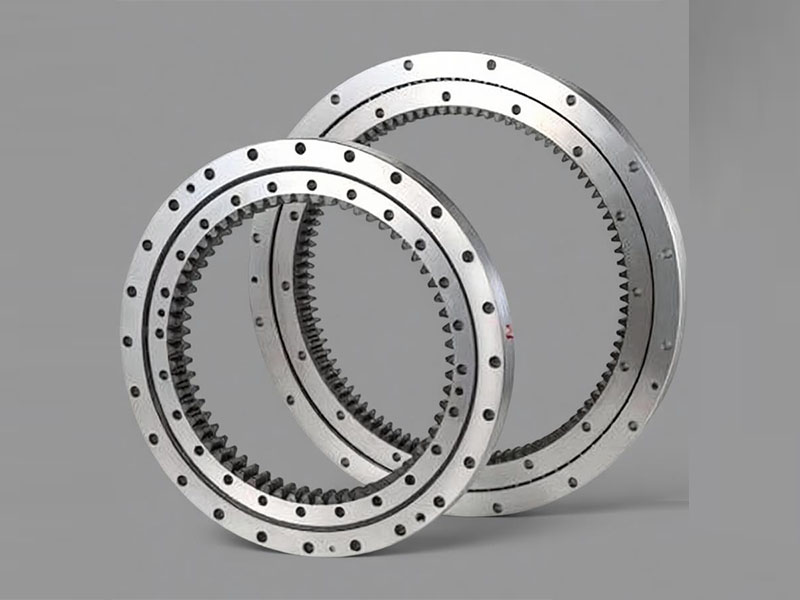
A slewing bearing, also known as a slewing ring or turntable bearing, is a large-sized bearing designed to handle the unique demands of slow-rotating, heavy-load applications. Unlike standard bearings that primarily manage radial or axial loads, a slewing bearing is a multi-functional powerhouse.
- Definition and Core Function: Its primary job is to simultaneously accommodate axial loads (thrust), radial loads, and the enormous tilting moment (overturning forces) generated by a jib crane’s arm. It provides a smooth, low-friction pivot point.
- Basic Structure: A typical slewing bearing consists of four key elements: an inner ring, an outer ring, rolling elements (balls or rollers), and a cage or spacer to keep the rolling elements separated. It also features integral seals to protect the rolling elements and pre-drilled mounting holes for easy integration. An integrated gear (internal or external) is common for direct drive systems.
3. Types of Slewing Bearings
Selecting the right type of slewing bearing is the first step in building a reliable jib crane. Here’s a breakdown based on common classifications:
By Rolling Element:
- Single Row Four-Point Contact Ball Bearing: The most common and cost-effective choice for light to medium-duty jib cranes. It can handle axial loads from both directions and a moderate tilting moment.
- Crossed Roller Bearing: Offers higher rigidity and rotational accuracy due to cylindrical rollers arranged perpendicularly in V-shaped grooves. Ideal for applications requiring precise positioning.
- Three Row Roller Bearing: The ultimate solution for heavy-duty jib cranes. Each row of rollers handles a specific load (axial up/down, radial), providing maximum load capacity and stability.
By Gear Integration:
- External Gear: The gear teeth are cut on the outer ring. The drive pinion is located outside the bearing, often used when space is limited on the inner diameter.
- Internal Gear: The gear teeth are cut on the inner ring. The drive pinion is located inside the bearing’s center, offering a cleaner, more protected drive mechanism, common in many jib crane designs.
- Non-Geared: For manually rotated cranes or those using a separate drive system, a gearless bearing is the simplest and most economical choice.
4. Why Jib Cranes Rely on Slewing Bearings
Why not simply use a kingpin and bushing arrangement? The answer lies in performance and longevity.
- Superior to Traditional Hinges: Compared to old-style central pivot points, slewing bearings distribute load over a much larger area. This drastically reduces friction, eliminates metal-on-metal wear, and ensures smooth, effortless rotation even under heavy loads.
- Meeting the Jib Crane’s Challenge: A jib crane’s arm creates a substantial lever arm. When a load is lifted, it generates a massive tilting moment that tries to tip the crane over. The slewing bearing is uniquely engineered to counteract this force. Its wide diameter provides a stable base, allowing the crane to handle loads many times its own weight with minimal deflection.
- Structural and Operational Advantages: The bearing’s compact design integrates the rolling elements, mounting points, and often the drive gear into a single, pre-assembled unit. This simplifies the crane’s overall structure, reduces assembly time, and provides a maintenance-friendly solution that is both robust and reliable.
5. The Role and Stress Analysis in Different Jib Cranes
The specific demands on a slewing bearing vary with the jib crane type.
What is a Jib Crane? A jib crane is a material handling device with a horizontal member (the jib or arm) that supports a movable hoist. Common types include wall-mounted (fixed to a building column), free-standing pillar (mounted on an independent foundation), and mobile (mounted on a movable base).
Core Role: In all types, the slewing bearing serves as the critical articulation point, connecting the rotating jib to its stationary mounting (wall bracket, pillar, or base).
Stress Characteristics:
- Wall-Mounted: The bearing experiences a combination of bending moment and shear forces, demanding high radial and tilting moment capacity.
- Pillar-Mounted: The bearing at the top of the pillar must handle the full tilting moment generated by the jib. Rigidity is paramount to prevent excessive deflection that could cause the load to swing.
- Mobile: The bearing must be robust enough to handle both the lifting forces and the dynamic stresses from moving the entire crane.
6. The High Stakes of Bearing Selection: Risks and Impacts
Choosing the wrong bearing is a gamble with serious consequences.
Risks of Improper Selection:
- Safety Hazards: The most critical risk. An undersized bearing can lead to catastrophic failure, including gear tooth fracture, mounting bolt fatigue and breakage, or even complete bearing seizure, potentially causing the crane to drop its load or collapse.
- Performance Issues: Excessive rotational friction, jerky movement, and noticeable play or deflection in the jib, leading to inaccurate load positioning.
- Economic Losses: Premature bearing failure results in unplanned downtime, expensive emergency repairs, and frequent replacement costs, directly impacting productivity.
The Value of Correct Selection: Investing time in proper selection ensures that the bearing’s capacity matches the crane’s operational demands. This is the foundation for a safe, reliable, and efficient material handling system with a predictable and manageable maintenance schedule.
7. How to Select the Correct Slewing Bearing for Your Jib Crane
Selection is an engineering process, not a guessing game. Key parameters include:
- Load Curves: Manufacturers provide static and dynamic load capacity curves. You must calculate the equivalent load (combining axial, radial, and tilting moment forces) based on your maximum load and jib geometry, and ensure this point falls within the bearing’s safe operating zone.
- Dimensions and Tolerances: Critical dimensions include the pitch circle diameter of the mounting holes, the bearing’s overall height, and the inner/outer diameter. These must precisely match your crane’s design specifications.
- Material Selection: For standard applications, bearing steel like 50Mn is common. For more demanding or larger bearings, alloy steel like 42CrMo, which offers higher strength and better hardenability, is preferred.
- Heat Treatment: The raceways are induction hardened to a specific depth. A proper hardening depth is crucial to withstand the repetitive rolling contact stresses without premature wear or brinelling.
- Gear Parameters: If using a driven system, the gear module, number of teeth, and material strength must be calculated to withstand the drive torque. Proper backlash must be specified for smooth engagement with the pinion.
- Seals and Lubrication: The seal type (e.g., nitrile lip seal, labyrinth seal) must be chosen based on the operating environment to prevent contaminant ingress. A centralized lubrication system with scheduled re-greasing is essential for long life.
8. Best Practices for Installation and Maintenance
Proper care from day one is non-negotiable.
8.1 Pre-Installation Preparation:
- Mounting Surface Check: The flatness of the mating structures (mounting flange) is critical. An out-of-flat condition will distort the bearing’s rings, leading to high friction and premature failure. Surface roughness must also meet specifications.
- Handling: Unpack and lift the bearing carefully using soft slings, avoiding impacts that could damage raceways or gear teeth.
8.2 Installation Essentials:
- Bolting is Critical: Use only high-strength bolts (e.g., grade 10.9 or 12.9) as specified. Clean the threads and mounting surfaces. Apply the exact torque value in a cross-tightening pattern over at least three passes to ensure even preload.
- Post-Installation Check: After torquing, rotate the crane by hand. It should turn smoothly. Check the running clearance and re-check mounting surface flatness.
8.3 Maintenance Regime for Longevity:
- Relubrication: This is the most important maintenance task. Follow the manufacturer’s schedule (e.g., initial re-grease after first 100 hours, then every 3-6 months or 500 operating hours). The correct grease type and quantity are vital to purge old grease and contaminants.
- Break-in Period: Monitor the bearing closely during the first weeks of operation. Check bolt torque and listen for any unusual noises.
8.4 Daily & Periodic Inspection Checklist:
- Listen: Any grinding, clicking, or inconsistent noise indicates a problem.
- Look: Inspect seals for damage or leakage. Check all accessible mounting bolts for signs of loosening (e.g., paint cracking around bolt heads).
- Feel: Note any excessive vibration or play in the jib movement.
9. Troubleshooting Common Failures
When issues arise, look for the root cause.
- Wear/Spalling on Raceways: Often caused by contaminated grease (abrasive wear) or inadequate lubrication. Severe spalling indicates the bearing has been overloaded or has reached its fatigue life.
- Broken Rolling Elements: Usually a sign of extreme shock loads or an overload condition far beyond the bearing’s design capacity.
- Gear Tooth Breakage: Can result from improper alignment between the pinion and bearing gear, debris jamming the teeth, or simply fatigue from high cyclic loads.
- Loose or Broken Mounting Bolts: Classic symptom of insufficient initial preload (torque) or a bearing that has become loose due to wear, subjecting bolts to cyclic bending fatigue.
Conclusion
The slewing bearing is far more than a simple component; it is the engineering heart of any jib crane, dictating its safety, precision, and longevity. From the initial design phase and meticulous selection to precise installation and diligent maintenance, every step in the bearing’s lifecycle demands attention. A well-chosen and properly maintained slewing bearing ensures smooth, reliable operation, minimizes downtime, and provides a safe working environment for years to come.
Navigating the technical complexities of selection and maintenance can be challenging. This is where a partnership with an experienced manufacturer like DUHUI Bearing becomes invaluable. With our deep understanding of material science, precision manufacturing, and application engineering, we don’t just supply bearings; we provide solutions.