When designing or maintaining rotating machinery, every component choice carries consequences. Among these, the selection between single row and double row ball bearings is a decision that directly impacts equipment reliability, operating costs, and maintenance intervals.
This article examines the technical distinctions between single row and double row ball bearings. DUHUI will compare their load characteristics, speed capabilities, and application suitability, providing the information needed to make an informed specification decision.
Single Row Ball Bearings: The Standard for High-Speed Versatility
The single row deep groove ball bearing is the most widely used bearing in the world, and for good reason. Its design offers an optimal balance of cost, friction, and speed capability.
Design Fundamentals
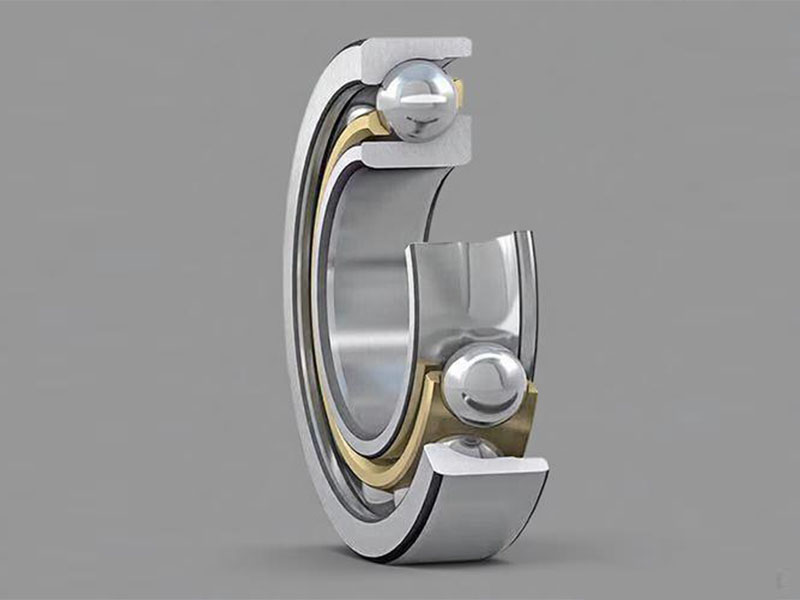
The basic structure consists of an inner ring, an outer ring, a cage, and a single row of balls. The deep groove raceways are slightly larger than the balls, allowing the bearing to accommodate not only radial loads but also moderate axial loads in both directions. This design has spawned numerous variants to suit specific needs, including:
- Shielded (ZZ): For grease retention and protection against light contamination.
- Sealed (2RS): For enhanced protection in dirty environments.
- Snap Ring (NR): For simple axial location in the housing.
- C3 Clearance: For applications involving high temperatures or interference fits.
Load Capacity & Speed Dynamics
- Radial Load: Single row bearings handle significant radial loads, but their capacity is limited by the number of rolling elements in a single circuit.
- Axial Load: They are excellent for applications with light to moderate axial forces. However, under pure axial load, the contact angle forms, distributing the load, but extreme axial loads are better suited for angular contact bearings.
- Speed Advantage: Because they have lower internal mass and generate less heat due to fewer rolling elements, single row ball bearings typically have higher limiting speeds than their double row counterparts. This makes them ideal for continuous high-speed rotation.
Primary Applications
Thanks to their standardization and low friction, you will find single row bearings in:
- Electric motors (small to medium frame)
- Household appliances (washing machines, fans)
- Industrial pumps and gearboxes
- Agricultural machinery
Double Row Ball Bearings: Maximizing Load Capacity in Limited Spaces
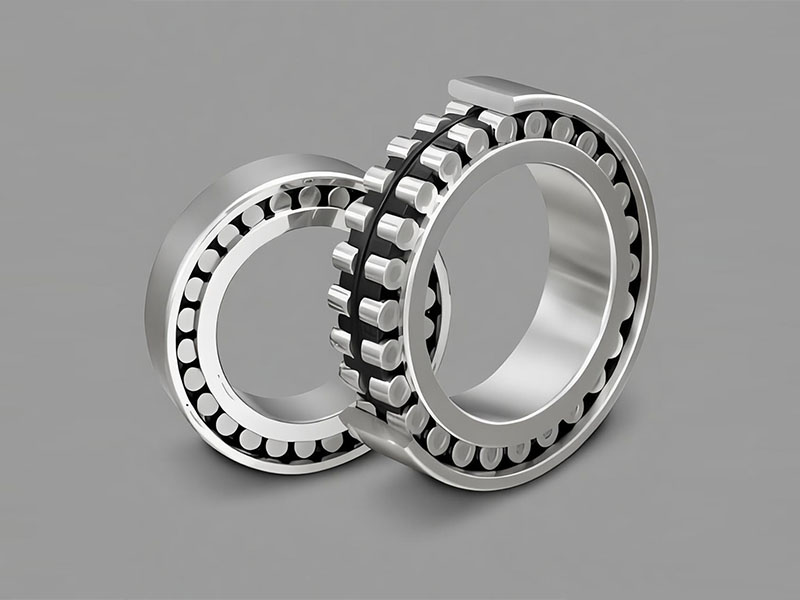
When the shaft needs extra support but the axial space (width) is limited, a double row ball bearing is often the engineer’s first choice. They are essentially two bearings in one, but with specific performance characteristics.
Structural Configuration
Double row bearings feature two rows of balls with a common inner or outer ring. The most common type is the double row deep groove ball bearing (e.g., 42, 43 series). There are also double row angular contact ball bearings (e.g., 32, 33 series), which are designed to handle higher axial forces.
Load Capacity & Rigidity
- Superior Radial Load: By adding a second row of balls, the bearing’s radial load capacity increases dramatically—typically by 40% to 50% compared to a single row bearing of a similar bore size.
- Moment Load Resistance: This is where double row bearings truly shine. They have a much wider effective load center, giving them excellent resistance to moment loads (tilting forces). This rigidity helps maintain shaft alignment under heavy or unbalanced loads.
Design Trade-offs
While they are powerful, double row bearings come with specific trade-offs:
- Speed Limitations: More balls mean more friction and heat. Therefore, their limiting speed is lower than a comparable single row bearing. They are not typically suited for very high-speed applications.
- Internal Clearance Complexity: Setting the correct internal clearance is more critical. If the application requires an interference fit on both the shaft and in the housing, the preload can increase unexpectedly, leading to rapid failure.
- Misalignment Sensitivity: They are very sensitive to misalignment. If the shaft bends or the housing is not perfectly aligned, the load distribution between the two rows becomes uneven, causing premature wear.
Direct Performance Comparison
To make an informed choice, engineers must weigh the technical metrics against the application’s demands.
Performance Under Load Scenarios
- Pure Radial Loads: In a confined space, the double row bearing is superior due to its higher load rating.
- Combined Loads (Radial + Heavy Axial): For moderate combined loads, a single row works. For heavy combined loads with moment forces, a double row angular contact bearing is often the better solution.
- High-Speed/Light Load: The single row is the clear winner. Its low friction and high-speed capability ensure cool running and long grease life.
Economic and Maintenance Considerations
- Initial Cost: A double row bearing is generally more expensive than a single row bearing due to the more complex manufacturing process and higher material content.
- Replacement Intervals: In heavy-load applications, the double row bearing may last significantly longer, offsetting the higher initial cost. In high-speed applications, a single row is less likely to overheat and fail.
- Downtime Impact: For critical machinery where downtime costs thousands per hour, choosing the bearing with the appropriate dynamic load rating (C) is vital. Over-specifying (using a double row where a single row suffices) can actually reduce reliability if speed is a factor.
Selection and Installation:Tips
At DUHUI, we guide our clients through a simple checklist to ensure the right fit.
Key Selection Factors
- Space Envelope: Is shaft diameter fixed? If you have the width, a double row offers more capacity. If width is tight but load is moderate, stick with single row.
- Speed Requirement: Calculate the DN factor (bore diameter in mm × RPM). If the DN factor is near the limit of grease lubrication, a single row is mandatory.
- Environmental Conditions: In dirty, high-temperature, or high-humidity environments, sealed variants of both types are available. However, the larger mass of a double row bearing may retain more heat.
Installation and Maintenance Tips
- Correct Mounting: Never apply mounting force through the balls. Use the correct press-fit tools. For double row bearings, ensure the housing and shaft tolerances are precise to avoid preloading the internal rows.
- Lubrication: For grease-lubricated applications, fill approximately 30-40% of the free space. Over-greasing leads to high operating temperatures, especially in double row bearings.
- Maintenance Plan: In continuous operation, monitor vibration and temperature. A rise in temperature often indicates an issue with lubricant or excessive preload.
Conclusion & Expert Support
The choice between single row and double row ball bearings ultimately rests on your specific operating parameters. Single row bearings deliver high-speed capability and low friction for general machinery applications. Double row bearings provide enhanced load capacity and rigidity where space is constrained but demands are high. Neither is inherently superior—only more or less appropriate for the conditions at hand.
If you are currently evaluating bearing options for a project or experiencing performance issues with an existing application, our engineering team is available to discuss your specific conditions. Sometimes the right solution begins with the right conversation.