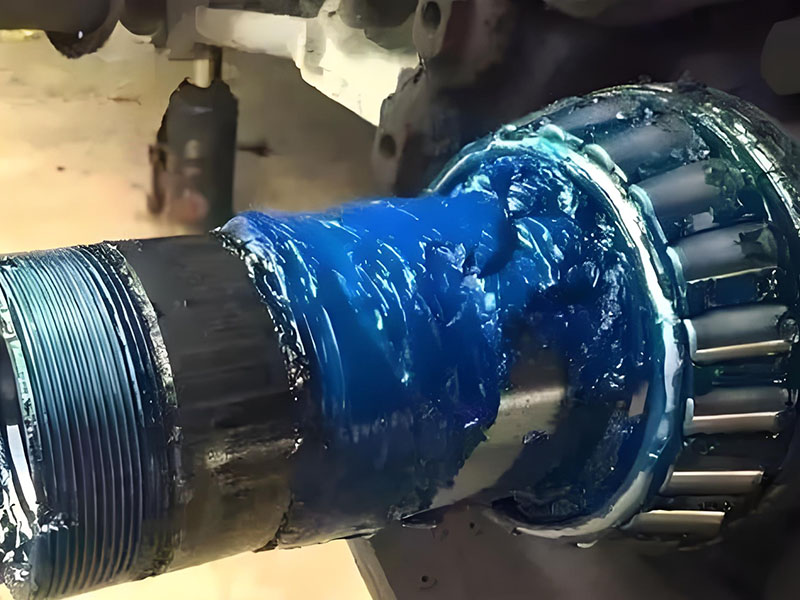
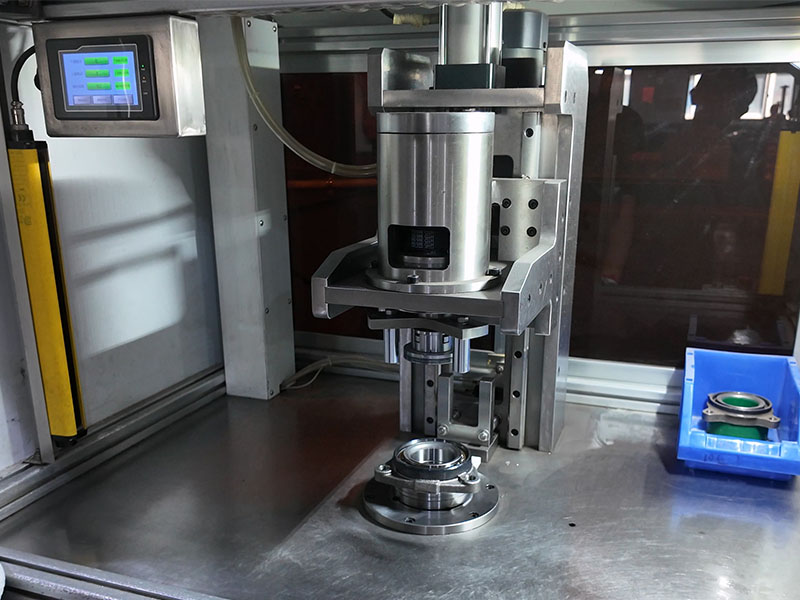
In the world of machinery and mechanical design, few components are as fundamental yet as misunderstood as bushings and bearings. Both serve the critical purpose of reducing friction between moving parts, supporting loads, and ensuring the smooth, efficient operation of equipment. At first glance, they might seem interchangeable. However, their internal workings, performance characteristics, and ideal applications are quite distinct.
Choosing the wrong component can lead to premature wear, increased energy consumption, equipment failure, and costly downtime. This comprehensive guide will demystify bushings and bearings. We’ll delve into their definitions, explore the various types, and provide a detailed head-to-head comparison. By the end, you’ll have the knowledge to make the right choice for your specific application.
1.What Are Bearings?
In engineering terms, a bearing is a machine element that constrains relative motion to only the desired motion and reduces friction between moving parts. The vast majority of bearings, particularly rolling-element bearings, work on the principle of rolling friction.
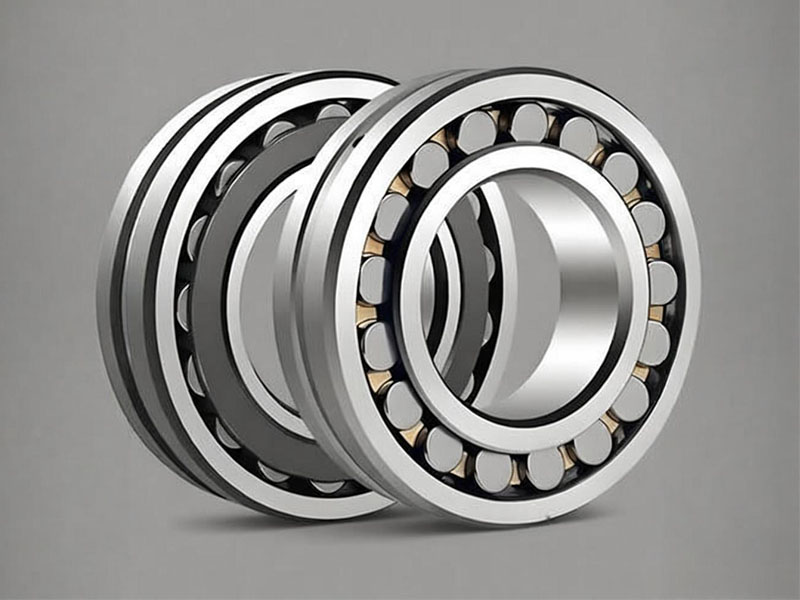
A typical rolling bearing consists of four main parts:
- Inner Ring: Mounts onto the shaft.
- Outer Ring: Fits into the housing.
- Rolling Elements: The balls or rollers that roll between the rings.
- Cage: Separates the rolling elements, ensuring even spacing and preventing contact.
The primary functions of a bearing are to support radial or axial loads (or a combination of both) and guide rotating parts with high precision.
Common Types of Bearings (Classified by Rolling Element):
- Ball Bearings (Deep Groove): The most common type, using spherical balls as the rolling element. They are ideal for moderate radial and axial loads and high-speed applications like electric motors and fans.
- Cylindrical Roller Bearings: These use cylindrical rollers, offering line contact with the raceways. This gives them a much higher radial load capacity than ball bearings, suitable for applications like gearboxes and rolling mills.
- Spherical Roller Bearings: Featuring barrel-shaped rollers, these bearings are designed to accommodate heavy radial and axial loads, as well as misalignment of the shaft. They are common in heavy-duty industrial machinery, conveyors, and wind turbines.
- Tapered Roller Bearings: Designed with tapered rollers and raceways, they are uniquely capable of handling combined radial and axial (thrust) loads. This makes them the go-to choice for vehicle wheel hubs, where they must support the weight of the car and cornering forces.
- Needle Roller Bearings: These bearings use long, thin cylindrical rollers resembling needles. Their compact cross-section makes them perfect for applications with limited radial space, such as automotive transmissions and rocker arm pivots.
Other Bearings Classified by Function:
- Thrust Bearings: Specifically designed to support axial loads. They can be ball or roller type and are used in applications like automotive transmissions and marine propeller shafts.
- Angular Contact Ball Bearings: With raceways displaced relative to each other, they are designed to support combined loads and are essential for high-speed, high-precision spindles.
2.What Are Bushings?
A bushing is a type of plain bearing. In its simplest form, it’s an independent, sleeve-like component that is inserted into a housing to provide a bearing surface for a rotating or sliding shaft. Unlike rolling bearings, bushings operate on the principle of sliding friction. The shaft slides against the bushing’s inner surface.
Bushings are typically a single-piece component made from a variety of materials, each offering unique benefits.
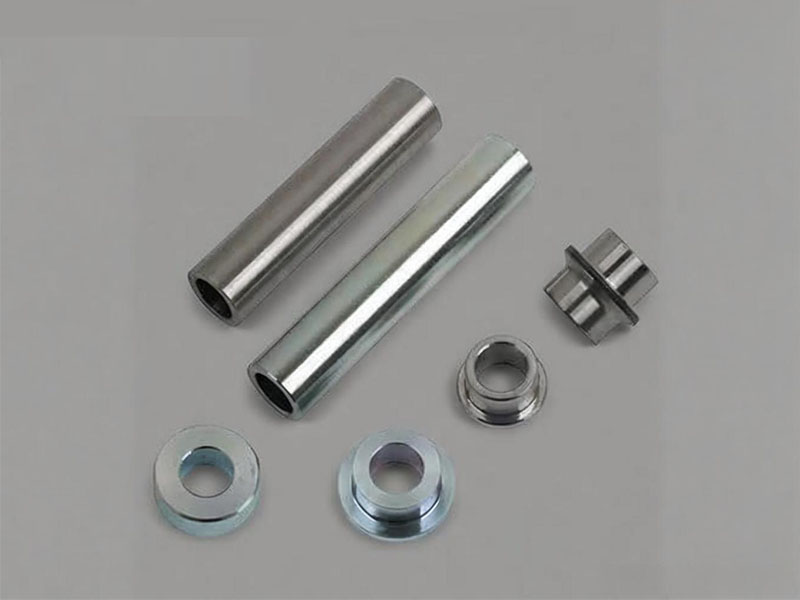
Common Bushing Materials:
- Metal (e.g., Bronze, Steel): Bronze bushings are renowned for their excellent wear resistance and compatibility with steel shafts. Steel bushings offer high strength and durability.
- Plastic/Polymer (e.g., PTFE, Nylon, PEEK): These are lightweight, corrosion-resistant, and can operate with little to no lubrication. They are excellent for clean environments or where chemical resistance is needed.
Common Types of Bushings:
- Sleeve Bushings: The most basic cylindrical shape, designed for radial loads.
- Flanged Bushings: A sleeve bushing with a flange at one end. The flange acts as a thrust surface, allowing it to handle light axial loads and simplifying installation.
- Thrust Washers: Flat, ring-shaped bushings used specifically to bear axial thrust loads between rotating and stationary surfaces.
- Tapered Bushings: Used to mount pulleys, sprockets, and couplings onto shafts securely. They provide a tight, concentric fit and are easy to install and remove.
- Linear Bushings: Designed for linear motion systems. They allow a shaft to move back and forth with minimal friction, often using recirculating balls or a plain polymer liner.
- Self-Lubricating / Oil-Impregnated Bushings: Often made from porous bronze, these are vacuum-impregnated with oil. As the shaft rotates and heats up, the oil expands and provides lubrication, making them a “fit-and-forget” solution.
3.Bushing vs Bearing: A Detailed Comparison
To clearly illustrate the differences, let’s put them side-by-side:
| Feature | Bushings (Plain Bearings) | Rolling Bearings |
| Motion Principle | Sliding friction | Rolling friction |
| Structure | Simple, typically one piece | Complex, multiple precision components |
| Load Capacity | Excellent for heavy, shock, and impact loads | Ideal for moderate to high, steady loads |
| Speed Capability | Superior in low to medium-speed applications | Superior in high-speed applications |
| Precision | Good for general use; clearance can affect precision | High precision and rigidity, controllable clearance |
| Noise & Vibration | Quiet operation, excellent damping properties | Can generate noise and vibration at high speeds |
| Lubrication | May require regular greasing; self-lube options exist | Usually requires precise, regular lubrication |
| Cost | Lower manufacturing and purchase cost | Higher manufacturing and purchase cost |
| Installation | Simple press-fit or slip-fit | Requires precise fits, shafts, and housings |
4.How to Choose: Bearing or Bushing?
Your choice hinges on the specific demands of your application. Ask yourself these questions:
- What are the speed and load conditions? For high-speed rotation, a rolling bearing is almost always the better choice. For heavy, oscillating, or impact loads at lower speeds, a bushing is often more durable and cost-effective.
- How much space do I have? If radial space is extremely tight, a needle roller bearing or a thin-walled bushing might be the only options.
- What level of precision is needed? Applications requiring precise shaft location and minimal runout, like machine tool spindles, demand high-precision rolling bearings.
- What is the operating environment? In dirty or dusty environments, a sealed bushing can be less susceptible to contamination than a precision bearing. For quiet operation (e.g., in office equipment), bushings are superior.
- What are the budget and maintenance goals? For a simple, low-cost, and easily replaceable solution, a bushing is ideal. If your design allows for a lubrication schedule and you need the performance of rolling elements, a bearing is the way to go.
As a leading manufacturer, DUHUI Bearing produces a comprehensive range of both high-quality rolling bearings and precision-engineered bushings. We don’t just sell parts; we provide solutions.
Conclusion & Partner with DUHUI
There is no universal “better” component—only the right component for the job. Bushings offer simplicity, durability, and cost-effectiveness for many applications, while bearings provide the precision, speed, and efficiency required for more demanding machinery. Understanding these fundamental differences is the first step toward optimizing your equipment’s performance and lifespan.
With two decades of manufacturing expertise and 15 years of serving the global market, DUHUI Bearing possesses the deep technical knowledge to guide you through this decision. Whether you need a robust tapered roller bearing for an automotive hub or a maintenance-free flange bushing for a new agricultural machine, our team is ready to assist.