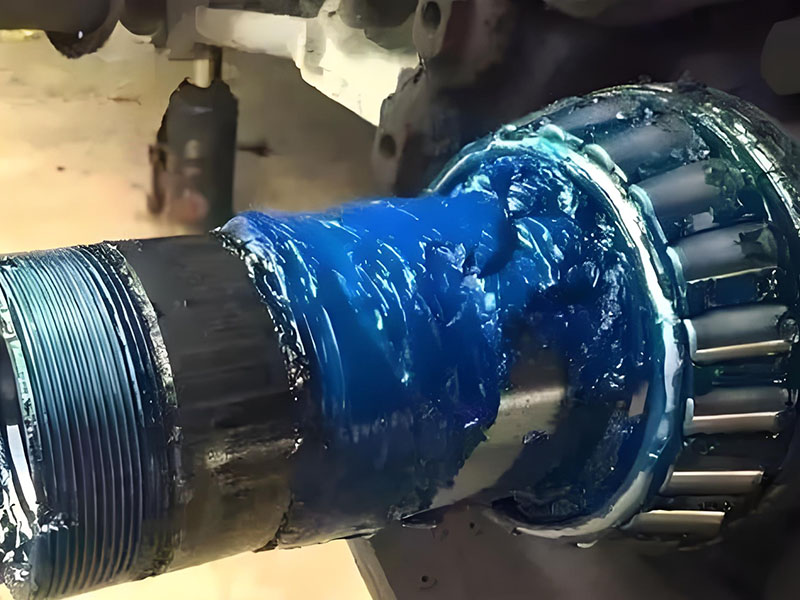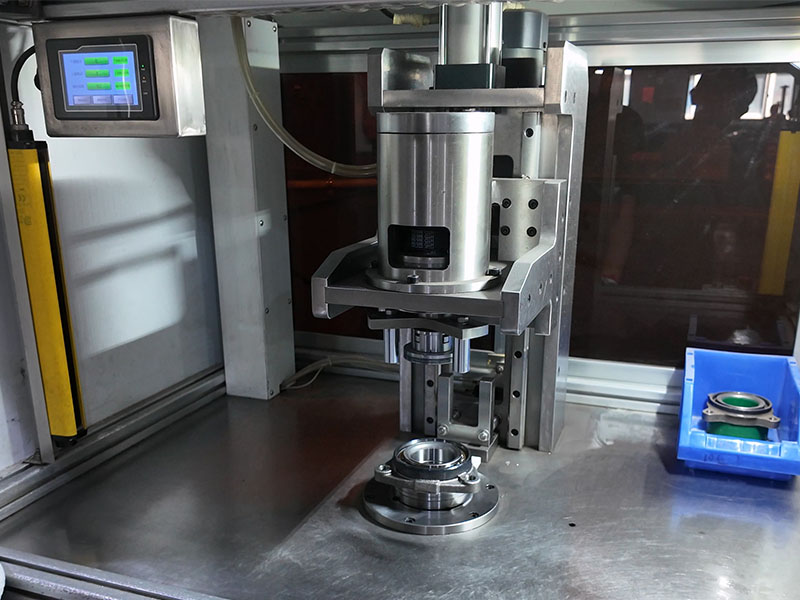
When designing or maintaining industrial equipment, one critical decision is choosing between sliding bearings and roller bearings. Both serve the fundamental purpose of reducing friction between moving parts, yet they operate on entirely different principles. How do sliding bearings and roller bearings differ, and which one is right for your equipment? DUHUI will break down their design, performance, and ideal applications to help you make an informed choice.
1. What Is a Sliding Bearing? (Plain Bearing)
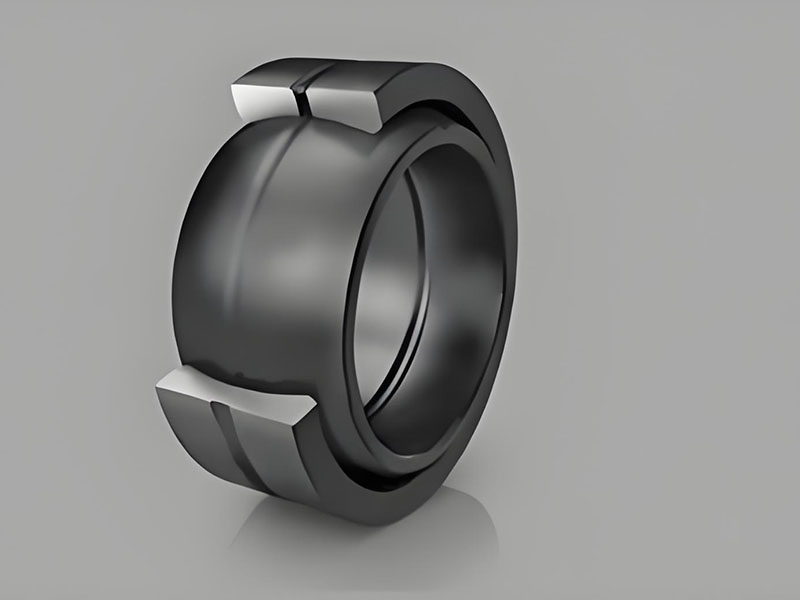
1.1 Definition
A sliding bearing, also known as a plain bearing, operates with two surfaces sliding against each other, typically with a lubricant layer separating them. There are no rolling elements; instead, the shaft (journal) rotates directly inside the bearing shell.
1.2 Key Characteristics: Design, Load Capacity, Friction Behavior
Sliding bearings have a simple design—often just a sleeve made of metal, polymer, or composite material. They distribute loads over a relatively large surface area, which allows them to support very loads. However, friction is higher than in rolling bearings during startup, though it reduces once a full lubricant film is established.
1.3 Common Applications: Heavy Machinery, Construction Equipment, Industrial Use
You’ll often find sliding bearings in:
- Heavy construction equipment like excavators
- Large industrial gearboxes
- Marine propulsion systems
- Hydraulic cylinders
1.4 Advantages: Cost-Effective, Robust, Easy to Maintain
- Cost-effective – simple structure means lower manufacturing costs.
- Robust – no rolling elements to fatigue or crack under extreme loads.
- Easy to maintain – fewer components reduce risk of assembly errors.
1.5 Limitations: Higher Friction Loss, High Lubrication Dependency, Not Ideal for High Speed
Sliding bearings rely heavily on a lubricant . If lubrication fails, friction rises sharply. They also generate more heat at high rotational speeds, making them unsuitable for high-speed applications.
2. What Is a Roller Bearing?
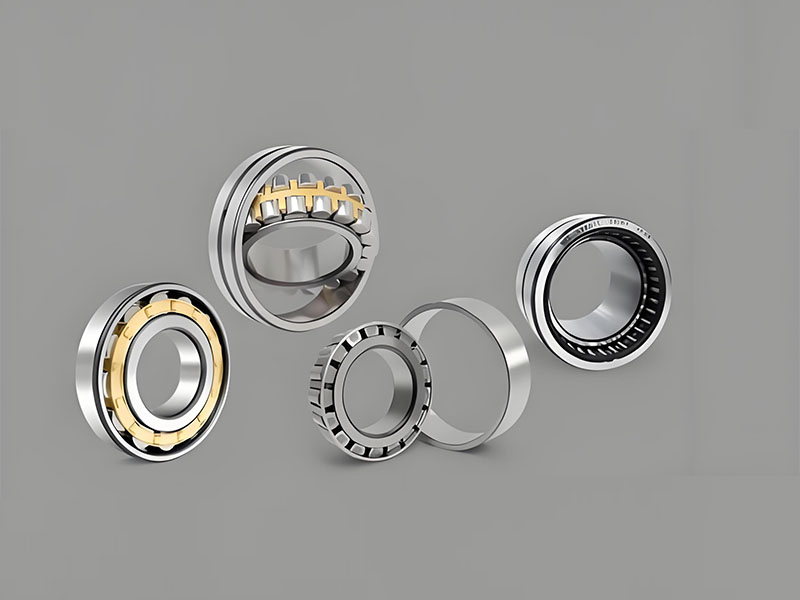
2.1 Definition
A roller bearing uses rolling elements (cylindrical, tapered, spherical, or needle rollers) between the inner and outer rings to reduce friction. The rolling motion replaces sliding, which significantly lowers resistance.
2.2 Main Components: Rolling Elements, Inner Ring, Outer Ring, Cage
Every roller bearing consists of:
- Inner ring – fits onto the rotating shaft
- Outer ring – sits in the housing
- Rolling elements – carry the load through rolling contact
- Cage – keeps rolling elements evenly spaced
2.3 Key Characteristics: Structure, Load Capacity, Friction Efficiency
Roller bearings handle loads through point or line contact, which reduces friction but also concentrates stress. They offer excellent friction efficiency, especially at higher speeds, and are available in configurations for radial, axial, or combined loads.
2.4 Typical Applications: Wheel Hubs, Wind Turbines, Motors, Pumps, Fans
- Automotive wheel hubs and transmissions
- Wind turbine main shafts
- Electric motors and industrial pumps
- High-speed fans and compressors
2.5 Advantages: High Efficiency, Long Service Life, Versatility
- High efficiency – low starting torque and minimal energy loss.
- Long service life – predictable fatigue life under proper lubrication.
- Versatility – many designs (cylindrical, tapered, spherical) for different
- load and alignment conditions.
2.6 Limitations: Higher Cost, Lower Shock Load Resistance, More Complex Maintenance
Roller bearings are generally more expensive to manufacture. They are sensitive to shock loads and misalignment, and maintenance requires precise handling to avoid damage to rolling surfaces.
3. Sliding Bearing vs Roller Bearing: Direct Comparison
3.1 Friction and Wear
Roller bearings have lower starting and running friction, making them energy-efficient in continuous rotation. Sliding bearings have higher startup friction but can operate with negligible wear if hydrodynamic lubrication is maintained.
3.2 Load Capacity and Shock Resistance
Sliding bearings excel in high static or shock loads due to their large contact area. Roller bearings are better suited for steady, moderate loads but can suffer brinelling under impact.
3.3 Speed Capability
Roller bearings are the clear choice for high-speed applications, as they generate less heat. Sliding bearings are limited to low or moderate speeds unless specially designed with advanced materials and pressurized lubrication.
3.4 Maintenance Requirements
Sliding bearings require careful lubrication management but have fewer components to inspect. Roller bearings need periodic relubrication and inspection for fatigue or spalling, especially in contaminated environments.
3.5 Cost Considerations
Sliding bearings typically have a lower initial cost. However, total lifecycle cost depends on lubrication, energy consumption, and replacement frequency. Roller bearings may have higher upfront cost but offer longer service intervals in high-speed applications.
4. How to Choose the Right Bearing for Your Application
4.1 When to Choose a Sliding Bearing: Heavy, Slow, or Shock-Load Conditions
Consider sliding bearings when:
- Loads are very heavy or involve frequent shocks.
- Operating speeds are low to moderate.
- Simplicity and durability outweigh energy efficiency concerns.
- The application allows reliable lubrication (e.g., oil bath or pressurized systems).
4.2 When to Choose a Roller Bearing: High Speed, High Precision, and Rotational Applications
Choose roller bearings when:
- High rotational speeds are required.
- Precision and minimal vibration are critical.
- Energy efficiency and low starting torque are priorities.
- Compact design with high load capacity per volume is needed.
5. Frequently Asked Questions (FAQ)
Which bearing is better for high-speed applications?
Roller bearings are generally better for high-speed use because they generate less friction and heat compared to sliding bearings.
Can sliding bearings handle heavy loads?
Yes, sliding bearings are excellent for heavy loads, especially when the load is constant or involves shock, as the large surface area distributes stress effectively.
Are roller bearings always more expensive?
Not always. While the purchase price is often higher, roller bearings can offer lower total cost of ownership in high-speed or precision applications due to reduced energy consumption and maintenance.
Conclusion
The choice between a sliding bearing and a roller bearing comes down to operating conditions: load type, speed, lubrication availability, and lifecycle cost priorities. Sliding bearings offer unmatched robustness for heavy, slow-moving equipment, while roller bearings deliver efficiency and precision in high-speed rotations.
If you have any needs, please feel free to contact us. As a professional bearing manufacturer, DUHUI Bearing provides both sliding bearing and roller bearing solutions.