Slewing bearings (also known as slewing rings or turntable bearings) are the “hips” of heavy machinery—they allow for smooth, controlled rotation while shouldering immense loads. Whether it’s a massive crane lifting tons of steel or a precision medical scanner rotating around a patient, a slewing bearing makes it possible.
In this guide, DUHUI will walk you through the inner workings, types, and engineering principles of slewing bearings to help you understand what makes them rotate—and how to make them last.
1. What is a Slewing Bearing?
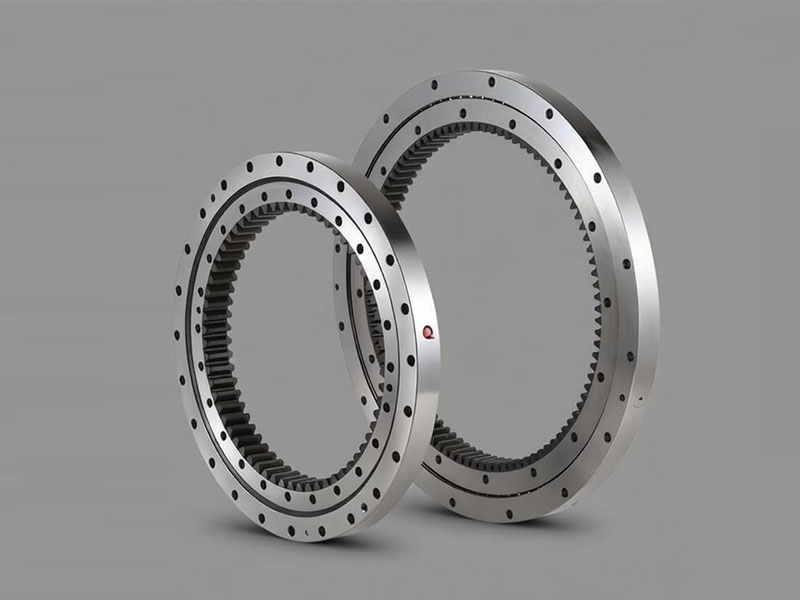
A slewing bearing is a large-sized rotational element that can handle combined loads: axial loads (thrust), radial loads, and a high tilting moment (overturning force). Unlike standard bearings, they are designed to be bolted directly into a structure, often incorporating gears on the inner or outer ring to transmit torque.
Core Structural Components
Understanding the parts is the first step to understanding the whole:
- Inner Ring and Outer Ring: Typically made from high-strength forged steel (like 50Mn or 42CrMo). At DUHUI, we apply advanced heat treatment to the raceways to ensure surface hardness and core toughness, resisting deformation under extreme pressure.
- Rolling Elements: These can be balls or cylindrical rollers. Balls provide smoother motion for high-speed applications, while rollers offer higher load capacity for heavy-duty jobs.
- Cage (Separator): This component spaces the rolling elements evenly, preventing friction between them and guiding their motion through the load zone.
- Seals: The seal is the first line of defense. A high-quality seal keeps contaminants like dust and water out, and lubricant in. This is critical for outdoor equipment like wind turbines or excavators.
- Mounting Holes: Pre-drilled holes (or tapped holes) allow the bearing to be easily bolted to the supporting structure and the rotating equipment.
- Gearing (Optional): Teeth cut into the inner or outer ring turn the bearing into a gear-driven rotational stage.
2. The Working Principle of Slewing Bearings
How does this single component manage to rotate smoothly while holding everything together? It relies on three key mechanical principles:
2.1 Rotational Motion
The fundamental principle is rolling, not sliding. The rolling elements (balls or rollers) sit between the inner and outer raceways. As one ring rotates (driven by a pinion gear or a motor), the rolling elements circulate within the raceways, drastically reducing friction compared to a plain bearing or a manual turntable.
2.2 Load Distribution
This is where slewing bearings get their superpower. Imagine a crane lifting a load—the force isn’t just straight down. It tries to tip the crane over. This creates a tilting moment.
- The bearing handles this by distributing the load across multiple rolling elements.
- Elements on one side of the bearing are compressed, while those on the opposite side are unloaded.
- The wide cross-section of the rings and the strategic placement of the raceways allow the bearing to act as a rigid connection that resists this overturning force.
2.3 Gear Mechanism
If the application requires powered rotation (like a robotic arm), the bearing is equipped with gear teeth.
- A small drive gear (pinion) meshes with the gear teeth on the bearing’s inner or outer ring.
- As the pinion turns, it pushes against the bearing’s teeth, creating torque that rotates the entire structure with high precision and repeatability.
3. Main Types of Slewing Bearings and How They Work
Different applications require different internal geometries. Here’s how the main types function:
3.1 Four-Point Contact Ball Bearing
This is the most common type. The raceways in the inner and outer rings are arched so that each ball makes contact at two points. This design allows a single row of balls to handle axial loads from both directions, as well as radial loads. It’s ideal for applications like small cranes or aerial work platforms where space is limited and speeds are moderate.
3.2 Eight-Point Contact Ball Bearing
By using two rows of balls, this design doubles the contact points. It offers higher load capacity and stability than the single-row version. It is often used when the equipment requires a larger diameter but cannot accommodate the height of a roller bearing.
3.3 Crossed Roller Bearing
Instead of balls, this type uses cylindrical rollers arranged perpendicularly in a “V” groove. Each alternate roller faces the opposite direction. This provides maximum rigidity and high tilting moment capacity with minimal rotational resistance. At DUHUI, we specialize in high-precision crossed roller bearings, which are essential for industrial robots and machine tool tables where zero play is required.
3.4 Three-Row Cross Roller Bearing
For the heaviest loads—like in large port cranes or tunnel borers—this is the solution. It separates the load paths: one row of rollers handles radial loads, and two rows (top and bottom) handle axial loads. This allows for independent optimization of each load path, resulting in the highest possible load capacity.
3.5 Combined Ball and Roller Bearing
This hybrid design uses balls to carry radial loads and rollers to handle axial loads. It offers a balance of smooth running and high capacity, often found in specific military or medical applications.
4. Typical Applications & Engineering Mechanics
The choice of bearing type is dictated by the physics of the machine.
Construction Machinery (Excavators & Cranes):
- Mechanics: These machines face massive, shifting loads. The bearing must withstand constant shock loads and vibrations.
- DUHUI Insight: We use induction hardening on the raceways to create a deep, durable hardened layer that resists brinelling (indentation) from impact.
Wind Turbines:
- Mechanics: The blade pitch and yaw bearings must operate at very slow speeds under extreme, fluctuating winds, often in freezing temperatures.
- Requirement: High corrosion resistance and long maintenance intervals. Sealing and material selection (like using galvanized rings) are critical.
Medical Equipment (CT Scanners):
- Mechanics: The bearing must rotate smoothly and quietly while carrying a heavy X-ray gantry.
- Requirement: Low noise, high precision, and zero contamination. This calls for high-grade steel and precision machining.
Robotics & Industrial Machinery:
- Mechanics: Repeatability is key. The bearing must return to the exact same position thousands of times.
- Requirement: High rigidity. Crossed roller bearings excel here because they eliminate “play” between the rings.
5. Common Failure Modes and Prevention
Knowing why bearings fail helps us engineer them better. Here are the most common issues and how quality manufacturing prevents them:
Fracture: Usually caused by severe overload or a material defect.
Prevention: Proper load calculation during the design phase is essential. DUHUI’s engineering team can assist in selecting the right bearing to avoid under-sizing.
Indentation (Brinelling): Marks on the raceways caused by static overload or shock loads. Once started, the bearing will vibrate and degrade quickly.
Prevention: Ensure the mounting structure is flat and rigid. Use induction-hardened raceways to resist deformation.
Wear: Gradual loss of material due to friction or contamination.
Prevention: High-quality seals are non-negotiable. We design our seals to exclude fine particles that act like sandpaper on the raceways.
Corrosion: Rust pitting on the rings or teeth.
Prevention: Proper surface treatments (like phosphating or zinc coating) and a robust lubrication schedule.
Tooth Breakage (Gear Failure): Chipping or breaking of gear teeth due to misalignment or foreign objects.
Prevention: Precise gear cutting and heat treatment ensure teeth are hard but not brittle.
6. Conclusion
Let’s return to our original question: How does a slewing bearing work?
Now we can answer with three core principles:
- Rolling replaces sliding, minimizing friction to its lowest possible level
- Multiple contact points distribute loads, simultaneously handling axial forces, radial forces, and tilting moments
- Gear integration enables drive, transforming passive support into active motion
These three principles run through all types, all applications, and all sizes of slewing bearings.
Understand them, and you understand the soul of the slewing bearing.