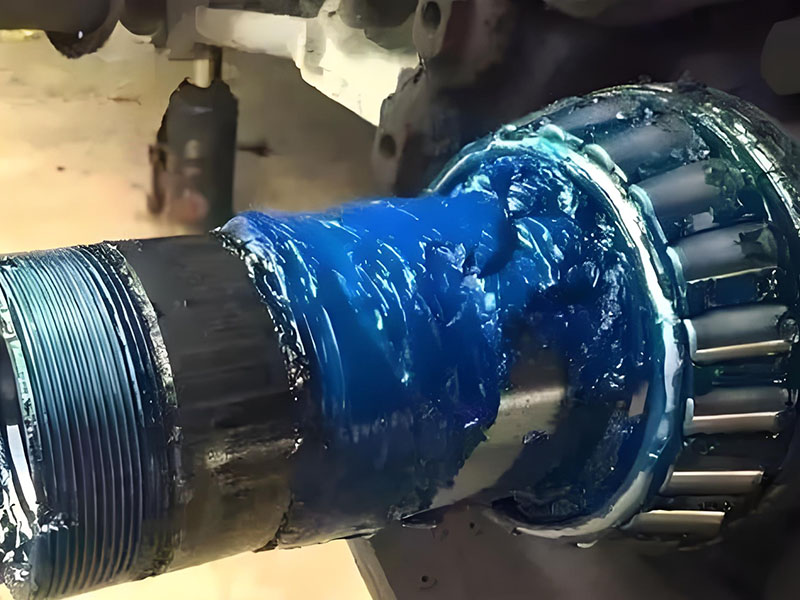
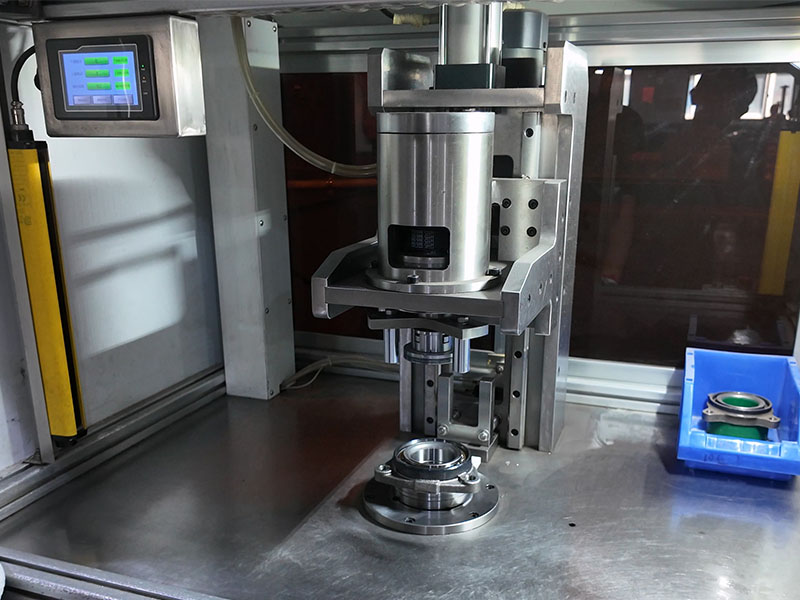
Railway bearings are critical components that support rotating wheelsets, transmit loads from the train to the rails, and enable smooth, low-friction motion at high speeds and heavy loads. Unlike general industrial bearings, railway bearings must endure extreme dynamic impacts, continuous operation for hundreds of thousands of kilometers, and harsh environmental conditions including moisture, dust, and temperature variations. DUHUI will cover the engineering principles, types, materials, selection criteria, quality inspection methods, and practical applications of railway bearings.
1. What Are Railway Bearings?
A railway bearing is a mechanical assembly installed between the axle journal and the axlebox (or wheelset hub). Its primary functions are to support the weight of the railcar (radial load), manage axial forces from curves and braking (axial load), and maintain precise rotational alignment while minimizing friction. A typical railway bearing unit includes inner and outer rings, rolling elements (rollers or balls), a cage, and seals, often pre-lubricated with grease. In modern rolling stock, most bearings are sealed-clean cartridge-type units that require no daily greasing.
2. How Do Railway Bearings Differ from General Bearings?
The differences are not merely dimensional; they are rooted in load magnitude, impact resistance, reliability requirements, and service life. The table below quantifies key contrasts.
| Parameter | Railway Bearings | General Industrial Bearings |
| Axial Load Capacity | 150,000 – 300,000 N (15-30 tons) | 1,000 – 50,000 N (0.1-5 tons) |
| Radial Load Capacity | 200,000 – 500,000 N (20-50 tons) | 2,000 – 100,000 N (0.2-10 tons) |
| Dynamic Impact Resistance | Very high; withstands rail joints, switches, and wheel flats | Low to moderate; designed for steady loads |
| Rotational Speed (DN value) | Up to 500,000 mm·rpm (for high-speed trains) | Typically below 200,000 mm·rpm |
| Required L10 Life | 1–3 million km (or >10 years) | 10,000–50,000 hours (intermittent operation) |
| Operating Temperature Range | -40°C to +120°C (with special grades up to 200°C) | -20°C to +80°C (standard) |
Railway bearings also incorporate robust sealing systems to prevent ingress of ballast dust and water, whereas many general bearings rely on external housing seals.
3. Types of Bearings Used in Railway Applications
Railway bearings can be categorized by rolling element structure and by application position.
By Rolling Element Structure
- Cylindrical Roller Bearings: High radial load capacity, moderate axial load capability. Commonly used in freight wagon axleboxes.
- Tapered Roller Bearings: Can handle combined radial and axial loads. The two-row tapered design is standard for locomotive and passenger car wheelsets (e.g., Class K, TBU configuration).
- Ball Bearings (Deep Groove or Angular Contact): Used in lower-load auxiliary applications such as cooling fans, small traction motor supports, or light rail vehicles. Lower friction but lower load capacity than roller types.
By Application Position
- Axlebox Bearings: Mounted on the axle journal at each wheel. They bear the weight of the vehicle and guide the wheelset. Most modern axlebox bearings are pre-assembled cassette units.
- Traction Motor Bearings: Support the rotor of the electric motor driving the train. They operate at higher rotational speeds and often require electrical insulation to prevent damage from stray currents.
- Gearbox Bearings: Found in the drive unit between traction motor and wheelset. They experience high torque and misalignment challenges.
Insulated bearings (ceramic-coated outer rings or hybrid ceramic balls) are increasingly used in traction motors to block current passage that would otherwise cause fluting and premature failure.
4. Common Materials and Surface Treatments for Railway Bearings
The material choice directly affects fatigue life, corrosion resistance, and safety.
- Advanced Steel Alloys: Through-hardening chromium steel (e.g., AISI 52100, SUJ2, 100Cr6) is used for rings and rolling elements. For case-hardened components (e.g., tapered roller bearing cups), carburizing steels like AISI 4320 or 8620 provide a tough core with a hard wear-resistant surface.
- Ceramics and Composite Materials: Silicon nitride (Si₃N₄) balls are used in hybrid bearings for traction motors, offering electrical insulation and reduced mass. Composite cages (PEEK, PA66-GF) reduce weight and improve lubricant retention.
- Surface Treatments: Black oxide (magnetite) coating improves running-in behavior and corrosion resistance. Diamond-like carbon (DLC) or phosphate coatings reduce friction and micro-pitting under mixed lubrication conditions.
5. How to Choose the Right Railway Bearings: Key Parameters
Selecting a railway bearing requires evaluating five core factors.
- Understand Load Requirements: Calculate both static and dynamic radial loads (from vehicle weight) and axial loads (from curving and braking). Freight wagons emphasize radial capacity; high-speed passenger trains require balanced axial control.
- Consider Speed Ratings: The DN factor (bearing bore diameter in mm × rotational speed in rpm) determines thermal limits. For speeds above 200 km/h, tapered roller bearings with optimized internal geometry or hybrid ceramic bearings are preferred.
- Environmental Conditions: Humid or sandy environments demand superior seals (e.g., HDS or triple-lip designs). Low-temperature operation (-40°C) requires special greases (e.g., synthetic base oil with lithium complex thickener).
- Maintenance Requirements: Sealed-for-life bearings (common in passenger rail) eliminate scheduled greasing but require condition monitoring. Open bearings (still used in some freight fleets) allow relubrication but increase labor and risk of contamination.
- Compliance with Standards: Verify that bearings meet AAR M-934 (North America), EN 12080 (Europe), or GB/T 275 (China). These standards define tolerances, cleanliness, and vibration limits.
6. How to Inspect the Quality of Railway Bearings
A three-stage inspection regime ensures reliability and prevents in-service failures.
Pre-Installation Inspection
- Dimensional verification: Measure bore diameter, outer diameter, width, and radial runout using calibrated instruments.
- Visual and tactile check: Rotate the bearing by hand – it should feel smooth without notching. Inspect for rust, dented raceways, or damaged seals.
- Magnetic particle or dye penetrant testing: Required for remanufactured bearings to detect surface cracks.
Operational Testing
- Vibration analysis: Accelerometers mounted on axleboxes detect early-stage defects (e.g., spalling on inner race). ISO 10816-3 provides reference levels.
- Temperature monitoring: A sudden temperature rise above ambient +40°C (or exceeding 100°C absolute) indicates lubrication failure or excessive preload.
- Acoustic monitoring (AE): Ultrasonic sensors capture micro-fracture signals before they become catastrophic.
Post-Use Maintenance Evaluation
- Grease analysis: Check for water content, oxidation, and metal particle concentration (ferrography).
- Endoscopic inspection: Look for spalling, pitting, or cage deformation without disassembling the axlebox.
- Brinell mark measurement: Indentations on raceways caused by impact loading can be quantified and compared to wear limits (e.g., AAR limit of 0.5 mm depth).
7. Railway Bearing Maintenance and Lubrication
Lubrication accounts for over 60% of bearing life extension. Railway bearings predominantly use grease (NLGI grades 1.5–2) with high base oil viscosity (ISO VG 150–220). For high-speed trains, synthetic greases (polyurea or lithium complex) with excellent shear stability are mandatory.
- Relubrication intervals: Sealed bearings – no relubrication; open bearings – every 100,000–200,000 km depending on duty.
- Condition-based maintenance: Replace bearings when vibration exceeds threshold (e.g., 1.5 mm/s RMS for freight, 0.5 mm/s for passenger high-speed) or when grease contamination reaches >1% water.
- Storage and handling: Bearings must remain in original packaging until installation. Never spin a dry bearing with compressed air – it can cause instantaneous raceway burn.
8. Advantages of High-Quality Railway Bearings
Investing in premium railway bearings delivers measurable operational benefits without overpromising.
Safety: Properly designed bearings reduce the risk of axle seizure or wheelset detachment. According to the European Railway Agency, bearing-related derailments account for less than 2% of incidents when using certified components.
Efficiency: Low-friction tapered roller bearings can reduce rolling resistance by 15–20% compared to worn plain bearings, leading to lower traction energy consumption.
Cost savings: Longer L10 life (up to 3 million km for premium bearings) lowers replacement frequency. Reduced unplanned downtime saves maintenance crew costs and lost revenue from canceled trips.
9. Applications of Railway Bearings Across Rolling Stock
Railway bearings are used in every powered and unpowered wheelset across:
- Locomotives: Heavy-duty two-row tapered roller bearings with increased rib strength to handle traction forces.
- Passenger cars (coaches): Sealed-clean cylindrical or tapered bearings designed for low noise and high-speed stability (200–350 km/h).
- Freight cars: Cost-optimized cylindrical roller bearings or standard tapered units with extended grease intervals for long-haul (>800 km) operation.
- Light rail and metros: Smaller-diameter ball or roller bearings with emphasis on low vibration and silent operation.
In each case, the bearing must interface with the axlebox housing and axle journal according to standardized dimensions (e.g., ISO 23481 for back-to-back tapered arrangements).
10. Frequently Asked Questions (FAQ)
Q1: What is the role of railway bearings in ensuring safety?
Railway bearings maintain correct wheelset alignment and prevent metal-to-metal contact between the axle and axlebox. If a bearing fails catastrophically, the axle can overheat and break, leading to derailment. Advanced condition monitoring (hot axle box detectors, trackside acoustic systems) continuously assess bearing health.
Q2: Why are roller bearings most advantageous in railway applications?
Roller bearings (cylindrical and tapered) have line contact between rollers and raceways, distributing heavy loads over a larger area than ball bearings (point contact). This results in higher load capacity and greater resistance to impact. For combined radial and axial loads, tapered rollers are uniquely suited.
Q3: What are the impacts of railway bearings on train performance?
Bearing friction directly affects acceleration, coasting distance, and fuel/electricity consumption. High-quality bearings with optimized internal geometry reduce running resistance. In addition, bearing clearance (internal setting) influences steering behavior – too much clearance causes hunting instability; too little leads to overheating.
Q4: What challenges do railway bearings face within the industry?
- Electro-erosion from traction return currents (solved by insulated bearings).
- White etching cracks (WEC) caused by hydrogen ingress from degraded grease – a current research focus.
- False brinelling from vibration during transportation or storage (mitigated by proper shaft grounding and anti-fretting lubricants).
- Lubricant starvation in extreme cold or after long idle periods.
Q5: What standards govern railway bearings?
Key standards include AAR M-934 (freight bearings, US), EN 12080:2017 (railway applications – axlebox bearings – general rules), ISO 281 (life calculation), and GB/T 275-2015 (rolling bearings – mounting dimensions for railway vehicles). Manufacturers like DUHUI Bearing produce components certified to these specifications.
Conclusion
Railway bearings are far more than commodity components – they are precision-engineered safety-critical elements designed for extreme loads, high-speed rotation, and decades of continuous service. This guide has covered their defining characteristics (load capacity, impact resistance, speed limits), structural types (cylindrical roller, tapered roller, ball bearings), material choices (steel alloys, ceramics, coatings), selection criteria, inspection protocols, lubrication regimes, and applications across locomotives, passenger cars, and freight wagons. By understanding these engineering principles, operators and maintenance engineers can select, inspect, and maintain railway bearings to achieve maximum reliability and lowest lifecycle cost.