In industrial design and maintenance, few choices are as common—or as critical—as selecting the right mounted bearing. Opt for a pillow block when the shaft runs parallel to a flat surface. Choose a flange unit when the shaft enters a machine at a right angle. It sounds simple, but the wrong choice can lead to premature failure, misalignment, and costly downtime.
This guide is designed to cut through the complexity. We’ll focus exclusively on the two most popular types—Pillow Block and Flange Mounted Bearings—and provide a clear, technical framework for making the right decision every time.
1. What Are Pillow Block and Flange Bearings?
Both are pre-assembled, ready-to-install units consisting of a bearing insert housed inside a metal or thermoplastic casing. They come pre-lubricated and sealed, offering a “plug-and-play” solution that simplifies machinery design and maintenance.
The fundamental difference lies in their mounting orientation:
- Pillow Block Bearings (Plummer Blocks): Feature a flat base with two mounting bolts. They are designed to be mounted on a surface parallel to the shaft.
- Flange Bearings: Feature a flanged casing with bolt holes. They are designed to be mounted on a surface perpendicular to the shaft.
This simple distinction dictates their application.
2. Pillow Block vs. Flange: Choosing by Application
How do you know which one your machine needs? The answer is dictated by the machine’s structural support points.
2.1 When to Choose a Pillow Block Bearing
Choose a pillow block when you need to support a shaft along its length, and you have a beam, frame rail, or base plate running parallel to it.
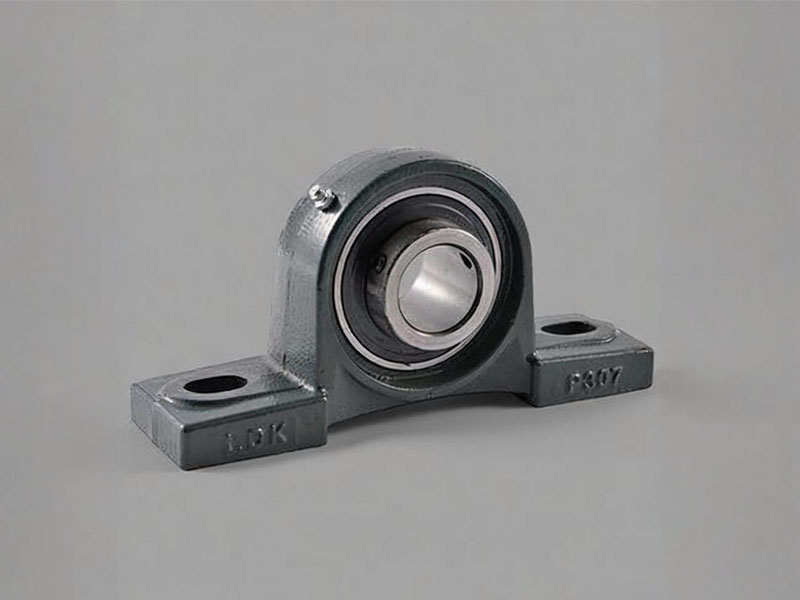
Classic Applications:
- Conveyor Systems: Supporting the drive shaft and idler rollers along the length of the conveyor frame.
- Agricultural Machinery: Mounting on the chassis of a baler or harvester to support rotating drivelines.
- Industrial Fans: Supporting the fan shaft on a heavy steel baseplate.
- Material Handling: The backbone of most overhead trolley and belt conveyor systems.
2.2 When to Choose a Flange Bearing
Choose a flange bearing when the shaft needs to pass through a vertical wall, a machine side plate, or the end of a structure.
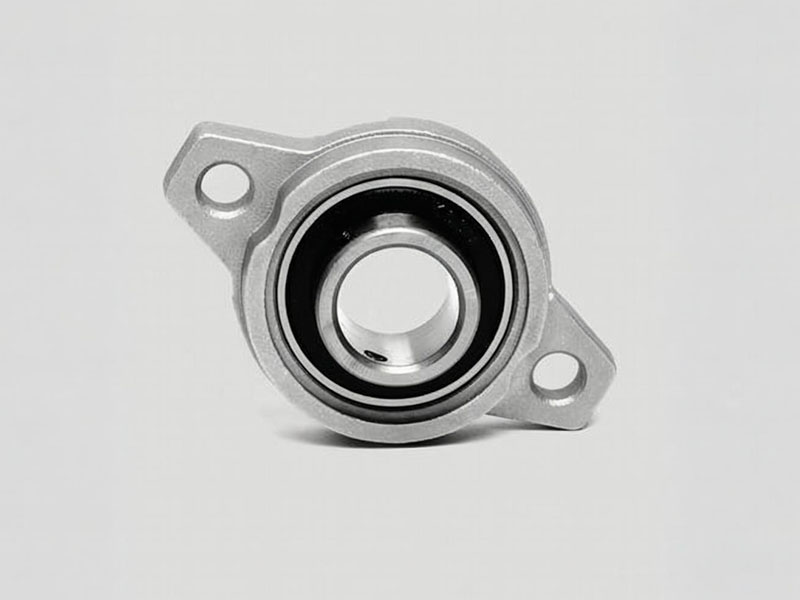
Classic Applications:
- Packaging Machinery: Mounting on the vertical side frames to support the ends of rollers that move product through the machine.
- Food & Beverage Processing: Ideal for supporting the shafts of mixing augers or conveyor pulleys on stainless steel equipment stands.
- Material Handling Ends: Used at the very end of a conveyor to support the tail pulley shaft against the side plate.
- Lift Systems: Supporting vertical screw jacks or drive shafts mounted against a wall.
3. Deep Dive: Pillow Block Bearing Units
The pillow block is the workhorse of the industry. Its design allows for easy installation and, in many cases, self-alignment to compensate for minor shaft deflection or mounting inaccuracies.
Pillow Block Selection Guide
Selecting the correct pillow block requires matching the locking mechanism to your operating conditions. Use this table as a quick reference.
| Locking Method | Duty Rating | Inner Ring Width | Typical Series (DUHUI Ref.) | Best Application |
| Set Screw | Normal | Wide | UCP200 | General industrial use, conveyors, packaging. Most economical. |
| Set Screw | Heavy | Wide | UCP300 | Heavy-duty conveyors, construction equipment, higher load requirements. |
| Set Screw | Normal | Narrow | BP200, BLP200 | Where space is constrained; often used in specific agricultural applications. |
| Eccentric Collar | Normal | Wide | UGP200 | Applications with vibration or reversing loads, like fans and some agricultural implements. |
| Eccentric Collar | Heavy | Wide | UGP300 | Heavy vibrating equipment, crushers, and large fans. |
| Concentric Collar | Medium | Wide | UEP200, UEPX00 | Higher-speed applications (e.g., electric motors, textile spindles) where concentricity is critical. |
4. Deep Dive: Flange Mounted Bearing Units
Flange units offer versatility in tight spaces. The choice between 2, 3, or 4 bolts often comes down to the available space and the magnitude of the load.
Flange Unit Selection Guide
The bolt pattern defines the housing type. Here’s how to navigate the options:
| Housing Type (Bolt Pattern) | Locking Method | Duty Rating | Typical Series (DUHUI Ref.) | Best Application |
| Two-Bolt (Diamond) | Set Screw | Normal | UCFL200, UCFA200 | Light to medium duty, ideal for tight spaces on packaging machines and light conveyors. |
| Two-Bolt (Diamond) | Eccentric Collar | Normal | KHFT200, UGFJT200 | Where space is tight but vibration is present, such as in small fans or compact agricultural gearboxes. |
| Three-Bolt (Triangular) | Set Screw | Normal | UCFB200, UCFK200 | Excellent for capturing thrust loads in one direction; common in specialized conveyor applications. |
| Four-Bolt (Square) | Set Screw | Normal / Heavy | UCF200, UCF300 | The most common flange unit for general and heavy-duty use. Offers the most secure mounting. |
| Four-Bolt (Square) | Concentric Collar | Medium | UEF200, UEFX00 | High-speed applications like precision spindles or food processing equipment where cleanliness and precision are vital. |
5. Critical Selection Criteria: Making the Final Choice
Beyond the housing style, your final specification must account for the operating environment and mechanical demands.
5.1 Match the Locking Method to Your Load
- For constant, smooth rotation: Set screw locking is a cost-effective and reliable choice.
- For vibration or shock loads: Upgrade to an eccentric collar or concentric clamp to prevent the bearing from spinning on the shaft (fretting corrosion).
- For high-speed precision: A concentric clamp is the only choice, as it provides 360° of clamping force without distorting the bearing or shaft.
5.2 Match the Material to the Environment
The housing material is your first line of defense against failure.
- Clean, Dry, Indoor Use: Cast Iron with a protective coating (like nickel or zinc) offers the best strength and value.
- Washdown, Food, or Chemical Environments: You need corrosion resistance. Choose 304 Cast Stainless Steel housings with FDA-compliant seals, or PBT Thermoplastic units which are lightweight, corrosion-proof, and non-sparking.
- Outdoor or Humid Environments: Consider Zinc-Plated Cast Iron or specialized ZDC Alloy housings for enhanced protection against rust.
5.3 Match the Bearing to Speed and Load
Always verify the manufacturer’s ratings. As a general guide based on our experience:
- Pillow Block (UCP200 series): Excellent for medium radial loads at speeds up to 3,000-4,000 rpm.
- Flange Units (UCF200 series): Can often handle slightly higher speeds due to their rigid mounting, but load capacity is dependent on bolt strength.
- High-Speed Applications (>5,000 rpm): You must move beyond standard set-screw units and select a concentric collar series like UEP200 or UEF200 to ensure true running.
6. Why Partner with DUHUI Bearing?
Choosing a bearing is a technical decision, but sourcing it should be a partnership. For 20 years, DUHUI Bearing has been a silent partner to manufacturers worldwide. Our 15 years of export experience mean we understand international quality standards, packaging requirements, and delivery timelines.
We don’t just cast housings and assemble bearings. We engineer solutions. Whether you need a standard UCP205 pillow block or a custom stainless steel flange unit for a unique application, our team has the expertise to deliver.