In the world of precision machinery, every rotation tells a story of fit and tolerance. At the heart of this story lies a single, critical dimension: the bearing bore diameter (designated as “d”).
While it may seem like just the hole in the middle, the bore diameter is the primary interface between the static shaft and the dynamic performance of your equipment. Whether you are designing a high-speed spindle or a heavy-duty automotive hub, understanding the bore—how to measure it, how it is manufactured, and how it dictates fit—is the first step toward mechanical reliability.
This guide will walk you through the technical nuances of bore diameter, ensuring you select and apply the correct bearing for a long service life.
1. What is the Bearing Bore Diameter (d)?
The bore diameter is the nominal inner diameter of the bearing, designed to mount onto a shaft. It is the foundational dimension from which all other bearing characteristics are derived.
The relationship between the bore and the shaft is defined by “fit,” which is determined by the tolerance of the shaft versus the tolerance of the bore:
- Clearance Fit: The bore is slightly larger than the shaft, allowing for easy sliding assembly. Common for non-locating bearings.
- Interference Fit (Press Fit): The bore is slightly smaller than the shaft. The bearing is pressed on, creating a tight lock to prevent the inner ring from rotating on the shaft (creep).
- Transition Fit: A compromise between the two, offering slight interference or slight clearance.
2. Precision Measurement: How to Verify Bore Diameter
Verifying the bore diameter is not just about taking a measurement; it’s about understanding the geometry of the circle. Out-of-roundness (ovality) can be just as damaging as an incorrect size.
2.1 Essential Tools
For accurate verification, professionals rely on calibrated tools such as digital inside micrometers or three-point bore gauges. These tools measure the internal distance between two opposing points on the bore.
2.2 Step-by-Step: The Art of Measurement
- Calibration: Always zero the tool against a known standard (setting ring) to ensure accuracy.
- Alignment: Insert the tool into the bore. It must be perpendicular to the bearing face. Tilting the tool will give a false, smaller reading.
- The “Rocking” Technique (Finding True Diameter): Gently rock the micrometer in the bore while extending the spindle. The true diameter is the maximum reading you feel as you pass through the exact center.
- Record and Repeat: Measure at multiple points around the circumference and along the width to check for taper and out-of-roundness.
3. Factors That Define the Final Bore
The number printed on the bearing box is the nominal size, but the actual bore is a result of sophisticated manufacturing controls.
3.1 Manufacturing Tolerances (ABEC/ISO)
The allowable deviation from nominal is defined by tolerance classes (ABEC 1, 3, 5, 7 / ISO P0, P6, P5, P4).
- ABEC 1 (P0): Standard for general applications like conveyor rollers and automotive wheel hubs where precision is balanced with cost.
- ABEC 5 (P5) and Above: Necessary for machine tool spindles or high-speed applications where micron-level accuracy prevents vibration at high RPM.
- The Trade-off: Higher precision requires significantly more stringent production control, increasing cost. The key is selecting the right grade for the job, not necessarily the highest.
3.2 The Material & Heat Treat Factor
A bearing bore doesn’t just hold its shape by accident. After heat treatment, bearing steel (like GCr15) can undergo micro-dimensional changes. At DUHUI, our processes include stabilization treatments (tempering) to relieve internal stresses, ensuring that the bore diameter remains dimensionally stable throughout the life of the bearing, even under thermal load.
4. Advanced Verification Methods
For high-volume production and mission-critical applications, standard micrometers are supplemented by advanced techniques:
- Air Gauging: This non-contact method uses airflow to measure the bore. It is incredibly fast and accurate, capable of averaging the diameter and detecting taper instantly.
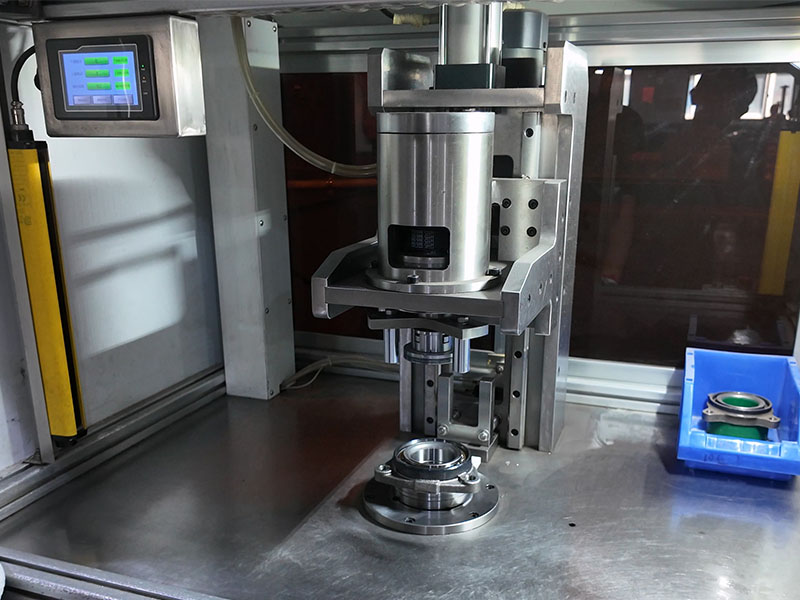
- Specialized Bearing Testers: Automated systems that measure radial runout of the bore, ensuring that the center of rotation is perfectly aligned with the geometric center.
5. Select bearings based on Bore Diameter
Choosing a bearing starts with knowing your shaft size. From that single dimension, a cascade of engineering decisions follows.
5.1 The Shaft Fit
Your shaft diameter tolerance and the bearing’s bore tolerance combine to create the actual fit. For rotating applications, an interference fit is usually required. You must calculate the effective interference to ensure the inner ring isn’t loose.
5.2 Mounting the Housing
The bore size dictates the overall bearing series. A 40mm bore is available in a “Light Series” (small outer diameter) or a “Heavy Series” (large outer diameter), depending on the load requirements of the housing.
5.3 Matching Design to Environment
- Seals & Shields: The bore size determines the inner ring land diameter, which is where seals make contact.
- Flanges: For unitized bearings (like wheel hub bearings), the bore size is the reference point for flange offset and bolt hole patterns.
- Material: High-temperature applications may require special steel, but the bore tolerance must be adjusted to account for thermal expansion.
5.4 Lubrication Pathways
Grease flow and distribution are influenced by the space between the rolling elements and the bore shoulders. The bore diameter helps define this internal geometry.
5.5 Internal Clearance (The Critical Calculation)
This is where bore diameter knowledge is crucial. When you press a bearing onto a shaft with an interference fit, the inner ring expands slightly, effectively reducing the bore diameter.
- The Squeeze Effect: A heavy interference fit can reduce radial internal clearance by 70-80% of the interference amount.
- Selection: If your application requires a standard clearance (CN) but your fit is heavy, the bearing will pre-load and fail quickly. This is why engineers often select C3 or C4 clearance bearings for press-fit applications—to maintain the necessary internal space after installation.
6. Why Partnering with an Experienced Manufacturer Matters
A mismatch in bore diameter—whether from incorrect measurement, poor tolerance selection, or manufacturing variability—leads to vibration, overheating, and catastrophic failure.
At DUHUI Bearing, our 20 years of experience mean we understand that the bore is the foundation of your assembly.
- Precision Manufacturing: Our production lines are equipped to hold tight tolerances, ensuring every bore is true to spec.
- Quality Assurance: We employ rigorous inspection protocols, including air gauging and roundness testers, to guarantee quality.
- Technical Partnership: We don’t just sell bearings; we provide technical support to help you navigate the complexities of fit, tolerance, and clearance.