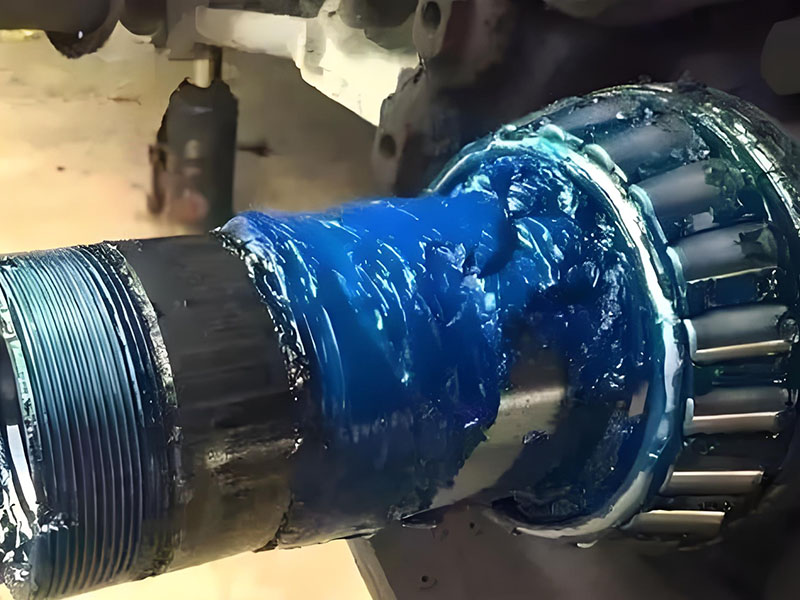
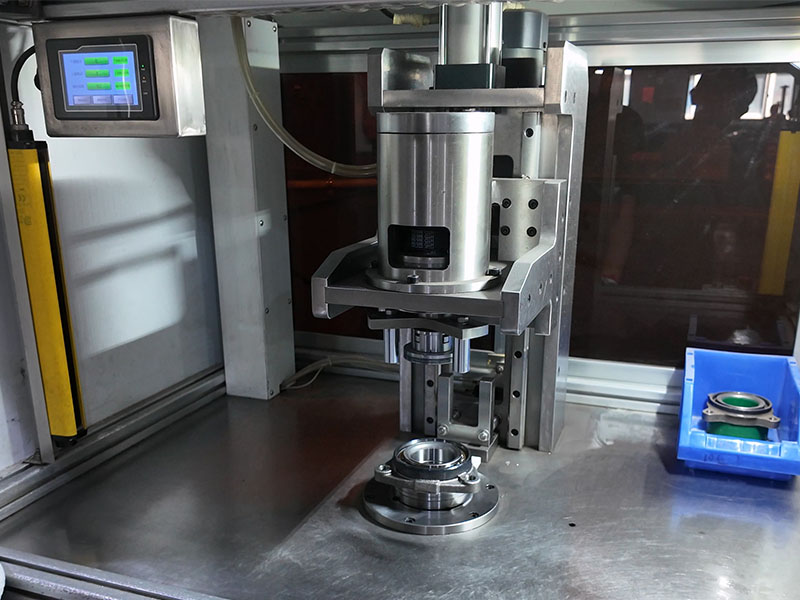
Tapered roller bearings are widely used across automotive, industrial, and heavy machinery sectors, but what exactly sets them apart from other bearing types? How do they manage to support both radial and axial loads simultaneously? And when should an engineer choose a tapered roller bearing over a cylindrical, needle, or spherical roller bearing? This article examines the design, structural components, performance advantages, and practical applications of tapered roller bearings, providing a technical comparison with other common roller bearing types.
What Are Tapered Roller Bearings?
A tapered roller bearing is a rolling-element bearing that uses conical rollers positioned between tapered inner and outer raceways. The tapered geometry enables the bearing to accommodate combined loads—radial and axial forces acting at the same time—while maintaining a true rolling motion that minimizes friction.
Tapered roller bearings are available in single-row, double-row, and multi-row configurations, allowing designers to scale load capacity according to application requirements. The bearings are also separable: the cone assembly (inner ring with rollers and cage) can be mounted independently from the cup (outer ring), which simplifies installation and maintenance.
Components of Tapered Roller Bearings
Tapered roller bearings are composed of four primary components:
- Cone (inner ring): The inner ring that fits onto the shaft. Its tapered raceway guides the rollers from the inner side.
- Cup (outer ring): The outer ring that fits into the housing. Its tapered raceway corresponds to that of the cone.
- Tapered rollers: Conical rolling elements that make line contact with both raceways. The taper angle ensures that the rollers contact the raceways along their full length, distributing load evenly.
- Cage: A retainer that spaces the rollers evenly around the bearing circumference and keeps them properly aligned. In separable designs, the cage retains the rollers on the cone when the cup is removed.
The cone, rollers, and cage together form the cone assembly, while the cup is a separate component. This separable construction is a distinctive feature of tapered roller bearings and contributes to their ease of maintenance.
How Tapered Roller Bearings Handle Radial and Axial Loads
Based on the structural components described above, the following explains how the tapered geometry enables load handling.
Radial load refers to forces applied perpendicular to the axis of rotation—for example, the weight of a rotating shaft or the force exerted by a belt drive. Axial load (also called thrust load) refers to forces applied parallel to the axis of rotation, such as the thrust generated by helical gears or the cornering forces on a vehicle wheel.
Combined load mechanism: The raceways of the cone and cup are tapered such that their projection lines intersect at a common point on the bearing axis, known as the apex point. This geometric arrangement ensures that the rollers make pure rolling contact with both raceways. The axial load carrying capacity increases with the contact angle α (typically between 10° and 30°)—a steeper angle provides greater axial load capacity but may reduce radial load capacity. This design allows tapered roller bearings to efficiently transmit forces in a specific direction while minimizing internal sliding friction.
Key Advantages of Tapered Roller Bearings
This load-handling mechanism gives rise to several performance advantages that make tapered roller bearings suitable for demanding applications:
- Combined load capability: They can support pure radial loads, unidirectional axial loads, or any combination of the two without modification. This versatility reduces the number of bearing types needed in a given assembly. (Note: For bidirectional axial loads, single-row bearings must be used in pairs or replaced by double-row configurations.)
- High load capacity: The line contact between rollers and raceways distributes loads across a larger area than point-contact bearings, allowing tapered roller bearings to support heavier loads than ball bearings of equivalent dimensions. Compared to cylindrical, needle, or spherical roller bearings, tapered roller bearings are particularly effective for applications requiring high thrust and radial capacity simultaneously.
- Minimal friction and heat generation: Proper rolling motion—rather than skidding or sliding—minimizes frictional heat, which extends bearing life and reduces lubrication demands.
- Adjustability: The internal clearance or preload can be adjusted during installation, allowing engineers to optimize stiffness and running accuracy for specific operating conditions.
- Separable design: The cone and cup can be mounted separately, which facilitates assembly in tight spaces and simplifies inspection and replacement.
Applications of Tapered Roller Bearings
Tapered roller bearings are used across a wide range of industries where combined loads, high rigidity, or adjustability is required.
- Automotive wheel bearings: Tapered roller bearings support the vehicle’s weight (radial load) and the cornering forces generated during turns (axial load) simultaneously. Their adjustability allows precise setting of wheel bearing endplay or preload.
- Gearboxes and reducers: In industrial and automotive transmissions, gears generate both radial and axial forces. Tapered roller bearings accommodate these forces while maintaining shaft alignment.
- Aerospace applications: Landing gear assemblies and other aircraft components benefit from the high load capacity and reliability of tapered roller bearings.
- Construction and mining equipment: Heavy machinery operating in extreme conditions—such as dump trucks in dusty, muddy, or stony terrain—uses tapered roller bearings designed for increased performance, reduced friction, and enhanced power density.
- Railroad axles: Railway axle boxes require bearings that can handle heavy radial loads from vehicle weight and axial loads from acceleration and braking, with minimal maintenance over long service intervals.
- Engines and industrial machinery: From conveyors and large drives to rolling mills and hoisting equipment, tapered roller bearings provide reliable operation under varying loads and speeds.
Cylindrical Roller Bearings vs Tapered Roller Bearings
Cylindrical roller bearings and tapered roller bearings are both designed for heavy loads, but they differ significantly in their load-handling capabilities and structural design.
Structural differences: Cylindrical roller bearings use cylindrical rollers with parallel raceways, while tapered roller bearings use conical rollers with tapered raceways.
Load capacity: Cylindrical roller bearings are optimized for high radial loads but have limited axial load capacity. Tapered roller bearings, in contrast, are designed for combined loads and can handle substantial axial forces alongside radial loads.
Axial load handling: Some cylindrical roller bearings incorporate ribs to provide limited axial guidance, but their axial capacity remains modest compared to tapered roller bearings. Tapered roller bearings, with their adjustable contact angle, can be configured for applications requiring high axial stiffness or precise preload.
Applications: Cylindrical roller bearings are commonly used in electric motors, rolling mills, and railway axle boxes where radial loads dominate. Tapered roller bearings are preferred for wheel hubs, gearboxes, and heavy machinery where combined loads are present.
Adjustability: Tapered roller bearings can be preloaded to eliminate internal clearance, providing high rigidity and positional accuracy. Cylindrical roller bearings typically operate with internal clearance and are not designed for preload adjustment.
Needle Roller Bearings vs Tapered Roller Bearings
Needle roller bearings use long, thin cylindrical rollers with a small diameter-to-length ratio. Their primary advantage is high load capacity in a compact radial space.
Structural differences: Needle roller bearings have a low cross-sectional height, making them suitable for applications with limited radial space. Tapered roller bearings require more radial space but offer superior axial load handling.
Load capacity: Needle roller bearings excel at radial loads in confined spaces but have limited axial load capacity. Tapered roller bearings provide balanced radial and axial load handling, though they require greater radial clearance.
Applications: Needle roller bearings are commonly used in cardan joints, planetary gear trains, and automotive transmissions where space constraints are critical. Tapered roller bearings are preferred when both radial and axial loads must be supported, and when adjustability or preload is required.
Friction characteristics: Both bearing types use line contact between rollers and raceways. However, needle roller bearings typically generate higher friction under axial loading due to the lack of a tapered geometry to guide axial forces efficiently.
Spherical Roller Bearings vs Tapered Roller Bearings
Spherical roller bearings feature two rows of barrel-shaped rollers and a spherical outer ring raceway. This design provides self-aligning capability, allowing the bearing to accommodate angular misalignment between the shaft and housing.
Structural differences: Spherical roller bearings have a spherical outer raceway that permits misalignment of ±1.5° to ±3.5°, depending on the series. Tapered roller bearings require precise alignment to maximize performance; misalignment can lead to edge loading and premature failure.
Load capacity: Both bearing types can handle heavy radial and axial loads. Spherical roller bearings are well-suited for applications with high shock loads and misalignment. Tapered roller bearings offer superior axial stiffness and can be preloaded to eliminate internal clearance, which is essential for precision applications like machine tool spindles.
Friction and heat generation: Tapered roller bearings, with their true rolling action and optimized surface finishes, generally operate with lower friction and generate less heat than spherical roller bearings under comparable conditions.
Applications: Spherical roller bearings are commonly found in heavy industrial equipment such as conveyors, vibratory screens, and wind turbines, where misalignment is unavoidable. Tapered roller bearings are preferred in automotive wheel ends, gearboxes, and differentials, where precise shaft positioning and preload are critical.
Comparison Summary: Tapered vs Cylindrical vs Needle vs Spherical Roller Bearings
The table below summarizes the key differences among the four roller bearing types discussed in the previous sections.
| Feature / Capability | Tapered Roller Bearings | Cylindrical Roller Bearings | Needle Roller Bearings | Spherical Roller Bearings |
|---|---|---|---|---|
| Radial load capacity | High | Very high | High (in compact space) | High |
| Axial load capacity | High (unidirectional; bidirectional with pairing) | Low to moderate | Very low | Moderate to high |
| Combined load handling | Excellent | Poor | Poor | Good |
| Self‑alignment capability | None (requires precise alignment) | None | None | Excellent (±1.5° to 3.5°) |
| Preload / adjustability | Yes (adjustable during installation) | No (typically operates with internal clearance) | No | Limited |
| Typical applications | Wheel hubs, gearboxes, differentials | Electric motors, rolling mills, railway axles | Automotive transmissions, planetary gears, universal joints | Conveyors, vibratory screens, wind turbines, heavy industrial equipment |
| Friction level | Low (true rolling motion) | Low | Moderate (higher under axial loads) | Moderate to high |
Conclusion
Tapered roller bearings are distinguished by their tapered geometry, which enables them to support combined radial and axial loads efficiently while allowing adjustability through preload or endplay setting. Their separable design simplifies installation and maintenance, and their high load capacity makes them suitable for demanding applications across automotive, aerospace, mining, and industrial sectors.
When selecting a bearing for a given application, the choice depends on the specific load profile—radial, axial, or combined—as well as space constraints, alignment requirements, and the need for adjustability. Tapered roller bearings are the optimal choice when combined loads are present and when the ability to set preload or endplay is required for system performance. For applications where misalignment is unavoidable, spherical roller bearings may be preferred; for purely radial loads in compact spaces, needle or cylindrical roller bearings offer alternative solutions.
FAQs
Q1: How do you install a tapered roller bearing correctly?
A1: Proper installation requires clean components, appropriate mounting tools to avoid brinelling, and correct tightening of the adjusting nut to achieve the specified endplay or preload. For wheel-end applications, a torque sequence is typically specified to seat the cones properly. After installation, rotational torque should be checked to confirm correct setting.
Q2: Can tapered roller bearings be preloaded? If so, why?
A2: Yes, tapered roller bearings can be preloaded by applying a controlled axial load during installation to eliminate internal clearance. Preload increases bearing stiffness, reduces noise and vibration, and improves positional accuracy. However, excessive preload can generate additional heat and reduce bearing life, so the preload must be set according to the manufacturer’s specifications.
Q3: What is the difference between single-row and double-row tapered roller bearings?
A3: Single-row bearings accommodate axial loads in one direction only and are typically used in pairs (face-to-face or back-to-back) to handle bidirectional thrust. Double-row bearings incorporate two rows of rollers in a single unit and can support axial loads in both directions without requiring a paired bearing arrangement.
Q4: How do you choose the right contact angle (α) for an application?
A4: The contact angle determines the bearing’s axial load capacity relative to its radial load capacity. A larger contact angle (e.g., 25°–30°) provides higher axial load capacity but reduces radial load capacity. A smaller contact angle (e.g., 10°–15°) favors radial loads. The calculation factor e (provided in product tables) correlates with the contact angle—a larger e indicates a larger contact angle and higher axial capacity.
Q5: What lubrication is recommended for tapered roller bearings?
A5: Lubrication requirements depend on operating conditions. For standard wheel-end applications, high-consistency grease with good film strength at operating temperature is typically used. For high-speed or high-temperature applications (such as gearboxes with circulating oil systems), oil lubrication may be required to provide adequate cooling and film formation. The lubricant must maintain sufficient viscosity at operating temperature to prevent metal-to-metal contact at the rib-roller end interface.